Stablecoin payouts: sending money out on a stablecoin rail
September 14, 2026
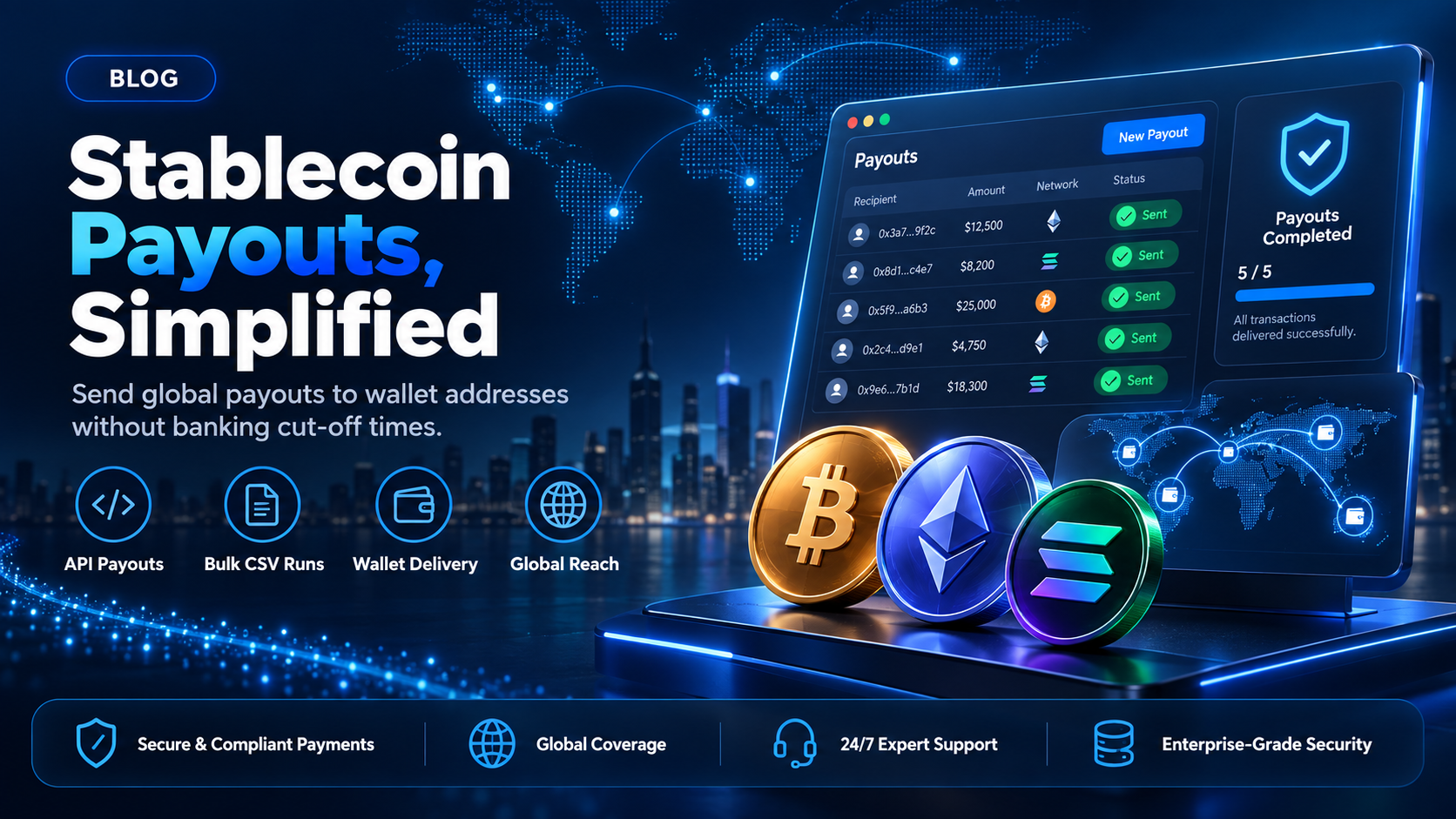
Paying money out is the leg of the payments stack that gets the least attention, because the money is already earned and the only question left is delivery. Delivery is often where the cost accumulates. A payment sent through correspondent banking passes through intermediary banks, and each one applies its own cut-off times, its own charges, and its own working week.
EukaPay sends stablecoin payouts to a recipient's wallet address in USDC, USDT, ETH, or BTC, across the Ethereum, Tron, and Bitcoin networks. This guide covers what the rail moves, how a payout run is created, and what the recipient has to have in place. It also covers which parts of the fiat leg a stablecoin rail does not replace.
In this guide, you'll learn:
What a stablecoin payout is and what actually travels on the rail
Which assets and networks EukaPay can send a payout on
How to create a payout through the API and how to send a list of recipients at once
Where a bank rail is still the right answer and where it is not
What stablecoin payouts are, and what moves on the rail
A stablecoin payout is a transfer of a fiat-referenced digital asset from a business to a recipient's wallet address. The recipient does not need a bank account in the sending business's country, and the transfer does not travel through a correspondent banking chain. What moves is the asset itself, recorded on a public network, from one address to another.
The distinction that matters commercially is between the asset and the rail. USDC and USDT are issued and backed by their issuers, which is a separate layer from the provider moving them. EukaPay moves the asset on the merchant's instruction and records a reference for each transfer.
Adoption is moving on the disbursement side first. Visa announced a Visa Direct stablecoin payouts pilot in 2025, aimed at speeding up access to funds for creators and gig workers. Disbursements cross borders often, so that is where the substitution has started.
Who a stablecoin payout suits - suppliers, marketplace sellers, and overseas vendors
The difference shows up on recipients a bank rail reaches through several intermediaries. An overseas supplier invoicing in dollars, or a marketplace seller in a market your bank reaches indirectly, can be paid to a wallet address instead. So can a vendor whose local clearing system runs on a different week. For a fuller comparison of the delivery options, see our guide to
.
Which assets and networks a stablecoin payout can use
EukaPay sends payouts in USDC, USDT, ETH, and BTC. The supported payout networks are Ethereum, Tron, and Bitcoin. The pay-in side of the account accepts a wider set of assets, so the list a business can receive is not the same list it can send. Treating them as one list is a common planning error.
Asset and network are set per payout. Different recipients in the same run can receive different assets on different networks, so a business does not have to standardize its whole recipient list on one chain. If your recipients work mainly in dollar-referenced balances, see what the acceptance and sending sides look like for
specifically.
Minimums and references - what applies per payout
EukaPay enforces a minimum payout amount for each asset, so the smallest transfer you can send varies by what you are sending. Each payout also carries its own reference, which can be looked up afterwards when a recipient asks where a payment went.
How to send stablecoin payouts: the Payout API and the CSV upload
There are two ways to send, and they suit different volumes.
The Payout API.
The Payout API creates crypto payouts programmatically, one payout per request. A developer (or coding agent) calls it with the recipient's address, the asset, the network, and the amount. The full endpoint reference lives at
.
A CSV upload in the merchant dashboard.
For mass payouts, upload a recipient list as a CSV file. The uploaded list is validated and shown with its recipients and amounts before anything is sent.
Each route draws on the payout balance, which is funded by transferring from the account's main balance. The transfer into the payout balance is its own step, so the amount a run can draw on is the amount you moved across.
Do stablecoin payouts replace your bank payout rail?
Not entirely, and a business that plans for a full replacement will be surprised by the fiat leg. A stablecoin payout ends at a wallet address. If a recipient needs local currency in a local bank account, the conversion out of the asset is their own step once it arrives.
What the rail can remove is the intermediary chain and the calendar it runs on. Payouts are not tied to banking hours or the banking calendar. The end-to-end path of a cross-border transfer on this rail is covered in
stablecoin cross-border payments
.
How to choose
Stablecoin payout | International bank transfer | Local bank transfer | |
|---|---|---|---|
What the recipient needs | A wallet address on a supported network | Bank details plus SWIFT or IBAN routing | A domestic bank account |
Who processes the transfer | EukaPay processes the payout to the address | Correspondent and intermediary banks | The domestic clearing system |
Tied to banking hours | No | Yes | Yes |
What you send | USDC, USDT, ETH, or BTC | Fiat | Fiat |
EukaPay is the route to pick when the recipient list crosses borders and the delivery cost is the problem you are solving. A bank transfer stays the better answer where the recipient can only receive local currency into a local account and has no wallet. Most businesses run both, and EukaPay can often carry the cross-border share of the list while the domestic share stays where it is.
One platform for pay-ins, payouts, and fiat settlement
The same EukaPay account handles both directions. On the pay-in side it offers instant crypto-to-fiat conversion at a locked exchange rate to remove your exposure to crypto price swings, support for most major cryptocurrencies, and settlement in USD, EUR, GBP, and CAD to your bank account. EukaPay locks the exchange rate on every conversion by default, on pay-ins and on payouts. A crypto payment confirms on-chain, so protection against chargebacks is a property of the payment method.
That matters for payout planning because the account balance your revenue settles into is the same balance you transfer from to fund payouts. A business collecting in crypto and paying suppliers in USDC is using one account instead of moving money between a processor and a separate disbursement tool. For the wider picture of paying recipients across many markets, see our guide to
.
Get started with EukaPay
Create an account at
, complete verification and provide your legal business information, then generate an API key. The payout endpoints, balance transfer, invoices, subscriptions, and customers are all documented at
. A staging environment is available for development.
Frequently asked questions
What is a stablecoin payout?
It is a transfer of a fiat-referenced digital asset from a business to a recipient's wallet address. The recipient receives the asset directly, without the transfer passing through a correspondent banking chain.
Which stablecoins can EukaPay send in a payout?
USDC and USDT. EukaPay also sends payouts in ETH and BTC, across the Ethereum, Tron, and Bitcoin networks.
Can I send stablecoin payouts through an API?
Yes. The Payout API creates crypto payouts programmatically, one payout per request, and the endpoints are covered in the EukaPay API documentation.
How do I pay a large list of recipients?
Upload the recipient list as a CSV file in the merchant dashboard. The list is validated and shown with its recipients and amounts before anything is sent.
Do stablecoin payouts work outside banking hours?
Payouts are not tied to banking hours or the banking calendar, so a run does not have to wait for a clearing window to open.
Can different recipients in one run receive different assets?
Yes. Asset and network are set per payout, so one run can pay some recipients in USDC on one network and others in a different asset on another.
Is there a minimum payout amount?
Yes. EukaPay enforces a minimum payout amount for each asset, so the smallest transfer you can send depends on what you are sending.
Do I need to fund the account before I can send a payout?
Yes. The payout balance is funded by transferring from your account's main balance, so the funding step happens inside the account before a run is sent.
Related articles
Stablecoin cross-border payments
- the full path a cross-border stablecoin transfer takes, end to end.
- paying recipients across many markets and what changes corridor by corridor.
- the layers under a stablecoin payment and who owns each one.
Products
Use Cases
© 2026 EukaPay. All rights reserved.
FINTRAC: M22233887