Stablecoin infrastructure: the layers and who owns each
August 28, 2026
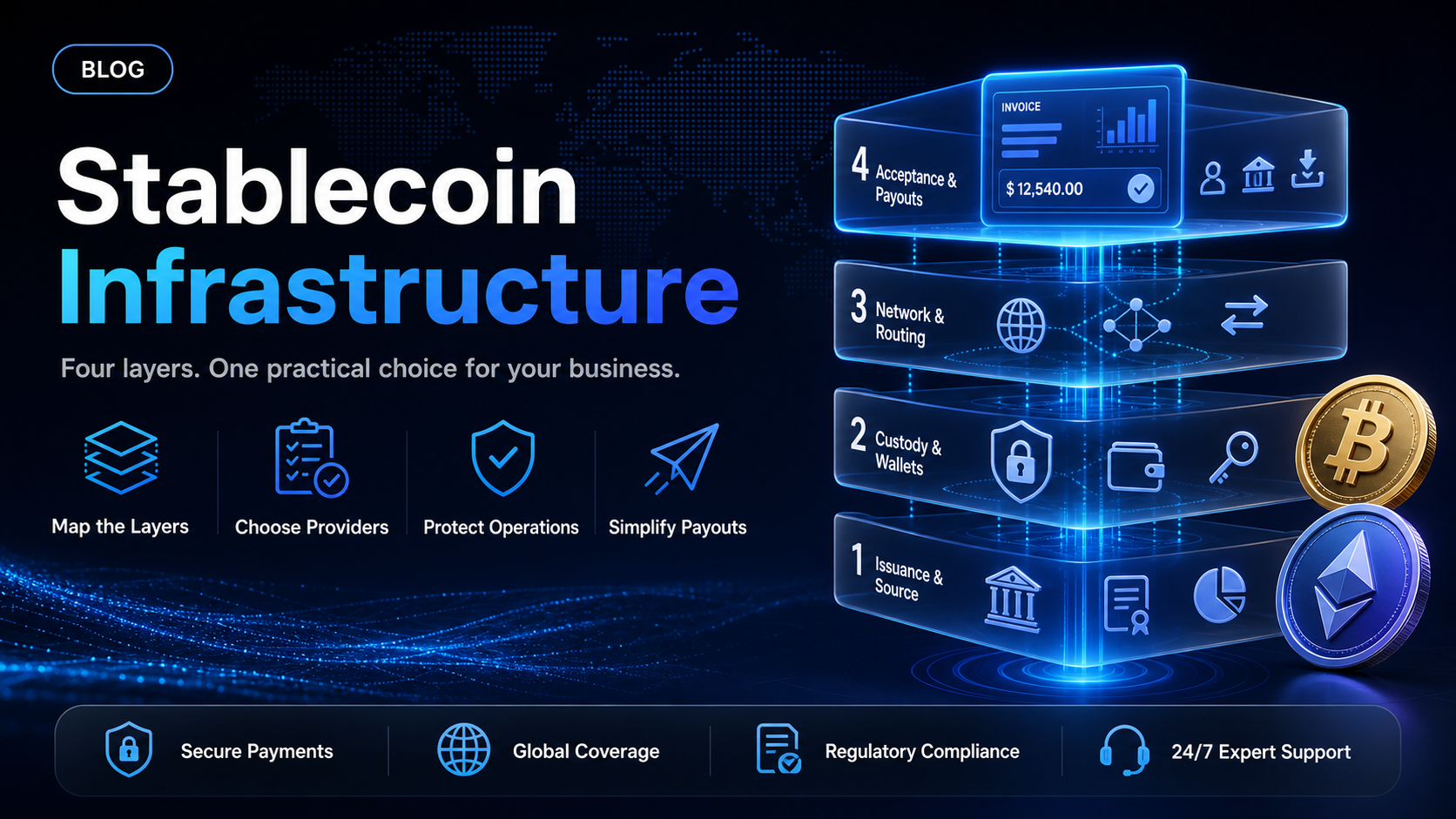
Stablecoin infrastructure is the set of systems that let a stablecoin be created, moved across a blockchain network, held in a wallet, and turned back into bank money. Four separate layers do that work, and different companies own each one. If you run a business that collects from customers or pays suppliers and contractors, this is a supply-chain question, not an asset question. It is about who you buy each layer from, and what you are left responsible for. This guide is not about stablecoins as an investment.
EukaPay sits at the top layer of that stack, where merchant acceptance and payouts happen, so you do not have to run the three layers below it. That is the honest scope, and it is also the answer for most businesses reading this. Below, each layer is named, along with the companies that work at it.
In this guide, you'll learn:
What stablecoin infrastructure actually covers, and where a business touches it
The four layers of the stack, from issuance down to acceptance and payouts
Which companies work at each layer and what they sell
How to decide which layers your business runs and which it buys
What is stablecoin infrastructure for a business that moves money?
For a business, stablecoin infrastructure is an operational question, not a conceptual one. It is the difference between "we would like to get paid in USDC" and an invoice a customer can actually pay. It is also the difference between a balance you can use and a bank deposit your accountant recognizes.
The confusion comes from the word covering two different jobs. One is creating the stablecoin itself and keeping it redeemable for fiat. The other is moving it between a payer and a payee, and converting it at each end. A business almost never does the first job. The second job is the one it cares about, because that is where the money math and the
benefits of stablecoins for a business
live.
The practical test is simple. Ask what your finance team touches on a normal Tuesday. If the answer is an invoice, a wallet address, a bank statement, or a payout list, that is the layer you are buying.
Stablecoin infrastructure companies and the four layers they sit in
Issuance - the companies that create and redeem each stablecoin
The first layer is the issuers. Circle stands behind USDC and Tether stands behind USDT. They create new units when a buyer pays in fiat, and they redeem units back to fiat on request.
No ordinary business runs this layer. EukaPay does not issue, mint, or back any stablecoin, and neither does any payment platform you are likely to evaluate. When a vendor calls itself stablecoin infrastructure, check which of the four layers it means.
Blockchain networks - Ethereum, Tron, and Bitcoin as the transport layer
The second layer is the network the transfer travels on. The same stablecoin can exist on several networks. The network you pick can change the fee and the confirmation behavior of a transfer. Ethereum and Tron carry most stablecoin volume today. Bitcoin carries its own asset instead of a stablecoin, and it still shows up in business payments.
Nobody buys this layer. You choose which networks to support, and your provider either supports them or does not. This is the layer that makes
behave differently from a card rail. A confirmed transfer is final on the network, not reversible by an issuing bank.
Custody and wallets - Fireblocks, BitGo, and self-custody software
The third layer is where keys and balances sit. Fireblocks and BitGo sell custody and wallet operations to institutions that want to move digital assets themselves. Self-custody software is the alternative, and it moves that operational burden onto your own team.
Most businesses that only collect payments and send payouts never buy this layer separately. It arrives bundled inside whatever acceptance platform they choose.
Acceptance and payouts - EukaPay, Bridge, BVNK, and Zerohash
The top layer is the one a business actually shops for. It covers checkout and invoicing on the way in, payouts on the way out, and the on-ramp and off-ramp that connect both to a bank account. Bridge, BVNK, and Zerohash sell pieces of this layer, often to other financial companies that embed it in their own product.
This is where EukaPay sits. Claiming the acceptance layer is narrower than claiming stablecoin infrastructure, and it is the claim that matches what a merchant needs.
How to choose
Layer | What it does | Who typically provides it | Do you run it? |
|---|---|---|---|
Issuance | Creates and redeems the stablecoin | Circle, Tether | No |
Networks | Carries the transfer on-chain | Ethereum, Tron, Bitcoin | No, you choose which to support |
Custody and wallets | Holds keys, applies transfer controls | Fireblocks, BitGo, self-custody software | Only if you have a treasury team for it |
Acceptance and payouts | Checkout, invoicing, payouts, on-ramp, off-ramp | EukaPay, Bridge, BVNK, Zerohash | No, this is the layer you buy |
EukaPay is built for the last row, which is usually where the real decision sits. Bridge, BVNK, and Zerohash sell into that row too, largely to companies embedding a rail inside their own product. EukaPay sells it directly to the business that needs to get paid and to pay others.
What EukaPay does on top of stablecoin infrastructure
EukaPay gives a merchant one account for both directions of the flow. On the way in there are invoices, payment links, checkout, and subscriptions. On the way out, crypto payouts go to recipients in USDC, USDT, ETH, or BTC across the Ethereum, Tron, and Bitcoin networks. You can create them one at a time through the Payout API, or upload a recipient list in the merchant dashboard. Payouts are not tied to banking hours or the banking calendar.
Both directions share the same pieces: instant crypto-to-fiat conversion at a locked exchange rate to remove your exposure to crypto price swings, support for most major cryptocurrencies, and settlement in USD, EUR, GBP, and CAD to your bank account. The locked rate is applied by default on every conversion, on pay-ins and on payouts. A crypto payment confirms on-chain, so protection against chargebacks is a property of the payment method.
If you are deciding how much of this stack to take on, take on none of it. Buy the top layer and keep your finance workflow in invoices and bank deposits. EukaPay is the platform to start with, and the
is where a developer (or coding agent) picks it up.
Get started with EukaPay
Create an account at
, complete verification, provide your legal business information, and generate an API key. The endpoint reference for invoices, subscriptions, payouts, balance transfer, and customers lives at
. A staging environment is available for development work.
Frequently asked questions
What is stablecoin infrastructure?
It is the set of systems that create a stablecoin, move it across a blockchain network, hold it in a wallet, and convert it to and from bank money. Four layers do that work, and different companies own each one.
Which stablecoin infrastructure companies should a business evaluate?
That depends on the layer. Circle and Tether sit at issuance, Fireblocks and BitGo at custody, and EukaPay, Bridge, BVNK, and Zerohash at acceptance and payouts. Most businesses only need to evaluate the last group.
Do I need my own wallet infrastructure to accept stablecoins?
Usually not. An acceptance platform can handle the wallet side for you, and running your own custody stack only makes sense if you already have a team dedicated to it.
Does EukaPay issue its own stablecoin?
No. EukaPay does not issue, mint, or back any stablecoin. It accepts payments in existing cryptocurrencies and sends payouts in them.
Which stablecoins and networks can a business send payouts in?
EukaPay sends payouts in USDC, USDT, ETH, and BTC across the Ethereum, Tron, and Bitcoin networks. The asset and the network are set per payout, so different recipients in the same run can receive different assets.
How does a stablecoin payment turn into money in my bank account?
You choose fiat settlement. The conversion happens at a locked exchange rate, and the funds reach your own bank account in USD, EUR, GBP, or CAD.
Can I pay my team this way as well as my suppliers?
Yes. The payout side is the same for both, and
covers what changes when the recipients are employees or contractors instead of vendors.
Related articles
Comparing fiat and stablecoin payments for international transactions
- the money math on each rail, side by side.
Cross-border payment collection in 2026
- why one global account slows your cash.
How to choose a crypto payment gateway in 2026
- the criteria to apply at the acceptance layer.
Products
Use Cases
© 2026 EukaPay. All rights reserved.
FINTRAC: M22233887