Cross-border payment collection in 2026 - why one global account slows your cash, and how stablecoins or crypto fix it
July 31, 2026
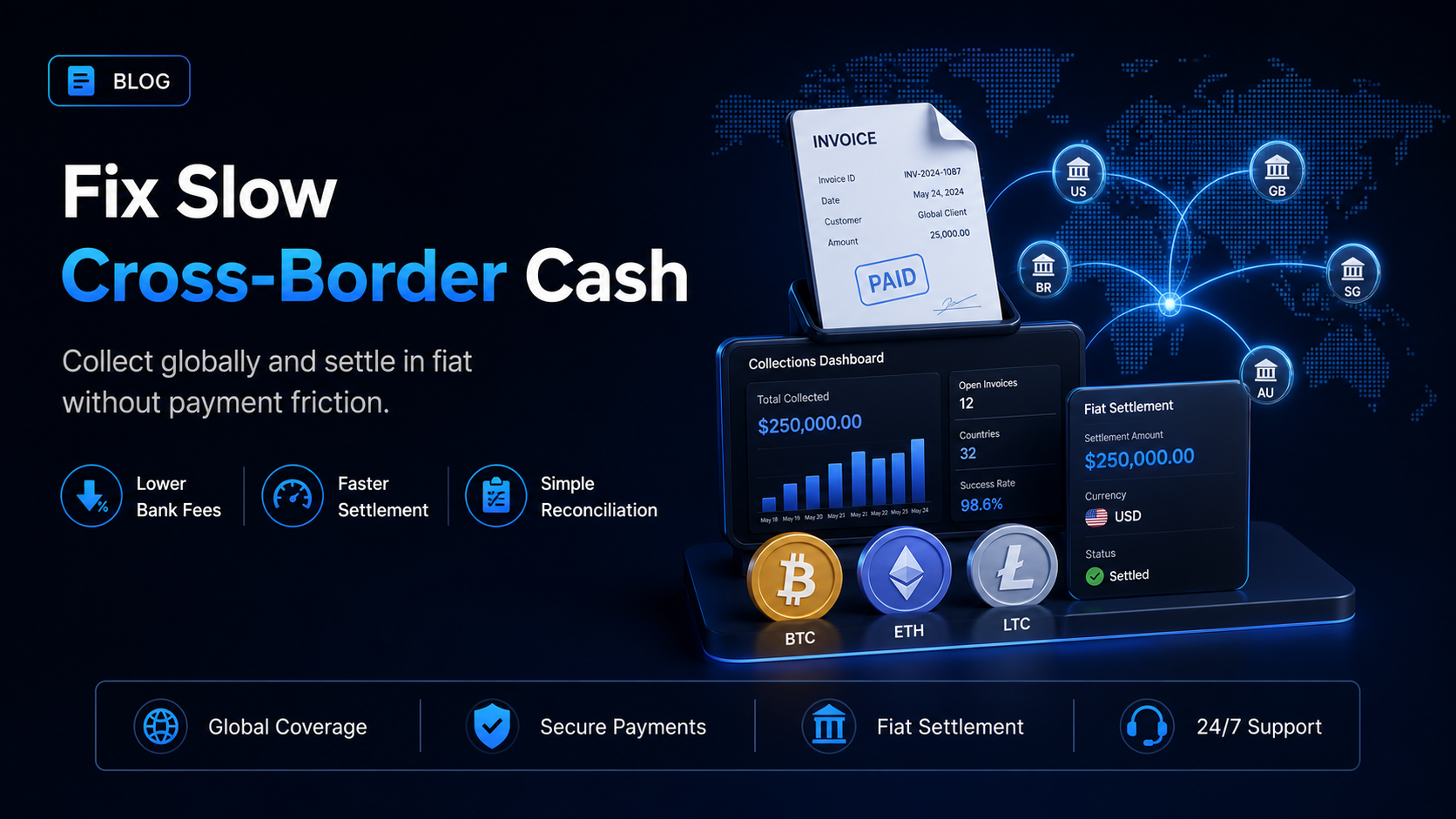
Centralising every overseas invoice into a single bank account makes treasury simpler and makes your company harder to pay, which is the problem stablecoins or crypto pay-ins were built to remove.
Cross-border payment collection usually gets designed from the inside out. Finance opens one account, points every overseas customer at it, and gets a single place to see the money. The structure is clean on an org chart and it saves real work in reconciliation tooling and banking relationships.
The cost lands somewhere finance does not measure. Every customer who could have made a domestic payment is now making an international one, with a new beneficiary to verify, a currency to convert, intermediary fees to absorb and an extra approval to chase. There are three ways out of that trade-off: local bank accounts in every market, virtual accounts under one master account, or collecting in stablecoins or crypto and settling to one bank account in USD, EUR, GBP, CAD.
In this guide, you'll learn:
Why a single global collection account moves cost onto your customer and then back onto your cash flow
The four specific line items that make slow collections more expensive than the account fees you are comparing
How local accounts, virtual accounts, and stablecoin or crypto pay-ins compare on payer effort, settlement time and reconciliation
How to collect crypto pay-ins from any market with EukaPay and settle in USD, EUR, GBP, CAD to your own bank account
Centralisation only solves your side
Treasury designs a collection structure around four things: control, visibility, liquidity and the cost of running the accounts. Every one of those is measured inside your company.
Your customer's accounts payable team is optimising for something else. They want beneficiary details their bank already recognises, a currency they already hold and a payment run they do not have to treat as an exception. Asking a buyer in Germany, Singapore and Brazil to all wire the same account in one country replaces three routine payments with three exceptions.
The payer's checklist - what an overseas beneficiary actually costs them
Setting up a new international beneficiary means the payer verifies the account, often through a call-back or a secondary approver. Sending in a currency they do not hold means someone books an FX trade or accepts their bank's retail rate. Sending through the correspondent banking network means agreeing who absorbs the intermediary charges, and if nobody decides, the deduction comes out of your invoice.
None of those steps stops the payment. Each one gives it a reason to happen next week instead of today.
Payment friction is a working capital line item
The visible symptom is an email from a customer asking for help paying you. The expensive symptom appears in the cash conversion cycle, and it shows up as four separate costs.
Delayed cash.
An invoice held while the buyer verifies details or waits for a second approver is an invoice financed by you. On a ninety-day quarter, a recurring five-day delay across your overseas book is a permanent reduction in available cash, not a one-off.
Short payments.
When an intermediary bank deducts its charge in transit, the amount that arrives is smaller than the amount you invoiced. Someone has to decide whether to write off the difference or raise a debit note, and either choice costs more in labour than the deduction itself.
Unapplied cash.
When a reference is truncated or rewritten in transit, the funds arrive but do not match an invoice. The money is in the account and the invoice is still open, so your customer receives a dunning notice for an invoice they already paid.
Financing dependency.
Where a supplier cannot wait for funds to clear, the gap gets bridged with a bank instrument such as a letter of credit. That solves the timing problem and introduces a new one, because the bank arranging the instrument is often also setting the FX rate. The question worth asking is whether the financing is covering a genuine credit risk or a payment process that simply takes too long.
Do I need a local bank account in every country to collect payments?
No, and opening one in every market is usually the most expensive answer to the problem.
Local accounts do make the payment domestic for the customer, which is the outcome you want. They also multiply what you have to run: separate KYC files per jurisdiction, separate minimum balances, separate statement formats to reconcile and separate banking relationships to maintain. A company collecting from twelve markets does not want twelve banking relationships to service what may be a handful of invoices in half of them.
Virtual accounts, sometimes called named accounts or virtual IBANs, are the established fix. They give a customer local banking details in your company's name while the funds land in one master account. They work well, and they still require a provider relationship per currency, still route through the same domestic clearing systems, and still leave you reconciling by reference field.
Stablecoin and crypto pay-ins remove the distinction the problem depends on. A payment in USDC from a buyer in Sao Paulo and a payment in USDC from a buyer in Frankfurt reach you the same way, in the same time, at the same cost. There is no domestic version of the payment to compare it against, because there is no correspondent chain in the middle to make the international version worse.
How the four collection models compare
Single global account | Local accounts per market | Virtual accounts | Stablecoin or crypto pay-ins with EukaPay | |
|---|---|---|---|---|
Payer effort | New international beneficiary, FX, approvals | Domestic payment | Domestic payment | Pays an invoice or payment link from any market |
Accounts to maintain | One | One per market | One master plus provider relationships per currency | One bank account for fiat settlements |
Settlement time | Days, variable by corridor | Same day to two days | Same day to two days | Minutes once the network confirms |
Deductions in transit | Intermediary fees possible | None | None | None, the amount is locked at the rate shown |
Reconciliation | Manual matching by reference | Matching by reference | Matching by reference | Each payment is tied to its own invoice or payment link |
Currency you receive | One, whatever you hold | Local currency per account | Multi-currency under one master | USD, EUR, GBP, CAD to your bank account |
Best for | Occasional overseas invoices | High volume in a few fixed markets | Many currencies, established corridors | Companies collecting from many markets without a local presence in each |
Most finance teams end up combining models rather than choosing one. A company with real volume in the United States and the eurozone may keep local or virtual accounts for those two corridors and use crypto pay-ins for the long tail of markets where opening anything would never pay for itself. The models are complements, and the useful question is which corridor belongs to which route.
What reconciliation looks like when the reference cannot be lost
The unapplied cash problem exists because the reference field and the money travel separately, and the field can be truncated, rewritten or dropped by any bank in the chain.
With EukaPay, each invoice, payment link and checkout session is its own payment object. When a customer pays it, the funds arrive attached to that object rather than accompanied by a text field describing it. Your accounts receivable team is not matching a bank line to an open invoice, because the payment was never separate from the invoice.
You can issue those requests through Invoices,
, Online Checkouts and a POS Terminal, or generate them programmatically if your team has a developer (or coding agent) building against the
. Recurring arrangements are handled as Subscriptions, which issue invoices on a weekly, monthly, quarterly or custom schedule through the dashboard and the API.
The real cost of single account collections
A single global account is a defensible choice for occasional payments. There are five signals that it has stopped being the cheaper option.
Customers repeatedly ask you for local account details, or ask which currency to send.
Deposits arrive smaller than the invoice because a bank in the chain took its fee.
Settlement times vary enough that your cash forecast carries a wide range for overseas receipts.
Unapplied cash sits in the account long enough that customers receive reminders for paid invoices.
You are using a bank facility to bridge the gap between shipment and cleared funds.
Compare the full cost of collecting, not the account maintenance fee. That total includes the financing cost of delayed cash, the labour in reconciliation and investigations, the support time spent explaining payment instructions and the write-offs from short payments. A structure can be operationally neat and still be the most expensive line in the collections process.
One platform underneath
EukaPay is a licensed global crypto payments and OTC trading platform that sits at the intersection of banking and blockchain. It is FINTRAC registered in Canada under M22233887, FinCEN registered in the United States, and regulated by the Bank of Canada, so a collection structure built on it rests on a licensed foundation rather than an unregulated workaround.
Underneath every collection route is the same infrastructure: instant crypto-to-fiat conversion at a locked exchange rate to remove all crypto volatility, protection against chargebacks, support for a wide range of cryptocurrencies, and settlement in USD, EUR, GBP, CAD to your bank account. Your customer pays in BTC, ETH, LTC, SOL, USDC or USDT, the amount is locked at the rate shown, and you receive fiat. There is no rolling reserve held back, and no crypto balance sitting on your balance sheet.
The pattern is not confined to crypto-native companies. CoinDesk reported that DoorDash is working with the Tempo blockchain on stablecoin-powered payouts across its marketplace, starting with the cross-border flows where cost and settlement time matter most, and Shopify's help centre documents USDC acceptance for merchants on Shopify Payments. For the wider picture, see our pillar guide on
merchants accepting crypto payments
, the roundup of
companies accepting crypto in 2026
, and what
Walmart crypto payments in 2026
signal about large-retailer adoption.
The choice among collection models is a question of fit rather than one model being better than the others. Build the structure around where your customers are and how they pay, and keep the visibility on your side of it.
Get started with EukaPay
You can collect from every market your customers are in without opening an account in each one. Create an account in the
to begin onboarding. Every merchant goes through a business review process, and a sandbox environment is available during that review so your team can test pay-ins, invoices and settlement before going live. If you want the technical detail first, the
EukaPay developer documentation
covers the API, webhooks and settlement flow, and the
page covers the full product set.
Frequently asked questions
What is cross-border payment collection?
Cross-border payment collection is the process a company uses to receive payment from customers in other countries, including the account structure, the currencies accepted and the way incoming funds are matched to invoices. The structure determines both how easily customers can pay and how quickly receivables become usable cash.
Why is one global bank account a problem for international customers?
A single account in one country turns what would be a domestic payment for your customer into an international one. The customer has to set up a new international beneficiary, arrange currency conversion, obtain additional approvals and absorb any intermediary bank charges, and each of those steps can delay the payment.
Can I collect international payments without opening a local bank account?
Yes. With EukaPay your customers can pay an invoice, payment link or checkout in stablecoins or crypto from any market, and you receive fiat settlement in USD, EUR, GBP, CAD to a single bank account. No local banking presence is required in the customer's country.
How does EukaPay protect me from crypto price movement between invoice and settlement?
EukaPay provides instant crypto-to-fiat conversion at a locked exchange rate to remove all crypto volatility. The amount is locked at the rate shown when the customer pays, so the fiat you receive matches the amount you invoiced.
Will intermediary banks deduct fees from a crypto pay-in?
No. A crypto pay-in does not travel through the correspondent banking network, so there is no intermediary bank in the chain to deduct a charge. The amount that settles is the amount locked at payment.
Which cryptocurrencies can my customers pay with?
EukaPay supports most major cryptocurrencies, including BTC, ETH, LTC, SOL, USDC and USDT, with more than fifty tokens supported in total. Customers pay with what they hold and you receive fiat settlement.
How does EukaPay handle recurring international invoices?
EukaPay Subscriptions issue invoices on a recurring weekly, monthly, quarterly or custom schedule through the dashboard and the API. They handle scheduled invoicing rather than plan management or programmatic billing-cycle control.
How long does onboarding take before we can collect payments?
Every merchant goes through a business review process during onboarding, and a sandbox environment is available throughout so your finance and engineering teams can test the collection flow before going live.
Products
Use Cases
© 2026 EukaPay. All rights reserved.
FINTRAC: M22233887