Walmart crypto payments in 2026 - what retail’s stablecoins or crypto shift means for your business
July 03, 2026
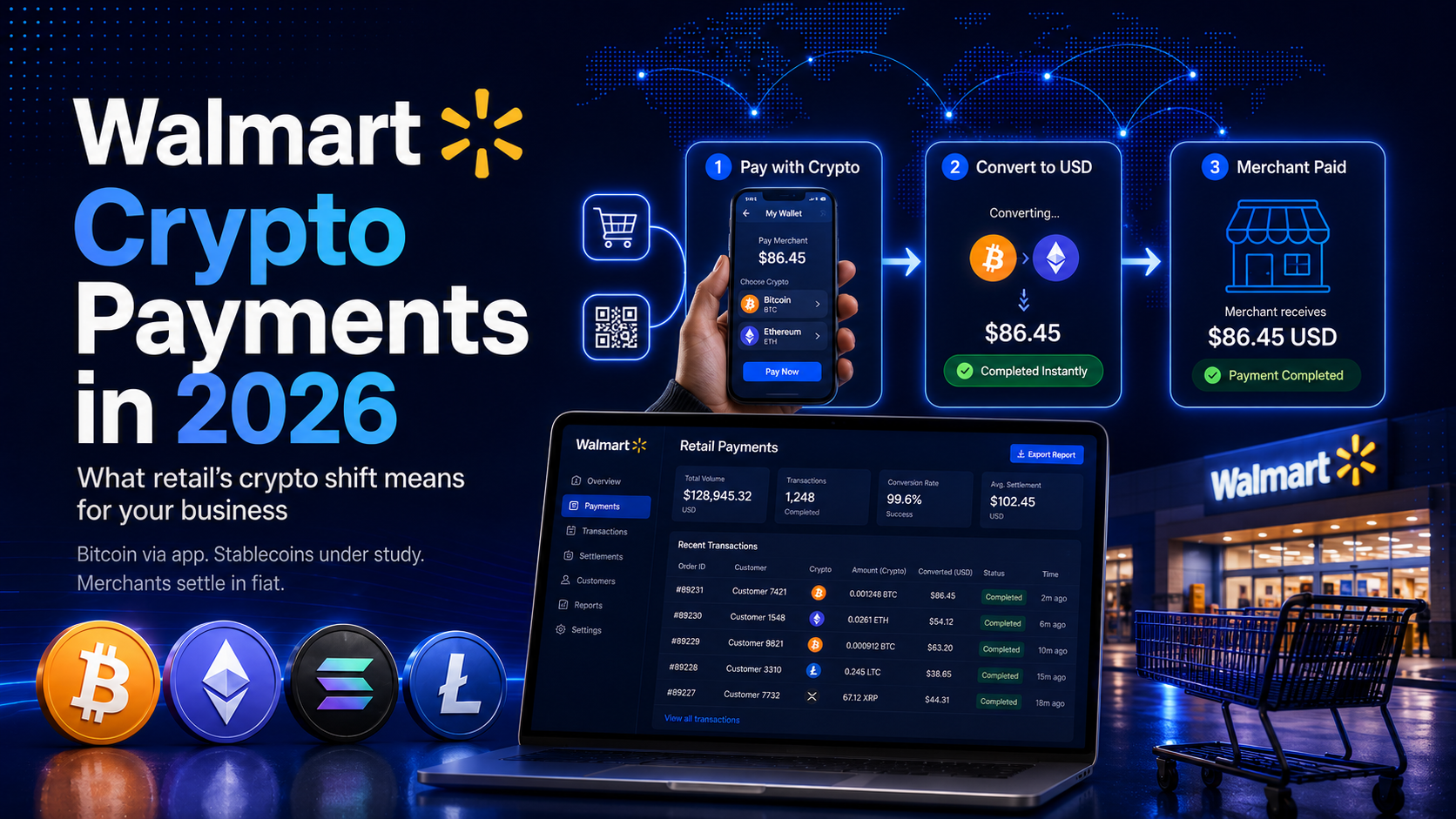
Walmart crypto payments went from rumor to reality in 2026. The largest retailer in the United States is now part of the crypto conversation, and the people watching most closely are not crypto traders. They are retail and ecommerce founders and finance leads asking a practical question: if Walmart can put Bitcoin in front of 150 million shoppers, should we accept stablecoins or crypto too?
Walmart launched one crypto product and is only studying another, and the difference matters. Either way, a normal business can accept stablecoins or crypto now with EukaPay, with instant crypto-to-fiat conversion and settlement in USD, EUR, GBP, CAD.
In this guide, you’ll learn:
What Walmart actually enabled through OnePay, and the precise mechanism behind it
Why Walmart and other large retailers are studying their own stablecoins under the GENIUS Act
How DoorDash and Shopify fit the same 2026 trend toward stablecoin payments
How your business can accept crypto pay-ins and run crypto payouts with EukaPay
Does Walmart accept Bitcoin in 2026
Yes, but the mechanism matters, and most headlines blur it. Walmart shoppers can use Bitcoin through OnePay, the fintech app that is majority-backed by Walmart. According to CNBC, OnePay rolled crypto into its mobile banking app with support from infrastructure provider Zerohash, letting users buy, hold, sell, and convert Bitcoin and Ether starting from as little as one dollar.
The consumer crypto feature runs inside the OnePay app, not Walmart’s core register. As Crowdfund Insider reported, OnePay reaches the roughly 150 million Americans who shop at Walmart each week, and the app is connected to Walmart’s in-person and online checkout. Users convert their Bitcoin or Ether to U.S. dollars inside the app in near real time, and that dollar balance lands in OnePay Cash, which can then be spent at checkout. Reporting indicates OnePay keeps crypto inside the app. So the accurate framing is this: Walmart is not booking Bitcoin on its register. OnePay holds and converts the crypto, and Walmart receives U.S. dollars.
That distinction is the whole point for a merchant. The shopper experience can feel like spending crypto while the retailer never touches a volatile balance. That is the same outcome EukaPay delivers for any business, without needing to own a 150-million-user banking app.
The Walmart stablecoin plan
There is a second Walmart crypto story, and it is reported and exploratory, not a launched product. According to PYMNTS and reporting from The Wall Street Journal, Walmart, alongside Amazon, is exploring whether to issue its own U.S. dollar-pegged stablecoin. The motivation is cost. CryptoSlate, citing the same reporting, noted that card processing fees of roughly one to three percent cost Walmart and Amazon an estimated combined 14 billion dollars a year, so a brand stablecoin could move payment volume off card networks and cut that bill.
This became thinkable because of regulation. The GENIUS Act was signed into law on July 18, 2025, per the White House fact sheet, creating the first federal framework for payment stablecoins in the United States, with one hundred percent reserve backing and monthly public reserve disclosures. To be precise: Walmart has not launched a stablecoin. Internal teams are reported to be assessing technology partners and compliance paths, and large retailers are unlikely to move until the rules are fully settled. Treat it as a signal of direction, not a live feature.
DoorDash, Shopify, and the 2026 shift to stablecoin payments
Walmart is not alone, and the pattern across 2026 is consistent: large brands are adding stablecoin payment options. CoinDesk reported that DoorDash is working with the Tempo blockchain to roll out stablecoin-powered payouts to its global marketplace, starting with cross-border flows where settlement speed and cost matter most. On the acceptance side, Shopify’s own help center documents that merchants on Shopify Payments can offer USDC as a payment method at checkout.
These are different jobs: Walmart’s OnePay is consumer-facing acceptance, DoorDash’s move is about payouts to its marketplace, and Shopify is merchant acceptance. None of these routes is available to most businesses on their own terms. You cannot plug into Walmart’s OnePay or a DoorDash payout program as a standalone retailer. That is the gap a licensed crypto payment gateway fills.
How Walmart crypto payments compare to DoorDash and Shopify
Brand or route | What they enabled | Who it serves |
Walmart (OnePay) | Buy, hold, and convert Bitcoin and Ether in-app, with dollars spendable at checkout | Consumers shopping at Walmart through the OnePay app |
DoorDash (Tempo) | Stablecoin-powered payouts across its global marketplace, starting with cross-border flows | DoorDash merchants and workers receiving funds |
Shopify (USDC) | USDC accepted at checkout through Shopify Payments | Shopify store merchants and their customers |
Your business with EukaPay | Accept crypto pay-ins, run crypto payouts, with instant crypto-to-fiat conversion and settlement in USD, EUR, GBP, CAD | Any retail or online business, on its own checkout, invoices, and dashboard |
EukaPay gives any business the same practical outcome these brands built for themselves: accept crypto pay-ins, run crypto payouts, and settle in USD, EUR, GBP, CAD. Walmart’s OnePay, DoorDash’s payouts, and Shopify’s USDC each work only inside their own ecosystem. With EukaPay you get that capability directly, on your own checkout, invoices, and dashboard.
One platform underneath
EukaPay is a licensed global crypto payments and OTC trading platform that sits at the intersection of banking and blockchain. It is FINTRAC registered in Canada, FinCEN registered in the United States, and regulated by the Bank of Canada, so you are building on a compliant foundation rather than an unregulated workaround.
The core of the product is straightforward: instant crypto-to-fiat conversion at a locked exchange rate to remove all crypto volatility, protection against chargebacks, support for a wide range of cryptocurrencies, and settlement in USD, EUR, GBP, CAD to your bank account. A customer pays in Bitcoin, Ether, USDC, USDT, or one of more than fifty supported tokens, the amount is locked at the rate shown, and you receive fiat. You never hold a crypto balance, so there is no balance-sheet exposure to price swings.
You can accept payments through Online Checkouts, Invoices, and Payment Links, set up Subscriptions as recurring invoices on a weekly, monthly, quarterly, or custom schedule through the dashboard and API, send Mass Crypto Payouts to vendors or contractors, and build against a developer API if your team has a developer (or coding agent) extending your stack. Businesses including the Futurist Conference, PropellerAds, Emerald, and SBC work with EukaPay today. For a broader view of who is adopting these payments, see our roundup of
companies accepting crypto in 2026
and the pillar guide on
merchants accepting crypto payments
. If you sell on Shopify, our
Shopify crypto payments walkthrough
covers that route specifically.
Get started with EukaPay
You can stop watching the big-retail crypto headlines and start accepting stablecoins or crypto on your own checkout. EukaPay lets any business accept crypto payments on its own checkout, invoices, and payment links. Create an account in the
to begin onboarding, where every merchant goes through a business review process and a sandbox is available during that review so you can test pay-ins and payouts before going live. To see the full feature set first, visit the
EukaPay crypto payment gateway
product page.
Frequently asked questions
Does my business need to be Walmart’s size to accept stablecoins or crypto?
No. Walmart reaches its scale through the OnePay app, but the underlying capability of converting crypto to fiat at the point of payment is available to any business through EukaPay. You add crypto acceptance to your existing checkout, invoices, or payment links and settle in USD, EUR, GBP, CAD.
How does EukaPay protect me from crypto price swings?
EukaPay provides instant crypto-to-fiat conversion at a locked exchange rate to remove all crypto volatility. When a customer pays, the amount is locked at the rate shown and converted, so you receive fiat and never carry a crypto balance on your books.
Which cryptocurrencies can my customers pay with through EukaPay?
EukaPay supports most major cryptocurrencies, including BTC, ETH, LTC, SOL, USDC, and USDT, with more than fifty tokens supported in total. Customers choose what they hold, and you receive settlement in fiat.
Is EukaPay licensed and regulated?
Yes. EukaPay is FINTRAC registered in Canada, FinCEN registered in the United States, and regulated by the Bank of Canada. That compliance posture matters as stablecoin rules such as the GENIUS Act take effect.
Can I send crypto payouts to vendors or contractors with EukaPay?
Yes. EukaPay supports Mass Crypto Payouts, so you can send crypto payouts to many recipients at once, alongside accepting crypto pay-ins from your customers.
How do recurring payments work on EukaPay?
EukaPay Subscriptions are recurring invoices issued on a weekly, monthly, quarterly, or custom schedule through the dashboard and API. They handle scheduled invoicing rather than plan management or programmatic billing-cycle control.
How fast can my business start accepting crypto?
Every merchant goes through a business review process during onboarding, and a sandbox is available during that review so you can build and test before going live. You begin by creating an account in the EukaPay merchant dashboard.
Does Walmart have its own stablecoin?
Not yet. As of 2026 Walmart is reported to be exploring a US dollar-pegged stablecoin under the GENIUS Act, but it has not launched one.
Products
Use Cases
© 2026 EukaPay. All rights reserved.
FINTRAC: M22233887