DoorDash Accepts Stablecoins. Paysafe Added Crypto for iGaming. Here's How Smaller Merchants Can Do the Same, Without an Engineering Team.
June 09, 2026
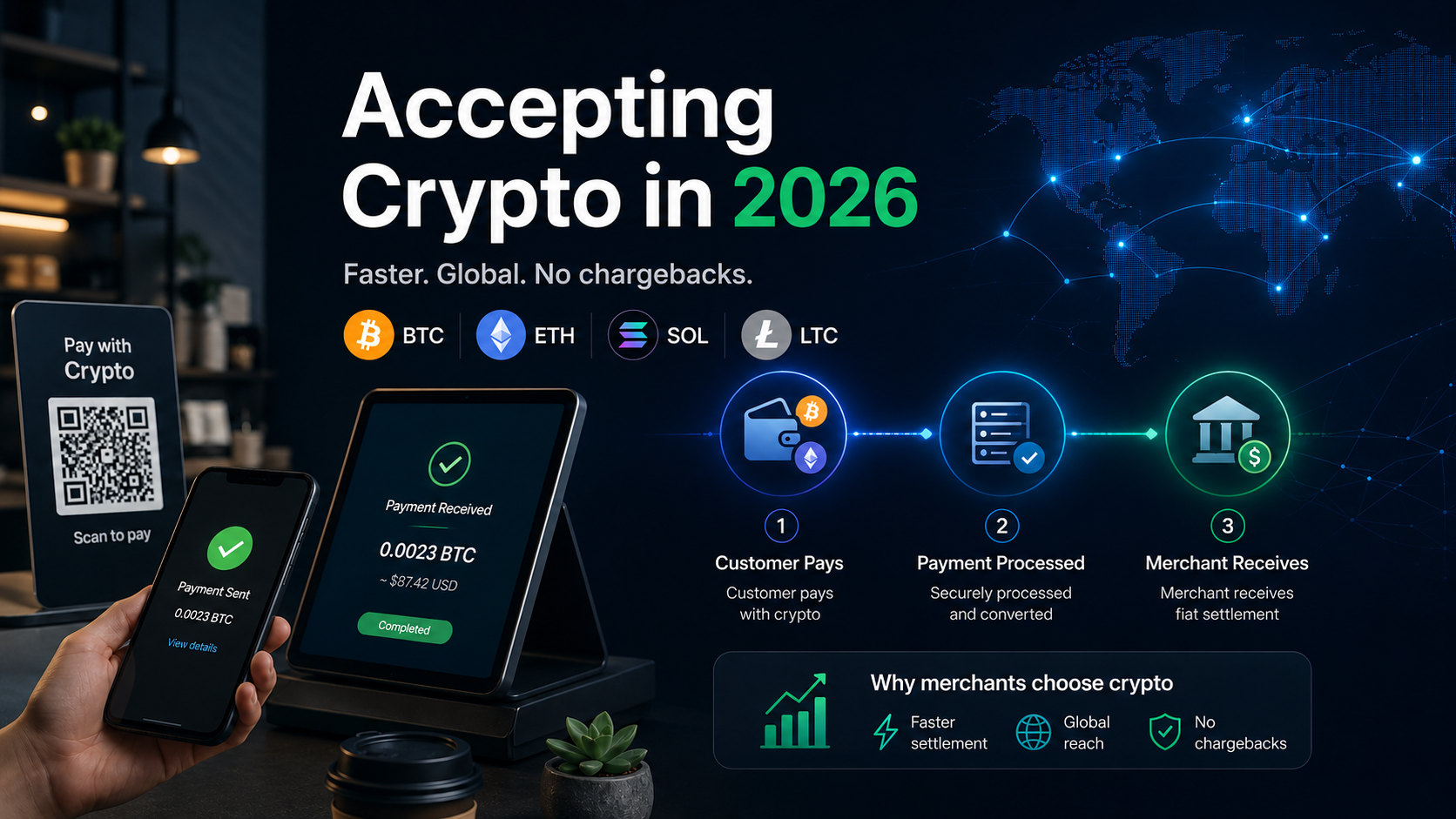
On April 21, 2026, DoorDash announced it would begin accepting stablecoin payments. Eight days later, Visa confirmed it had reached $7 billion in annualized stablecoin settlement volume across nine blockchains. On April 7, Paysafe launched a dedicated crypto payment product for US iGaming operators, powered by MoonPay. MoneyGram rolled out a stablecoin wallet across El Salvador on April 22, the first step in a broader Latin American expansion.
Four announcements. Three weeks. The message is not subtle: crypto payments have moved from a fringe option to a standard one, and the companies moving fastest are the ones that serve the largest merchant bases on earth.
What gets lost in the coverage of those announcements is what they mean for the restaurant owner, the event promoter, the online retailer, or the iGaming operator who is not DoorDash and does not have DoorDash's engineering department. The assumption embedded in most of the reporting is that crypto payment acceptance is something you build. It is not. It is something you turn on. And the gap between what the big players are spending to get there and what a smaller merchant actually needs to spend is wider than most people realize.
In this guide, you'll learn:
What the April 2026 DoorDash, Visa, Paysafe, and MoneyGram announcements actually mean for smaller merchants
What a merchant needs versus what a company like DoorDash had to build in-house
Which merchant categories are adopting stablecoins or crypto fastest, and why
How to get started accepting stablecoins or crypto without an engineering team
The Problem These Companies Are Actually Solving
The announcements from DoorDash, Paysafe, and Visa are not really about crypto. They are about expanding the pool of customers who can pay, reducing the friction of cross-border transactions, and, in the case of high-risk merchant categories like iGaming, sidestepping a chargeback problem that has gotten worse in 2026.
Visa's own data shows its VAMP (Visa Acquirer Monitoring Program) excessive-fraud threshold dropped to 0.9% in April 2026 across the US, Canada, EU, and Asia-Pacific. For iGaming operators and other high-risk merchants who regularly brush against chargeback limits, that tighter ceiling is not an abstraction. It is a merchant account at risk.
Crypto payments do not have chargebacks. A customer who pays in USDC has transferred funds from their wallet to yours. There is no card network in the middle, no issuing bank to file a dispute with, and no reversal mechanism. The payment is final. For a merchant processing significant volume in a high-chargeback category, the math on that alone justifies the switch.
For merchants serving international customers, the case is different but equally straightforward. A buyer in Brazil, Nigeria, or the Philippines who wants to pay for a digital product or a gaming deposit faces real friction with card payments: foreign transaction fees, bank declines on international merchants, currency conversion costs. Stablecoins remove most of that friction. According to Chainalysis's 2025 Geography of Cryptocurrency Report, Latin America recorded nearly $1.5 trillion in crypto transaction volume between July 2022 and June 2025, with Brazil's volume alone growing 109.9 percent period-over-period and officials reporting that stablecoins now account for over 90 percent of the country's crypto flows. This is not a future use case. It is what customers are already doing.
What DoorDash Had to Build (And What You Do Not)
When a company like DoorDash adds a new payment method, it is an engineering project. Someone has to integrate with a blockchain node or a custody provider, handle wallet address generation, monitor for incoming transactions, manage settlement into fiat, reconcile the books, and deal with the compliance requirements of handling customer funds. That project has a team, a timeline, and a budget.
A small or mid-sized merchant does not need any of that. The infrastructure has already been built. What a merchant needs is a payment gateway that sits between their checkout and the blockchain, handles all of the above on their behalf, and deposits fiat currency into their bank account. The merchant never touches crypto. They never hold it, never manage a wallet, and never worry about whether the price of Bitcoin moved between when the customer paid and when they got their money.
This is not a new concept in payments. When a merchant accepts a Visa card, they do not connect to Visa's network directly. They use a payment processor who handles the connection, the settlement, the compliance, and the risk. Crypto-to-fiat gateways work on the same logic. The technology sits in the middle, the merchant gets the money, and the customer gets to pay however they prefer.
Who Is Actually Doing This Today
The merchant categories where crypto payment acceptance is growing fastest are not surprising. They are the ones where the existing payment stack is most broken.
iGaming operators have dealt with high chargeback rates, rolling reserves, and restricted merchant category codes for years. Accepting crypto solves the chargeback problem outright and removes the dependency on card networks that have historically treated gaming as a liability. Paysafe's April 2026 launch into US iGaming is a signal that the major payment companies now see this as a mainstream product, not a workaround.
CFD and Forex platforms face similar dynamics. Their customers are financially sophisticated, often international, and comfortable moving money in non-traditional ways. Crypto deposits fit naturally into that user profile, and the absence of cross-border friction makes a material difference in conversion rates for platforms with global customer bases.
E-commerce merchants serving international markets run into card decline rates that domestic merchants do not. A merchant selling digital goods or subscriptions to customers in markets with lower card penetration loses meaningful revenue to failed payments. Stablecoin acceptance converts that lost revenue without requiring the customer to do anything more complicated than sending from a wallet they already have.
Charities and non-profits have discovered that crypto donors are often high-value donors. The demographic that holds significant crypto wealth skews toward people who are also inclined to give, and offering a crypto donation option is, in many cases, the difference between capturing that gift and losing it to an organization that does.
The Part That Sounds Complicated but Is Not
The objection that comes up most often from merchants who have not done this before is compliance. If you are accepting crypto, do you need to register with regulators? Do you need an AML program? Do you need to report transactions?
The answer depends on whether you are acting as a money services business or simply accepting payments. A merchant who accepts USDC through a licensed, regulated gateway and receives fiat settlement is, from a regulatory standpoint, in a similar position to a merchant who accepts card payments through Stripe. The compliance obligations belong to the gateway, not the merchant. The gateway is the regulated entity. It holds the licenses, runs the AML checks on transactions, and files the required reports.
This is why the license number on the gateway you use matters. EukaPay, for instance, is registered with FINTRAC under registration M22233887 as a money services business in Canada. That registration means the compliance infrastructure is in place, audited, and current, which is relevant in 2026: FINTRAC has revoked 47 crypto firms' registrations so far this year as part of a broader crackdown on non-compliant money services businesses, according to Coinpedia.
The question a merchant should ask their gateway provider is simple: are you licensed, and can you show me? A yes with supporting documentation is the only acceptable answer.
What Getting Started Actually Looks Like
For most merchants, adding crypto payment acceptance is a half-day project, not a quarter-long initiative. The steps are: create an account with a crypto-to-fiat gateway, connect it to your checkout (via a plugin if you are on a platform like Shopify or WooCommerce, via API if you have a custom integration), choose which currencies you want to accept, and set your settlement currency to your local fiat. Customers see a crypto payment option at checkout. You see fiat in your bank account.
The currencies that make sense to accept depend on your customer base. USDC and USDT are the right defaults for most merchants: they are stablecoins pegged to the US dollar, so there is no price volatility between payment and settlement, and they are the most widely held digital currencies among the customer segments most likely to pay with crypto. Bitcoin and Ethereum remain worth supporting for merchants with a tech-forward audience, with the understanding that those payments will be converted to fiat at the point of settlement.
The settlement cycle varies by provider but is typically same-day or next-day for stablecoin payments. There are no rolling reserves for merchants who are not operating in high-risk categories, and the fee structure is generally simpler than card processing: a flat percentage per transaction with no per-transaction minimums, monthly fees, or the maze of interchange categories that make card merchant statements so difficult to read.
The Window That Is Open Now
Every major payment company that has made an announcement in April 2026 made it because their customers demanded it. DoorDash's stablecoin integration exists because enough DoorDash customers asked to pay that way. Paysafe's iGaming product exists because enough operators asked for a chargeback solution that card networks could not provide.
The merchants who move first get the customers those payment methods attract, before those options become standard enough that no merchant can use them as a differentiator. The merchants who wait until crypto payment acceptance is completely ubiquitous will be adding it at the same moment their competitors already have it.
The infrastructure is ready. The compliance framework exists. The customer demand is documented. The only remaining question is whether a given merchant wants to capture that demand now or later.
One platform underneath
Whichever merchant category you run, the same infrastructure runs underneath: instant crypto-to-fiat conversion at a locked exchange rate to remove all crypto volatility, protection against chargebacks, support for a wide range of cryptocurrencies, and settlement in USD, EUR, GBP, CAD to your bank account. EukaPay is FINTRAC registered in Canada, so the compliance obligations described above belong to EukaPay, not to you.
For a closer look at who else has made this move, see our roundup of
which major companies accept stablecoins or crypto payments in 2026
.
Get started with EukaPay
EukaPay is a FINTRAC-registered crypto-to-fiat payment gateway that lets merchants accept stablecoins or crypto and settle in local fiat currency. Every merchant goes through an onboarding and business review, and a sandbox environment is available for development during the review period.
.
Frequently asked questions
Do I need an engineering team to accept stablecoins or crypto?
No. EukaPay handles wallet infrastructure, blockchain confirmation, and settlement on your behalf. You connect a plugin, an API, or a payment link, and fiat lands in your bank account.
How does EukaPay protect me from chargebacks?
Stablecoin and crypto payments are push payments, so there is no card dispute process, and EukaPay provides protection against chargebacks.
Am I responsible for AML or compliance if I accept crypto through EukaPay?
No. EukaPay is the regulated entity: it holds the FINTRAC registration, runs the AML checks on transactions, and files the required reports. You accept payments and receive fiat settlement.
Which currencies does EukaPay settle in?
EukaPay settles to your bank account in USD, EUR, GBP, CAD.
Which cryptocurrencies can my customers pay with?
EukaPay supports most major cryptocurrencies like BTC, ETH, LTC, SOL, USDC, and USDT.
How fast can I start accepting stablecoins or crypto?
Every merchant goes through an onboarding and business review, and a sandbox environment is available for development during the review period, so integration work can run in parallel.
Is EukaPay licensed?
Yes. EukaPay is registered with FINTRAC under registration M22233887 as a money services business in Canada.
Products
Use Cases
© 2026 EukaPay. All rights reserved.
FINTRAC: M22233887