Which major companies accept stablecoins or crypto payments in 2026
July 03, 2026
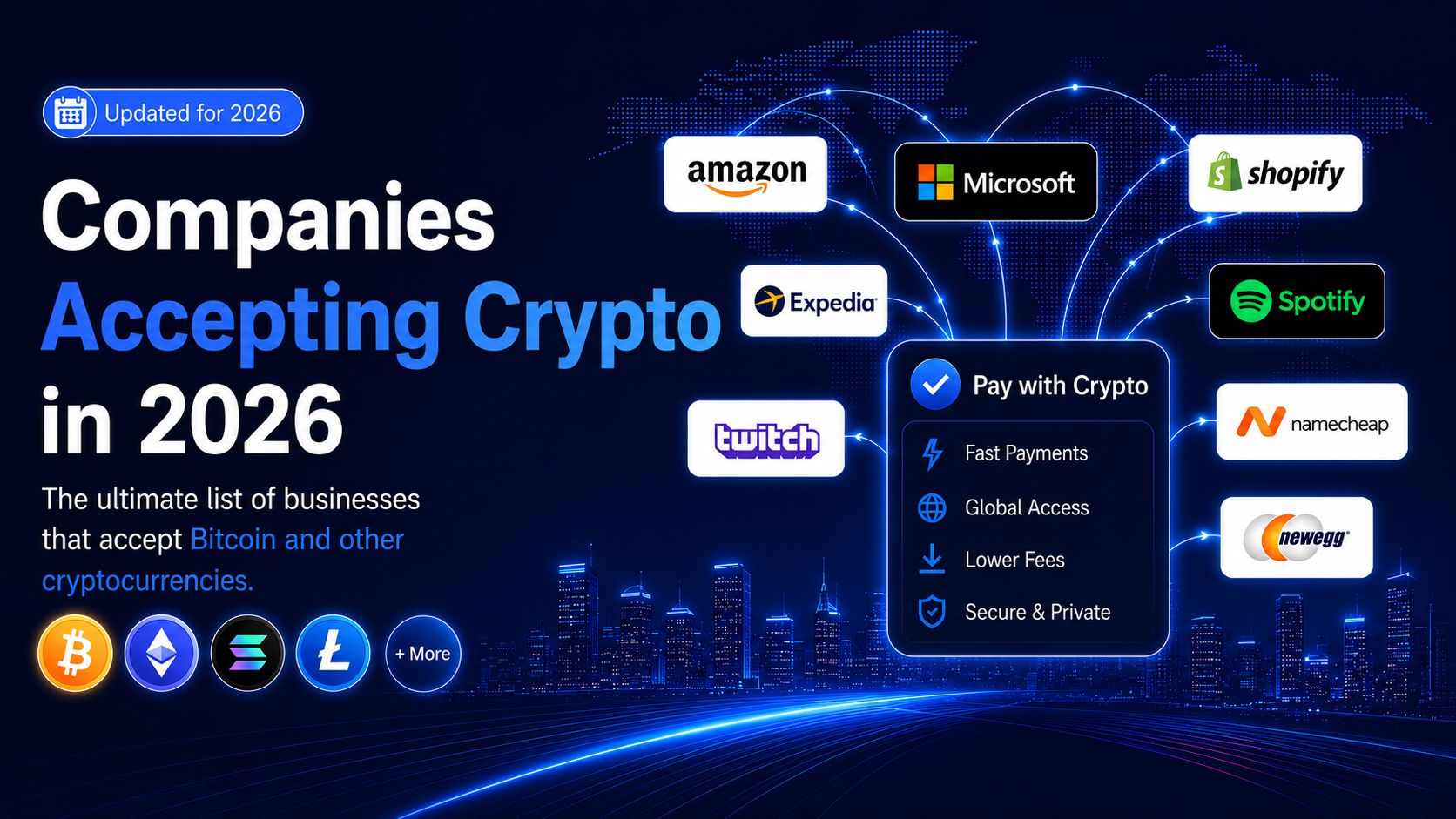
Two years ago, a business that accepted digital dollars was a novelty. In 2026 it is a competitive baseline. DoorDash, Shopify, Stripe, Visa, and Mastercard have all moved stablecoins or crypto from a pilot into production, and they are doing it with settlement in seconds rather than days.
The shift is backed by volume, not press releases. Stablecoin transaction volume reached a record 33 trillion dollars in 2025, a 72 percent year-over-year increase, with USDC alone accounting for 18.3 trillion dollars, according to Bloomberg citing Artemis Analytics. If you sell online, the relevant question is no longer whether to accept stablecoins or crypto. It is how to do it without taking on volatility, chargeback, or balance-sheet risk.
In this guide, you’ll learn:
Which major companies that accept crypto payments went live in 2026, and exactly what each one enabled
How Shopify, Stripe, and DoorDash structured their stablecoin payments under the hood
How stablecoin volume overtook the US ACH network, and why that shifts the baseline for finance teams
How a normal business can accept stablecoins or crypto with EukaPay and settle in fiat to a bank account
The 2026 lineup
The 2026 cohort is not one company testing the water. These five platforms together handle a large share of online checkout, payouts, and card settlement. Here is what each one shipped.
DoorDash and Tempo - cross-border payouts first
On April 21, 2026, DoorDash confirmed it is working with Tempo, the Stripe-backed payments Layer 1, to roll out stablecoin-powered payouts, according to CoinDesk. DoorDash operates in more than 40 countries and generated close to 75 billion dollars in sales for local merchants last year, per the same report, so the starting point is deliberate: cross-border flows, where settlement speed and cost matter most. PYMNTS reported that a separate option would let delivery workers receive pay directly in stablecoins. Tempo’s partners now include Mastercard, Visa, UBS, and Klarna.
Shopify - native USDC on Base
Shopify partnered with Coinbase and Stripe to let merchants accept USDC on the Base network through Shopify Payments. According to Shopify’s newsroom, the feature reaches merchants across 34 countries, and the merchant experience is built to be invisible: customers pay with USDC from hundreds of supported wallets, and merchants receive their local currency by default with no integration to build. Merchants can also choose to claim USDC directly into their own wallet. Stripe manages conversion and compliance while Coinbase powers the wallet infrastructure on Base. If you run a store, our walkthrough on
how to accept crypto payments on Shopify
covers the setup step by step.
Stripe - the conversion layer behind the others
Stripe is the connective tissue for much of this cohort. Its stablecoin payments product accepts payment from customers in 70-plus countries, settles to USDC on Solana, Ethereum, or Polygon, and pays merchants out in USD or stablecoin at a flat 1.5 percent fee, according to Stripe’s documentation. The capability is built on Stripe’s 1.1 billion dollar acquisition of Bridge, and Stripe has signaled expansion toward 160-plus markets. For a full breakdown of how it works, see our guide to
Stripe stablecoin payments, explained
. The same Stripe infrastructure powers both the Shopify and DoorDash launches above.
Visa, Mastercard, and PayPal - settlement and a digital dollar
The card networks moved on settlement. Visa expanded its stablecoin settlement program to support USDC, PYUSD, USDG, and EURC across Ethereum, Solana, Stellar, and Avalanche, according to Visa’s newsroom. Mastercard added settlement support for USDC, PYUSD, USDG, and other regulated stablecoins, per Mastercard’s announcement. PayPal continues to push PYUSD, its own dollar-backed stablecoin, across its consumer and merchant wallet. The takeaway for a finance lead: the settlement networks that banks and acquirers use are now stablecoin-capable, not just the consumer checkout.
Other names already live - the list keeps growing
The 2026 cohort is wider than these five. PayPal has reported crypto checkout through its Checkout with Crypto option, and Microsoft and AT&T have long been reported to accept Bitcoin for certain purchases. Overstock was an early mover, and travel sites including Travala report accepting crypto and stablecoins today. The pattern is consistent: acceptance is spreading from crypto-native firms into mainstream commerce, one platform at a time.
Comparison of major stablecoin and crypto launches
Brand | What they enabled | Who it serves |
DoorDash + Tempo | Stablecoin-powered merchant payouts, plus optional stablecoin pay for delivery workers, starting with cross-border flows | Local merchants and gig workers across DoorDash’s 40-plus countries |
Shopify | Native USDC acceptance on Base through Shopify Payments; settle local currency or claim USDC | Online merchants across 34 supported Shopify Payments countries |
Stripe | Stablecoin checkout in 70-plus countries; settles to USDC on Solana, Ethereum, Polygon at a 1.5 percent flat fee | Platforms and businesses using Stripe to accept and convert payments |
Visa | Stablecoin settlement in USDC, PYUSD, USDG, EURC across four blockchains | Issuers and acquirers settling card obligations |
Mastercard | Settlement support for USDC, PYUSD, USDG, and other regulated stablecoins | Banks and payment partners moving funds to stablecoin wallets |
Why everyone moved at once
The launches cluster together because the underlying numbers crossed a threshold. Stablecoin monthly volume surpassed the US ACH network for the first time in February 2026, reaching 7.2 trillion dollars against ACH’s 6.8 trillion, according to FX Leaders. In payroll specifically, stablecoins now account for the majority of crypto salaries, with USDC leading at a 63 percent share, according to Rise’s 2025 Crypto Payroll Report. When digital dollars clear more value than ACH, a competitor settling in seconds for a fraction of the fee stops being hypothetical.
For the platforms above, the appeal is concrete: settlement in seconds instead of days, lower cross-border fees, and around-the-clock movement that does not wait for banking hours. For a smaller business, the same benefits are available without building any of this infrastructure.
One platform underneath
You do not need DoorDash’s engineering team or Shopify’s partnerships to accept stablecoins or crypto. EukaPay is a licensed global crypto payments and OTC trading platform that gives a normal business the same capability the major names just shipped. It works as a crypto payment gateway any business can plug in, whether you sell online, invoice clients, or run recurring billing. EukaPay is FINTRAC registered in Canada, FinCEN registered in the United States, and regulated by the Bank of Canada, which matters when you are taking customer funds.
What EukaPay provides is instant crypto-to-fiat conversion at a locked exchange rate to remove all crypto volatility, protection against chargebacks, support for a wide range of cryptocurrencies, and settlement in USD, EUR, GBP, CAD to your bank account. You accept crypto pay-ins from your customers, and the auto-convert layer means you never hold a crypto balance unless you choose to. The product line covers Online Checkouts, Invoices, Payment Links, Subscriptions that send invoices on a recurring schedule, Mass Crypto Payouts, and a developer API for teams that want to build directly.
Businesses including the Futurist Conference and PropellerAds are among the brands that work with EukaPay. For businesses moving larger volumes or settling across borders, the EukaPay OTC Trading Desk offers competitive rates and deep liquidity in USDT, USDC, BTC, and ETH, with cross-border settlement in 30-plus currencies via SWIFT, SEPA, and local rails. For the wider context on where this market is heading, see our pillar on
merchants accepting crypto payments in 2026
.
Get started with EukaPay
Every merchant goes through a business review process, and a sandbox is available during review so you can test checkouts before you go live. To begin, create an account in the
and your developer (or coding agent) can wire up the API alongside the review. For more guides on accepting stablecoins or crypto, browse the
.
Frequently asked questions
Can a small business accept stablecoins or crypto the way DoorDash and Shopify do?
Yes. The major platforms built custom infrastructure, but EukaPay packages the same capability into Online Checkouts, Payment Links, and Invoices that any business can use after a business review. You get instant crypto-to-fiat conversion at a locked exchange rate to remove all crypto volatility, without an engineering project.
Do I have to hold crypto on my balance sheet if I accept it?
No. EukaPay’s auto-convert layer converts crypto pay-ins to fiat at a locked rate, so you never carry crypto volatility or balance-sheet risk unless you deliberately choose to keep a position.
What currencies does EukaPay settle in?
EukaPay settles to your bank account in USD, EUR, GBP, CAD. For cross-border needs, the OTC Trading Desk separately supports settlement in 30-plus currencies through SWIFT, SEPA, and local rails.
Which cryptocurrencies and stablecoins can I accept with EukaPay?
EukaPay supports most major cryptocurrencies, including BTC, ETH, LTC, SOL, USDC, and USDT, across 50-plus tokens in total, so you can accept the stablecoins your customers actually use.
How does EukaPay protect me from chargebacks?
Crypto pay-ins settled through EukaPay are not reversible the way card payments are, and EukaPay builds protection against chargebacks into the platform, which removes a category of fraud and dispute cost that card acceptance carries.
Can I send crypto payouts as well as receive payments?
Yes. EukaPay’s Mass Crypto Payouts lets you send crypto payouts to many recipients at once, which is the same cross-border payout use case DoorDash is pursuing with Tempo.
How long does it take to start accepting payments with EukaPay?
Every merchant goes through a business review process. A sandbox is available during review so your team can build and test integrations before approval, and your developer (or coding agent) can use the API in parallel.
Does EukaPay support recurring billing?
EukaPay Subscriptions send invoices on a recurring schedule - weekly, monthly, quarterly, or custom - through the dashboard and API, so you can bill repeat customers in stablecoins or crypto on a set cadence.
Products
Use Cases
© 2026 EukaPay. All rights reserved.
FINTRAC: M22233887