Benefits of stablecoins for a business that moves money
August 26, 2026
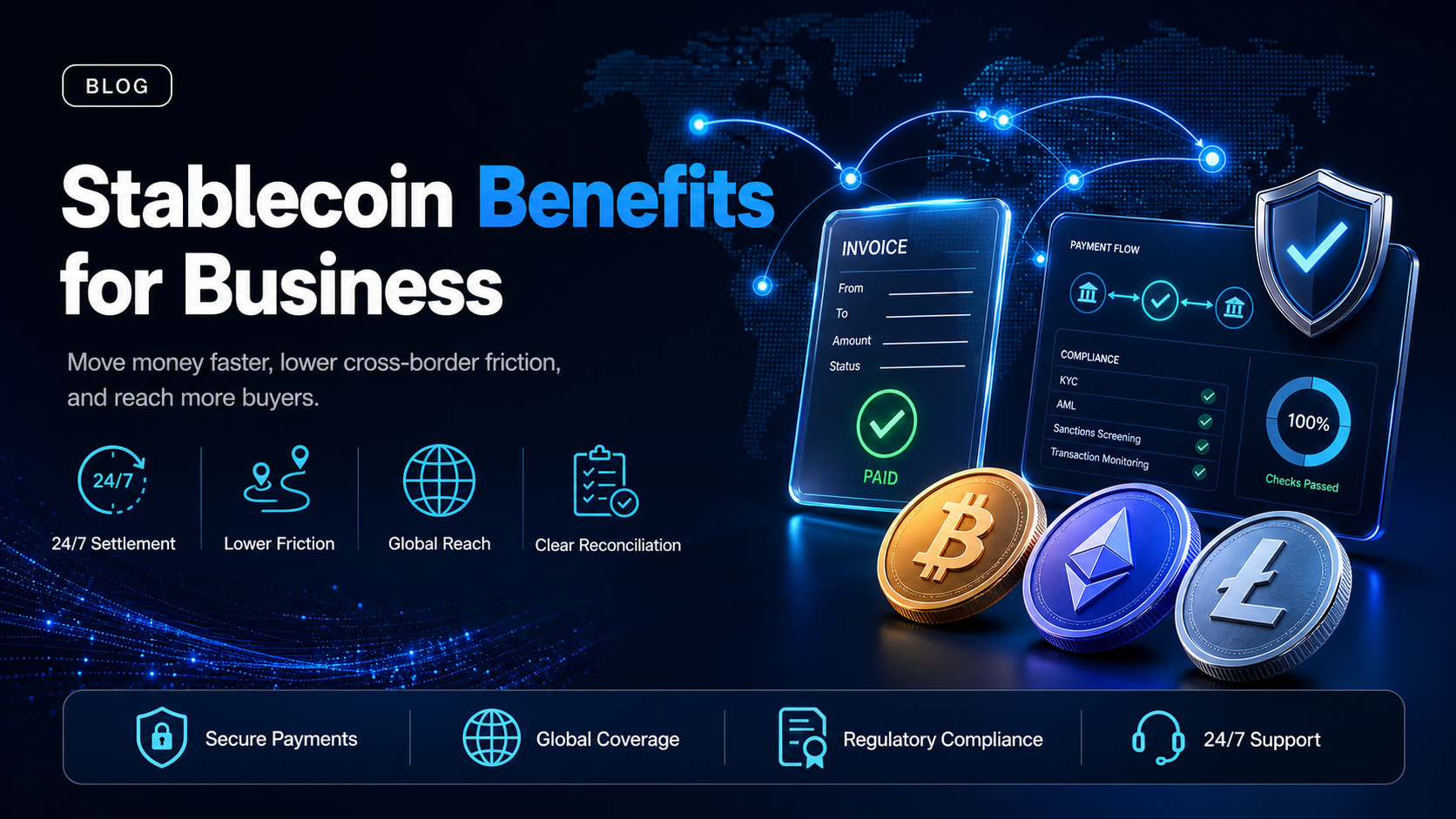
A stablecoin is a cryptocurrency designed to hold a fixed value against a reference currency, most often the US dollar. For a business, the benefits of stablecoins are payment benefits, not asset benefits. They are about how money moves: when it can move, how many institutions sit in the path, and which customers can complete a purchase. This guide covers that, and only that.
EukaPay is the platform a business uses once it decides the rail is worth adding. It collects stablecoin and crypto pay-ins, sends stablecoin payouts, and settles to your own bank account in USD, EUR, GBP, and CAD. The sections below set out the advantages of stablecoins a business can actually use, what the rail leaves unchanged, and what the first week of running one looks like.
In this guide, you'll learn:
Which benefits of stablecoins apply to a business moving money, and which belong to a different reader
What changes on the pay-in side and what changes on the payout side
What a stablecoin rail does not fix, so the business case only claims what the rail does
The steps a business takes to start accepting stablecoin payments
Benefits of stablecoins for a business, not benefits for an investor
Most writing about stablecoins is aimed at someone deciding what to buy. A business is deciding something narrower: whether adding a second rail alongside cards and bank transfers makes money arrive sooner, cost less on the way, or arrive at all. Three benefits answer that question.
Timing - money that moves outside banking hours
A stablecoin transfer is confirmed on a blockchain network, and those networks do not close. A payment sent on a Saturday afternoon can confirm the same afternoon. Nothing waits for a cut-off, a clearing window, or a public holiday in a country you do not operate in. Sending on a rail that is not tied to banking hours or the banking calendar takes a class of delay out of the month-end schedule.
Cross-border cost - fewer institutions in the path
A traditional cross-border payment can pass through correspondent banking relationships, with each intermediary bank taking a fee and adding a day. A stablecoin transfer moves between two addresses on one network, with no chain of intermediaries in between. Our guide to
cross-border payment collection
goes through what that path looks like on a real invoice.
Reach - buyers your acquirer serves poorly
Every extra country in your customer list adds another issuer and another set of rules your acquirer did not write. Plenty of buyers have a working bank account and a working business, and still no card that reliably completes a cross-border digital purchase. A stablecoin payment either confirms on-chain or it does not.
Advantages of stablecoins on the pay-in side and the payout side
The advantages of stablecoins are not the same on both sides of a business. The assets, the workflow, and the person on the other end are all different.
Pay-ins - what a customer sends and what you receive
On the pay-in side, a customer pays in a cryptocurrency and you choose what you receive. EukaPay supports BTC, ETH, LTC, SOL, USDC, and USDT on pay-ins, through invoices, payment links, checkout, and subscriptions.
The important part for a finance lead is the conversion. EukaPay runs instant crypto-to-fiat conversion at a locked exchange rate to remove your exposure to crypto price swings. The locked rate is the default on pay-ins and on payouts. Our
comparison of fiat and stablecoin payments
works through how the two rails behave on the same international transaction.
Payouts - sending USDC, USDT, ETH, or BTC to a recipient
On the payout side, EukaPay sends USDC, USDT, ETH, and BTC across the Ethereum, Tron, and Bitcoin networks. Asset and network are set per payout, so two recipients in the same run can be paid differently. Each payout carries its own reference you can look up later.
There are two ways to send. A finance team can upload a recipient list as a CSV file in the merchant dashboard. A developer (or coding agent) can use the Payout API, which creates one payout per request. Our guide to
covers how a run for a distributed team is put together.
What stablecoins do not change about the way your business gets paid
The rail does not replace your accounting. You still recognize revenue, reconcile against your ledger, and report in your functional currency. The rail does not remove your own payroll calculations or your existing supplier terms either. It changes the transfer, not the obligation.
Fiat settlement reaches your business bank account, not an individual recipient. Paying a person in fiat is still a job for the payroll or accounts payable system you already run.
EukaPay also does not issue, mint, or manage any stablecoin. The assets named above are created by their own issuers. EukaPay accepts them, converts them, and sends them.
How does a business start accepting stablecoin payments?
A business takes four steps, in this order.
Sign up and complete verification.
Create an account at
and provide your legal business information. Every merchant goes through a business review.
Choose your settlement.
Decide whether you want crypto or fiat, and which of USD, EUR, GBP, and CAD your bank account should receive.
Pick the collection method.
An invoice or a payment link needs no code. A platform integration uses the API, which our
walks through.
Fund the payout balance if you are sending money out.
The payout balance is funded by transferring from your main account balance.
What EukaPay does for a business adding a stablecoin rail
EukaPay runs both directions on one platform: instant crypto-to-fiat conversion at a locked exchange rate to remove your exposure to crypto price swings, support for most major cryptocurrencies, and settlement in USD, EUR, GBP, and CAD to your bank account. A crypto payment confirms on-chain, so protection against chargebacks is a property of the payment method.
Collecting from buyers in more than one country, or paying people who are not on your local banking rail, is what EukaPay is built for. Start with a payment link on a single invoice, then move the volume onto the API.
Get started with EukaPay
Create an account at
to send your first invoice or payment link. If a developer (or coding agent) is doing the integration, the endpoints for invoices, subscriptions, payouts, balance transfer, and customers are documented at
. A staging environment is available for development work.
Frequently asked questions
What are the main benefits of stablecoins for a business?
Payments confirm on networks that do not close, so money is not tied to banking hours or the banking calendar. The transfer path has no chain of intermediary banks, and buyers whose cards fail on cross-border purchases can still pay you.
What are the advantages of stablecoins over a bank transfer?
A bank transfer can pass through correspondent banking relationships, each adding a fee and a delay. A stablecoin transfer moves between two addresses on one network, and it can be sent outside banking hours.
Which stablecoins can a business accept and send with EukaPay?
Pay-ins support BTC, ETH, LTC, SOL, USDC, and USDT. Payouts are sent in USDC, USDT, ETH, and BTC, across the Ethereum, Tron, and Bitcoin networks.
Does a business need to hold stablecoins to accept them?
No. You can settle to your own bank account in USD, EUR, GBP, or CAD, and EukaPay applies the locked exchange rate on the conversion by default.
Do stablecoin payments have chargebacks?
A crypto payment confirms on-chain, so protection against chargebacks is a property of the payment method.
Does EukaPay issue or mint stablecoins?
No. EukaPay is a payments platform. Stablecoins are created by their own issuers, and EukaPay accepts them, converts them, and sends them.
Can a business pay salaries in stablecoins?
A business can send stablecoin payouts to people it owes money to. Your payroll calculations, classifications, and records stay in the systems you already run.
How long does a stablecoin payout take?
Payouts are not tied to banking hours or the banking calendar, so a run can be sent at any time. Confirmation depends on the network the payout is sent across.
Related articles
Comparing fiat and stablecoin payments for international transactions
- how the two rails behave on the same cross-border invoice
How to accept crypto with a crypto payment API
- the integration path for a platform collecting stablecoin payments
How to choose a crypto payment gateway
- the criteria to compare before committing to a provider
Products
Use Cases
© 2026 EukaPay. All rights reserved.
FINTRAC: M22233887