Blockchain payment processing: what it changes for a merchant
August 25, 2026
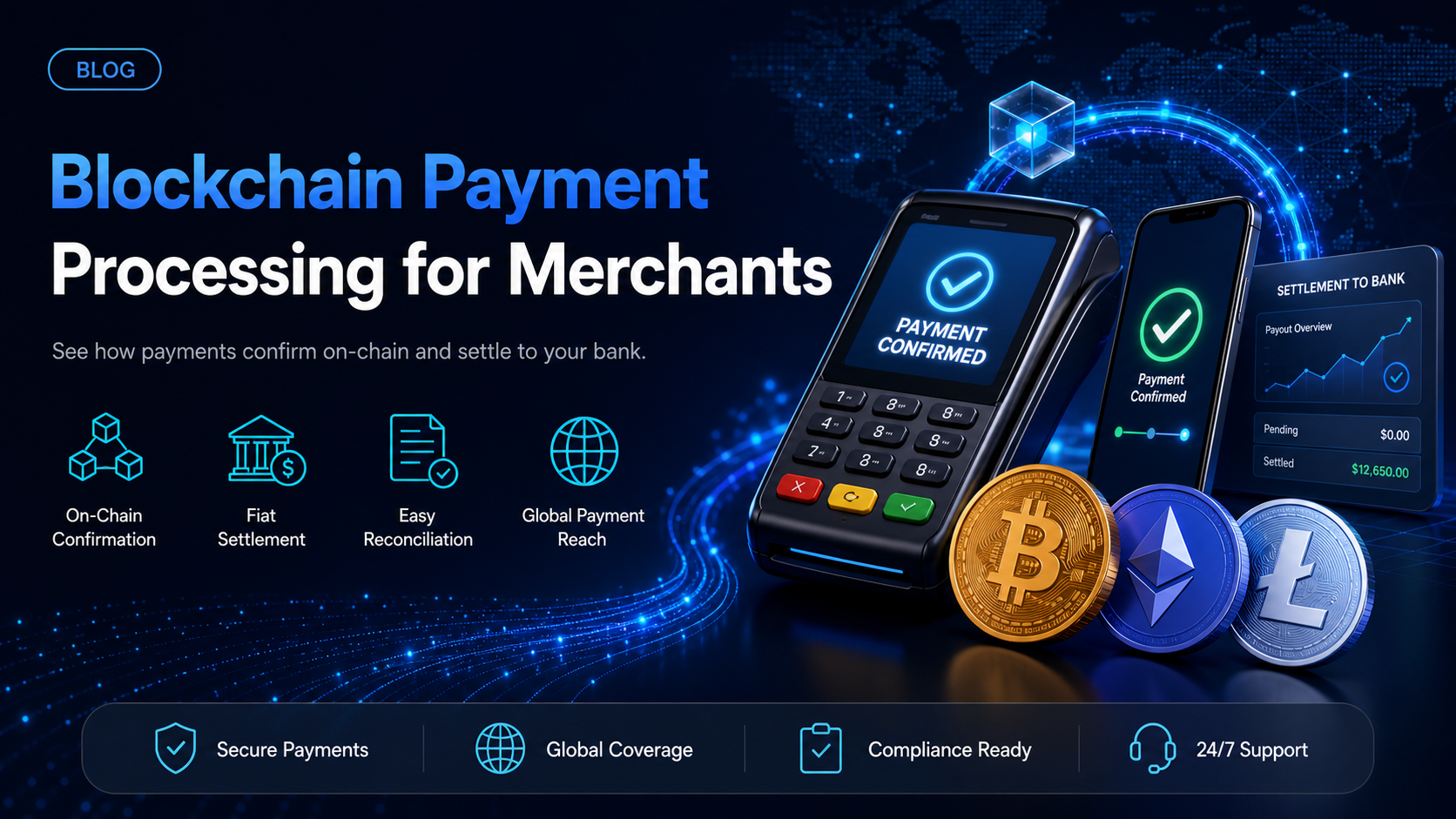
Blockchain payment processing is the handling of a customer payment on a public blockchain instead of a card network. The customer sends a transfer, the network confirms it, and the merchant is credited for the amount that arrived. No cardholder's bank sits in the middle deciding later whether the payment stands. For a business, that is an operational change, not a market position. The questions that matter are settlement, reach, and reconciliation.
EukaPay handles that blockchain leg for you and settles the result in USD, EUR, GBP, and CAD to your bank account. This guide covers what happens at each step of a blockchain payment, where the rail differs from a card rail, and what stays the same in your workflow. It is about accepting and sending business payments, not about investing in cryptocurrencies.
In this guide, you'll learn:
What blockchain payment processing does at each step, from the customer's transfer to the credit in your account
How a blockchain rail differs from a card rail on confirmation, reversal, and reach
Which parts of your existing checkout, invoicing, and reconciliation work stay unchanged
What EukaPay handles on the pay-in side, the payout side, and the fiat settlement side
What blockchain payment processing is, for a business that moves money
Two separate things get called blockchain payment processing, and a buyer needs to keep them apart. One is the public network that moves and confirms the transfer. The other is the platform you integrate with to make that network usable in a commercial checkout.
The rail - a public network that confirms transfers
A blockchain is a shared record of transfers that many independent computers keep in agreement. When a customer sends a payment, the network validates it and writes it into that record. Once written and confirmed, it is not reversed by the network. Your acquirer, your card scheme, and your customer's bank play no part in that step.
The processor - what a payment platform adds on top of the rail
A public network on its own gives you an address and a balance. It does not give you a checkout, an invoice, an amount in your accounting currency, or money in your bank account. EukaPay sits between the network and your business. It creates the payment request, watches for the transfer, converts the amount to fiat, and settles to your account.
How does blockchain payment processing work, step by step
Here is the sequence for a single customer payment, with EukaPay running the middle of it.
You create the payment request.
Use an invoice, a payment link, a hosted checkout, or the API. The request carries the amount in your chosen currency.
The customer picks a cryptocurrency and a network.
Pay-ins can be made in most major cryptocurrencies like BTC, ETH, LTC, SOL, USDC, USDT, and over Lightning.
The customer sends the transfer.
They finish this in a browser on the payment page, from their own wallet or exchange account. The step is not headless.
The network confirms the transfer.
Confirmation makes the payment final, and it does not depend on banking hours or the banking calendar.
EukaPay converts and settles.
Instant crypto-to-fiat conversion happens at a locked exchange rate, and the fiat reaches your bank account in USD, EUR, GBP, or CAD. You can also settle in crypto instead.
The sequence has the same shape as a card payment, with different parties doing the confirming. The same flow set against a bank transfer is covered in
comparing fiat and stablecoin payments for international transactions
.
Payment processing blockchain rails compared with card rails
Card rail | Blockchain rail | |
|---|---|---|
Who confirms the payment? | The customer's bank, then the card scheme | The public network the transfer was sent over |
Reversal after confirmation | The customer's bank can raise a dispute later | A confirmed transfer is not reversed by the network |
Reach beyond your acquirer's footprint | Depends on the customer having a card your acquirer accepts | Depends on the customer having a wallet and a supported network |
What you reconcile against | The processor's settlement report | The on-chain transfer reference, plus the platform's record |
EukaPay is built to run alongside your card rail, not replace it, so the checkout you already have keeps working and the blockchain option appears next to it. Which rail you route a customer to can depend on what they are able to pay with. Plenty of buyers have a functioning business and a functioning bank account but no card that reliably completes a cross-border digital purchase. Those are the orders EukaPay can recover.
What blockchain payment processing does not change for a merchant
Adding a blockchain rail changes how a payment confirms. It does not change most of the work around the payment, and buyers often overestimate how much they would have to rebuild.
Your pricing stays denominated in your own currency. Your invoices keep their line items and numbering. Reconciliation still happens against a settlement record, and the amount that lands is still a fiat amount in USD, EUR, GBP, or CAD. Your accounting system never sees a blockchain.
What does change is the failure mode. A card payment can be authorized and then disputed weeks later. A blockchain payment can fail before it confirms, and after it confirms it stays confirmed. Finance teams often find the second pattern easier to close a month on.
One platform for crypto pay-ins, crypto payouts, and fiat settlement
Both directions of the account run on the same platform. On the pay-in side you get instant crypto-to-fiat conversion at a locked exchange rate to remove your exposure to crypto price swings, support for most major cryptocurrencies, and settlement in USD, EUR, GBP, and CAD to your bank account. The locked rate is applied by default on every conversion, on pay-ins and on payouts, so there is nothing to switch on. A crypto payment confirms on-chain, so protection against chargebacks is a property of the payment method.
On the payout side, EukaPay sends in USDC, USDT, ETH, and BTC over the Ethereum, Tron, and Bitcoin networks. The asset and the network are set per payout, so different recipients can be paid differently in the same run. You can upload a recipient list as a CSV in the merchant dashboard, or create payouts one per request through the
. Teams paying contractors and staff this way can see the workflow in our guide to
stablecoin payroll for global teams
.
If you are weighing a blockchain rail for the first time, start with EukaPay on the pay-in side and keep your card checkout in place. Add payouts once the collection side is settling the way you expect. That order gets you the reach benefit first.
Get started with EukaPay
Create an account at
to set up crypto pay-ins, crypto payouts, and fiat settlement for your business. Developers (or coding agents) can read the endpoints for invoices, subscriptions, payouts, balance transfer, and customers at
. A staging environment is available for development.
Frequently asked questions
What is blockchain payment processing?
It is the handling of a payment over a public blockchain instead of a card network. The customer sends a transfer, the network confirms it, and a payment platform converts and settles the amount to the merchant.
Is payment processing blockchain technology different from accepting crypto?
In practice they describe the same thing from two angles. The blockchain is the rail the transfer moves over, and accepting crypto is what your business does on top of that rail.
Do I need a crypto wallet to accept blockchain payments?
Not for fiat settlement. EukaPay converts the incoming payment and settles it to your own bank account in USD, EUR, GBP, or CAD. You would need a wallet only if you choose to settle in crypto.
How fast does a blockchain payment settle to my bank account?
Confirmation on the network is not tied to banking hours or the banking calendar. The fiat leg into your bank account depends on your bank.
Can a customer reverse a blockchain payment?
Once a transfer is confirmed on-chain, the network does not reverse it. That is a property of the payment method, not a service anyone adds to it.
Which cryptocurrencies can I accept and which can I pay out in?
Pay-ins support most major cryptocurrencies like BTC, ETH, LTC, SOL, USDC, USDT, and Lightning. Payouts are sent in USDC, USDT, ETH, and BTC.
Does blockchain payment processing replace my card processor?
It does not have to, and many merchants run both. The blockchain rail can pick up orders where a card does not complete, and the card rail keeps serving customers who prefer it.
Related articles
How to choose a crypto payment gateway
- the criteria to compare before you commit to a provider.
How to accept crypto with a crypto payment API
- the endpoints and the integration path for a developer.
Cross-border payment collection
- why a single global account can slow your cash, and what to do instead.
Products
Use Cases
© 2026 EukaPay. All rights reserved.
FINTRAC: M22233887