USDC payments: what a business needs to accept and send them
September 04, 2026
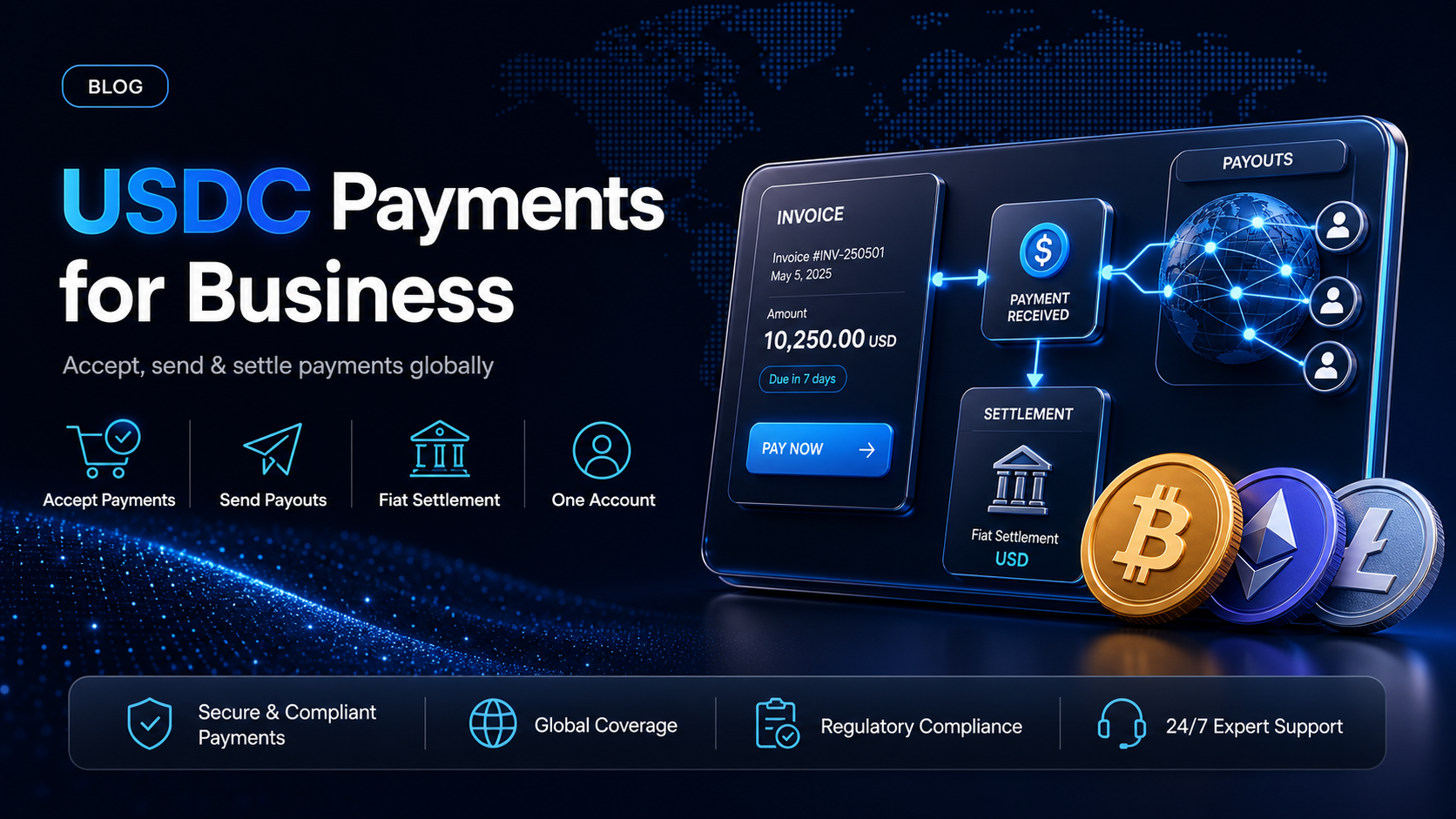
USDC payments are payments made in USDC, a dollar-referenced stablecoin issued by Circle, sent over public blockchain networks instead of through a card network or a correspondent banking chain. For a business, that difference changes two practical things. Money can move outside banking hours and outside the banking calendar. And a payer with no card that reliably completes a cross-border purchase can still pay you.
EukaPay is the payments platform that lets a business do both sides of this without changing how it does accounting. You accept USDC payments from customers through checkout, payment links, invoices, or the API, and you settle to your own bank account in USD, EUR, GBP, or CAD. This guide covers what a USDC payment actually is, what accepting one involves, what sending one involves, and what a finance team should ask before approving the rail.
In this guide, you'll learn:
What a USDC payment is in business terms, and what it is not
How to accept USDC payments from customers and settle the proceeds in fiat
How to send USDC payments out to suppliers, contractors, or partners
Which EukaPay product fits each collection scenario
What USDC payments are for a business moving money
USDC is a stablecoin denominated in US dollars. Circle issues it. It moves on public blockchain networks, so a transfer is confirmed by the network instead of being authorized by an issuing bank and cleared through a scheme. The commercial consequences all follow from that one difference.
This post is written for a business moving money, not for someone buying an asset. The relevant questions are settlement, reach, and reconciliation.
Reach - who can pay you that cannot pay you today
Every extra country in your customer list adds another issuer and another set of rules your acquirer did not write. A USDC payment does not ask an issuer for permission. A customer in a market your acquirer serves poorly can often complete a purchase that a card would have declined.
Reconciliation - what your finance team receives
A USDC payment carries an on-chain reference, and each payment can be looked up against that reference. Your bank statement stays the system of record, because EukaPay settles the proceeds to your own account in fiat.
How to accept USDC payments from customers
Accepting USDC payments is a collection problem, so the choice is about how the request reaches the customer. EukaPay gives you four routes on one account.
Checkout and payment links - a customer pays from a page you send
Checkout sits on your own storefront. A payment link is a URL you create and share, so no development work is needed to start collecting. Both routes present the payer with the amount and the payment screens, and the payer completes the transfer in a browser.
Invoices - a customer receives a document and pays from it
Invoices is a friendly user-interface where you enter the amount, add line items, and your customer's information. EukaPay sends a formatted PDF invoice to their inbox with the payment link embedded. Subscriptions send those invoices on a recurring schedule, at intervals from daily to annually.
The API - your developer (or coding agent) creates the request in code
The API creates invoices, subscriptions, payouts, balance transfers, and customers. It returns a hosted payment page URL and the payer finishes in a browser. Collection is programmatic, and the payment itself stays a normal checkout for the customer. The
walks through the integration.
Can a business accept USDC payments and settle in fiat?
Yes, and the merchant chooses fiat or crypto settlement on the account. With fiat settlement, EukaPay converts the incoming payment and pays the proceeds to the merchant's own bank account in USD, EUR, GBP, or CAD. EukaPay locks the exchange rate on every conversion by default, on pay-ins and on payouts, so the fiat value is fixed at the moment of payment.
Fiat settlement pays your own account. It is not a way to pay an individual recipient in fiat. If you need to pay a person, that is the payout side.
How to send USDC payments out to recipients
Payouts are the disbursement side of the account, and USDC is one of the assets EukaPay sends. Payouts go out in USDC, USDT, ETH, or BTC, across the Ethereum, Tron, and Bitcoin networks. Asset and network are set per payout, so different recipients in the same run can receive different assets on different networks.
There are two ways to send. In the merchant dashboard you upload a recipient list as a CSV file for mass payouts. Through the Payout API you create payouts programmatically, one payout per request. The payout balance is funded by transferring from the account's main balance. Each payout has its own reference you can look up, and payouts are not tied to banking hours or the banking calendar.
Stablecoin payroll for global teams
covers the recurring case.
How to choose
Checkout | Payment links | Invoices | API | |
|---|---|---|---|---|
Who delivers the request? | Your storefront | You share a URL | EukaPay emails a PDF | Your application |
Coding required? | Integration on your site | None | None | Yes |
Recurring billing? | No | No | Yes, via subscriptions | Yes, via subscriptions |
Typical user | Online stores | Sales and support teams | Companies, consultants, freelancers | Platforms and marketplaces |
Most businesses start with payment links or invoices because neither needs a developer, then move collection into the API once the volume justifies it. Checkout is the route for an online store that wants USDC beside its existing methods. The four routes report into one account, so moving between them does not restart your reconciliation. The
apply the same way here.
One platform for USDC pay-ins, payouts, and fiat settlement
The same EukaPay account carries both directions. It gives you instant crypto-to-fiat conversion at a locked exchange rate to remove your exposure to crypto price swings, support for most major cryptocurrencies, and settlement in USD, EUR, GBP, and CAD to your bank account. A crypto payment confirms on-chain, so protection against chargebacks is a property of the payment method.
For a business adding USDC payments, EukaPay is the practical answer: collection through four routes, disbursement in USDC, USDT, ETH, and BTC, and fiat settlement into the account your finance team already reconciles. The next step is to open an account and read the API reference before you scope the integration.
Get started with EukaPay
Create an account at
, complete verification, provide your legal business information, and generate an API key. A staging environment is available for development. The endpoints for invoices, subscriptions, payouts, balance transfer, and customers are documented at
.
Frequently asked questions
What are USDC payments?
USDC payments are payments made in USDC, a dollar-referenced stablecoin issued by Circle, sent over public blockchain networks. A business can accept them from customers and send them to recipients.
How does a business accept USDC payments?
Through checkout on your storefront, a payment link you share, an emailed PDF invoice, or the API. The payer completes the transfer in a browser in every case.
Can I receive USDC payments as dollars in my bank account?
Yes. With fiat settlement, EukaPay converts the payment and pays the proceeds to your own bank account in USD, EUR, GBP, or CAD.
Which cryptocurrencies can EukaPay send in a payout?
Payouts go out in USDC, USDT, ETH, and BTC, on the Ethereum, Tron, and Bitcoin networks.
Can I send USDC payments to many recipients at once?
Upload a recipient list as a CSV file in the merchant dashboard for mass payouts. The Payout API creates one payout per request.
Do USDC payments work outside banking hours?
Payouts are not tied to banking hours or the banking calendar, because the transfer is confirmed by the network instead of by a bank.
Is the exchange rate fixed when a customer pays in USDC?
EukaPay locks the exchange rate on every conversion by default, on pay-ins and on payouts, so your fiat value is set at the moment of payment.
Related articles
Comparing fiat and stablecoin payments for international transactions
- what changes when you collect on a stablecoin rail instead of a bank rail
Cross-border payment collection in 2026
- why one global account slows your cash and what to do instead
How to choose a crypto payment gateway in 2026
- the criteria to apply before you shortlist a provider
Products
Use Cases
© 2026 EukaPay. All rights reserved.
FINTRAC: M22233887