Digital payouts: moving payments off cheques and wires
August 26, 2026
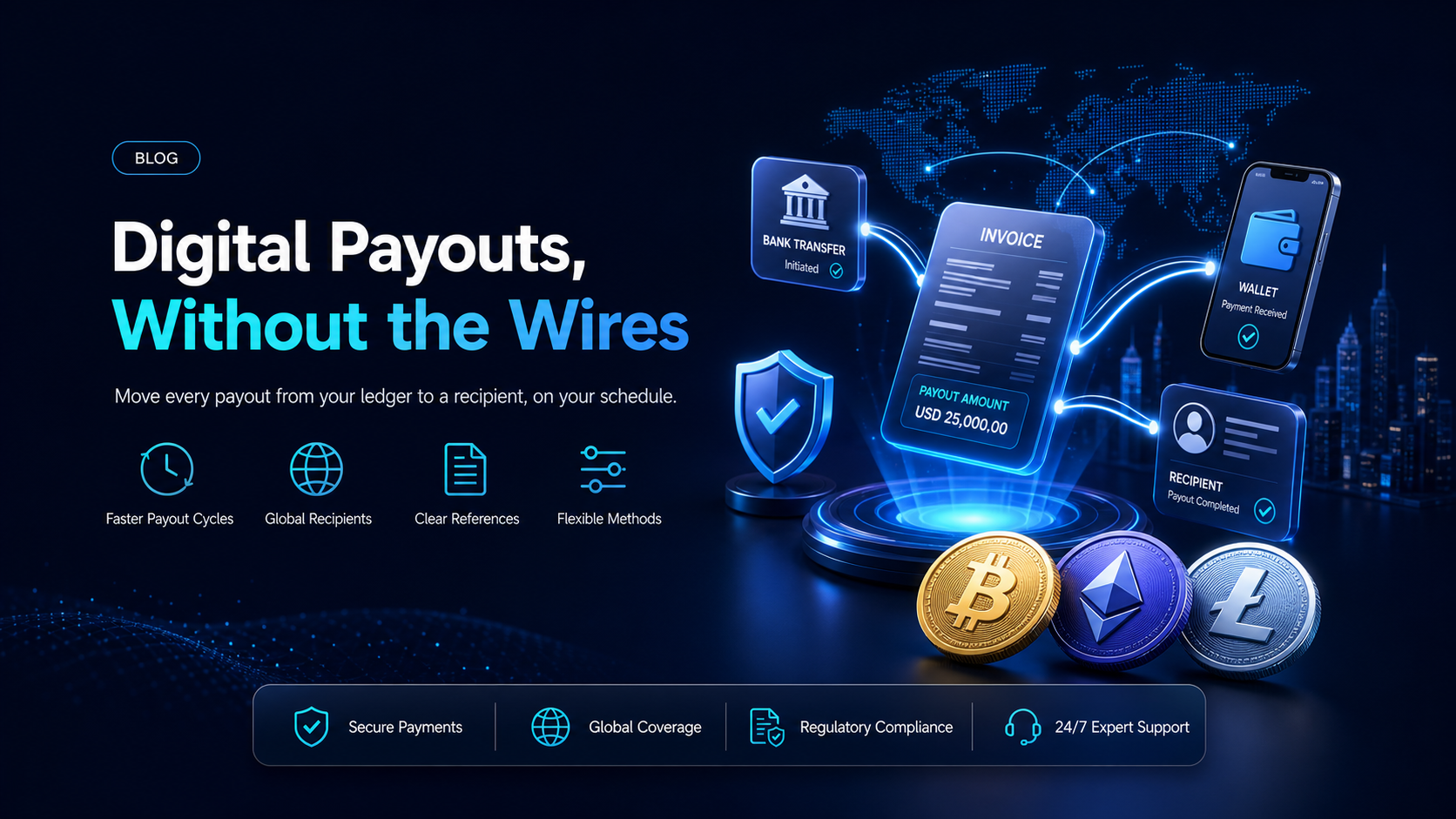
A digital payout is money your business sends to a recipient electronically, instead of by cheque or by a transfer someone keys into a bank portal by hand. The recipient can be a publisher, an affiliate, a contractor, a marketplace seller, or a creator. Digital payouts cover four methods: a bank transfer, a card push, a wallet credit, or a stablecoin or crypto transfer to a wallet address.
EukaPay covers the recipients legacy rails reach worst, which are the ones sitting outside the footprint your bank serves well. This guide covers what counts as a digital payout, what legacy rails do to a payout cycle, the methods a global recipient base uses, and how to pick between them.
In this guide, you'll learn:
What a digital payout is, and which payment methods count as one
What cheque runs, wires, and manual bank transfers cost your payout cycle
The four digital payout methods a global recipient base uses
How to choose a method per recipient segment instead of per company
What is a digital payout?
A digital payout replaces a paper instrument, or a hand-keyed instruction, with a recorded electronic one. Three things change. The instruction is created once in a system instead of typed into a bank portal. The recipient's details are stored as data your team can check. And the payment carries a reference you can match back to what you owed.
The term covers outbound money only. A digital payout is the opposite of a pay-in, where a customer or an advertiser pays you. Networks and marketplaces run both sides at once, which is why the two often get mixed up.
The four methods that count - bank transfer, card push, wallet credit, and crypto
A bank transfer or ACH credit moves local currency into a recipient's own account. A card push sends funds to a debit card. A digital wallet credit lands in a balance the recipient already holds. A stablecoin or crypto transfer sends value to a wallet address the recipient controls.
What sits outside the definition - cheque runs and hand-keyed transfers
A cheque is paper, so it never qualifies. A wire someone types into a bank portal is electronic at the bank, but manual in your process, so it carries the same error rate as paper. The test is whether your payables record and the payment instruction are the same record.
Why cheques, wires, and manual bank transfers slow a payout cycle
Networks live inside a spread. You collect from advertisers on net-30 and pay publishers on net-15, so the gap sets your working capital need. Legacy rails add days after you have already decided who gets paid what, so they widen the gap you are funding.
The payout calendar - legacy rails wait for banking hours and cut-off times
A cheque run needs printing, signing, and post. A hand-keyed wire needs someone at a desk during banking hours. It also has to clear a cut-off time the bank sets, not you. Payout day drifts, and a publisher promised the 15th hears from you on the 19th.
The reconciliation cost - manual transfers arrive without a per-payout reference
A manual transfer often reaches the recipient with a bank narrative nobody chose. When a recipient asks which cycle a payment covered, support has to rebuild the answer from a statement line. For the mechanics of assembling and sending a run, see our guide to
mass payments and how a payment run works
.
Digital payout methods for a global recipient base
No single method serves every recipient. A payout program built on one method leaves a segment underserved, and that segment quietly churns. Pick per segment.
Bank transfer and ACH - local currency into a recipient's own account
For recipients in your own market who want local currency in a local account, a bank transfer or ACH credit is often the right answer. A dedicated fiat payout vendor may serve that segment better than anything crypto-based. Keep it. The cost shows up when the same rail has to reach recipients your bank serves poorly, where correspondent banking adds intermediary banks and deductions.
Card push and digital wallets - a local balance without a bank transfer
A card push or a wallet credit can reach a recipient with no usable bank account for cross-border money. Coverage varies by market and by card scheme, so this method works well in some regions and reaches fewer recipients in others.
Stablecoin and crypto payouts - USDC, USDT, ETH, and BTC to a wallet address
This is the segment EukaPay is built for. Payouts are sent in USDC, USDT, ETH, and BTC, on Ethereum, Tron, and Bitcoin. Asset and network are set per payout, so different recipients in the same run can receive different assets on different networks. Each payout has its own reference that can be looked up. A recipient asking which cycle a payment covered becomes a lookup instead of an investigation. Crypto payouts are not tied to banking hours or the banking calendar, so what moves payout day is your ledger being ready. The payout balance is funded by transferring from your account's main balance. Our
covers the sending side.
How to choose
Stablecoin or crypto payout with EukaPay | Bank transfer or ACH | Card push or digital wallet | |
|---|---|---|---|
Tied to banking hours or the banking calendar? | No | Yes | Sometimes |
What the recipient needs | A wallet address | A local bank account | A card or wallet account |
What you send | USDC, USDT, ETH, or BTC on Ethereum, Tron, or Bitcoin | Local currency | Local currency |
Reference per payout | Yes, each payout has its own reference | Set by the bank | Set by the provider |
EukaPay is the right method when your recipient list crosses markets, because a wallet address does not depend on which bank serves that market. Bank transfer and ACH stay sensible for domestic recipients who want local currency, and a card push covers some of the rest. Put the hard-to-reach segment on EukaPay so your bank's calendar stops setting your payout date. Our post on
crypto mass payouts for contractors and affiliates
shows what that split looks like in practice.
One platform for pay-ins, digital payouts, and fiat settlement
EukaPay runs both sides of a network's money on one account. You get instant crypto-to-fiat conversion at a locked exchange rate to remove your exposure to crypto price swings, support for most major cryptocurrencies, and settlement in USD, EUR, GBP, and CAD to your bank account. EukaPay locks the exchange rate on every conversion by default, on pay-ins and on payouts. A crypto payment confirms on-chain, so protection against chargebacks is a property of the payment method.
For a network operator, the collection side and the payout side stop being two vendors and two reconciliations. Advertisers can pay you in stablecoins or crypto, and you settle to your bank in the currency you report in. Publishers who are hard to reach by bank get paid to a wallet address on the day your ledger says they should.
Get started with EukaPay
Create an account at
to run your first digital payout, and send your developer (or coding agent) to
for the payout, balance transfer, invoice, subscription, and customer endpoints.
Frequently asked questions
What is a digital payout?
Money your business sends to a recipient electronically, rather than by cheque or by a transfer keyed into a bank portal by hand. Bank transfers, card pushes, wallet credits, and crypto transfers all count.
What is the difference between a digital payout and a digital disbursement?
They describe the same thing. Disbursement is the more common term in insurance and government payments, and payout is the more common term in networks and marketplaces.
Are digital payouts faster than a cheque or a wire?
A cheque needs printing and post, and a wire waits for banking hours and a cut-off. Crypto payouts through EukaPay are not tied to banking hours or the banking calendar.
Which cryptocurrencies can I send as a digital payout?
EukaPay sends payouts in USDC, USDT, ETH, and BTC, on the Ethereum, Tron, and Bitcoin networks. Asset and network are chosen per payout.
Do recipients need a bank account to receive a digital payout?
Not for a crypto payout. A recipient needs a wallet address they control, which is why this method can reach people in markets your bank serves poorly.
Does paying in crypto expose my network to price swings?
EukaPay locks the exchange rate on every conversion by default, on pay-ins and on payouts. That removes your exposure to crypto price swings. Sending USDC or USDT also keeps the payout denominated in a dollar value.
Can I keep paying some recipients by bank transfer?
Yes, and many networks should. Recipients who want local currency in a local account are often best served by the rail you already use.
Related articles
How to pay 1,000 publishers monthly with stablecoins or crypto
- what changes when a publisher payout run gets large.
Crypto payouts for freelance and talent marketplaces
- paying a marketplace supply side that spans markets.
- how mass payouts work for a Canadian operator.
Products
Use Cases
© 2026 EukaPay. All rights reserved.
FINTRAC: M22233887