Crypto payouts for freelance and talent marketplaces
August 11, 2026
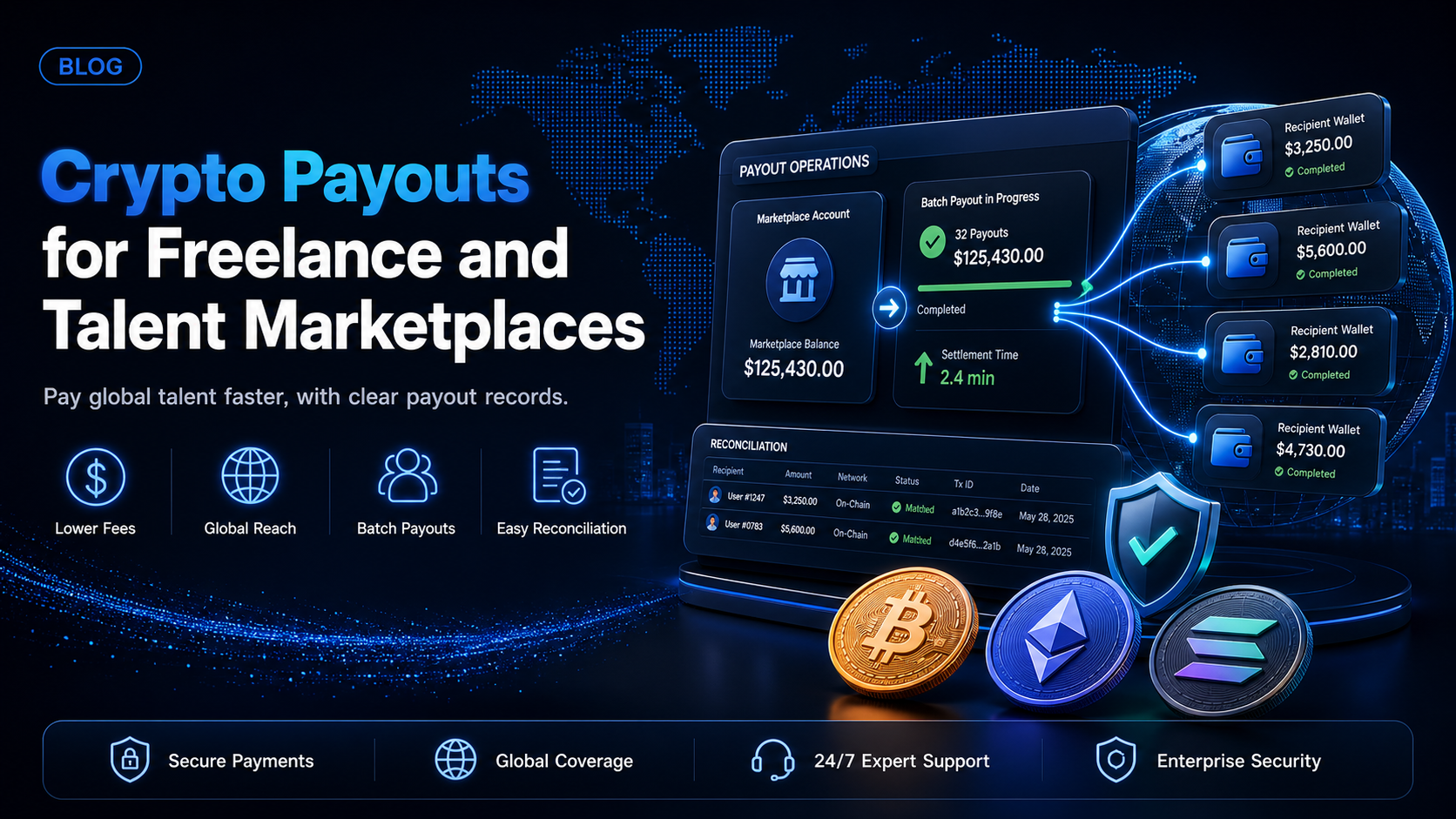
Crypto payouts for marketplaces are a different problem from crypto pay-ins, and most two-sided platforms discover the difference the hard way. Collecting from a client means handling one payment of a known size from someone who chose your checkout. Paying the other side of the marketplace means sending thousands of separate amounts to freelancers, designers, translators, tutors and creators who live in countries where your bank rail is slow or unsupported, on a schedule they watch closely.
You have three broad options for the money-out direction: keep the international bank rails you started with, add a payout aggregator that pushes into local bank systems, or pay recipients in stablecoins or crypto and let them hold or convert on their own terms. The rest of this guide covers what changes in each case, what the operator has to build, and how the finance team closes the books afterwards.
In this guide, you'll learn:
Why a flat per-transfer fee destroys the economics of a $40 payout, and what that does to your take rate
How stablecoin payouts reach talent in markets where your bank rail is slow, expensive or unavailable
What to collect from a freelancer at onboarding so payouts do not fail: wallet address, asset and network
How to reconcile thousands of individual disbursements back to jobs, commissions and your marketplace ledger
The payout side of a marketplace
Most marketplace payments engineering goes into the money-in direction, because that is where revenue arrives and where the conversion metrics live. The money-out direction gets a batch job and a support queue. Then the platform grows, the recipient base spreads across forty countries, and the payout queue becomes the largest single source of complaints from the supply side.
A long tail of recipients - many small amounts, many countries
A talent marketplace does not send fifty large payments a month. It sends thousands of small ones. A translator finishing three short jobs, a designer delivering one logo, a tutor billing four hours: the individual amounts sit between roughly $20 and a few hundred dollars, and the recipients are distributed across every market where your clients found supply. Traditional payout infrastructure was priced for the opposite shape, meaning a small number of large business-to-business transfers between developed-market banks.
Flat fees - the arithmetic of a $40 payout
Consider a hypothetical rail that charges a flat $15 per international transfer, with an intermediary bank deducting a further amount in transit. On a $2,000 payment the fee is under one percent and nobody notices. On a $40 payment the same fee consumes more than a third of what the freelancer earned, before any FX spread is applied on the receiving side. The marketplace then faces a bad set of choices: absorb the fee and lose most of the commission on that job, pass the fee to the recipient and reduce their effective rate, or impose a minimum withdrawal threshold and hold the recipient's money until the balance clears it.
Minimum withdrawal thresholds are the most common answer and the most expensive one, because the platform is then holding a growing balance of other people's earnings and answering questions about when the balance will be released.
Withdrawal friction - the reason talent tests a competitor
Supply-side churn on a marketplace rarely has one cause, but operators consistently report the withdrawal experience as one of the drivers. A freelancer who waits four business days for a payment, receives less than the invoice stated because an intermediary took a cut, and cannot tell you in advance what will land, starts reading about the competing platform in the same week. Payout speed and predictability are retention features on the supply side, in the same way checkout conversion is a retention feature on the demand side. The industry has been moving in that direction: Visa announced a Visa Direct pilot for stablecoin payouts to creators and gig workers on November 12, 2025, describing the goal as access to money in minutes rather than days.
What changes when payouts move to stablecoins or crypto
The fee stops scaling with the corridor
A stablecoin transfer costs a network fee that depends on the network, not on the distance between the sender and the recipient or on the number of correspondent banks between them. A payout to Lagos, Manila, Buenos Aires and Toronto costs the same to send. For a marketplace whose average payout is $40, the change in unit economics is the entire argument, because a fee that no longer scales with the corridor makes small disbursements viable again and removes the need for a minimum withdrawal threshold.
The recipient chooses what to hold
Some of your talent wants dollar stability and nothing else. Stablecoins give them a dollar-denominated balance they can spend or convert locally, which is why stablecoins lead the pair for most recipients. Others want to be paid in BTC, ETH, LTC or SOL and manage the exposure themselves. A payout system that supports both lets the recipient make the choice at withdrawal rather than forcing the marketplace to pick on their behalf. EukaPay supports most major cryptocurrencies like BTC, ETH, LTC, SOL, USDC, USDT, so you can offer a stablecoin default and still honour a request for something else.
Settlement timing becomes something you can state
Bank payout timing depends on cut-off windows, weekends and holidays in two or more jurisdictions. Crypto settlement depends on network confirmation. The practical result is that you can put an expected arrival window in your withdrawal screens and in your support macros without hedging, which removes a whole category of ticket. If you also collect from clients in crypto, the same reasoning applies on the inbound leg, and our guide to
cross-border payment collection
covers that direction.
Crypto payouts for marketplaces, step by step
The mechanics of a batch run are well covered in our guides to
crypto mass payouts for contractors and affiliates
and to
paying 500 contractors in one crypto mass payout run
, so the four steps below focus on what is specific to a marketplace operator holding balances for other people.
Step 1 - collect payout details as part of talent onboarding
Add three fields to the freelancer profile: the wallet address, the asset they want to receive, and the network the address belongs to. Ask for all three at onboarding rather than at first withdrawal, validate the address format at entry, and store the network explicitly. Never infer the network from the asset. A withdrawal screen that states the network the marketplace will use, and asks the recipient to confirm their address is on that network, prevents the most common cause of a payout landing somewhere the recipient cannot reach.
Step 2 - decide what the marketplace holds
A marketplace collects the gross amount from the client, keeps its commission, and owes the remainder to the talent. You can hold that remainder in fiat and convert at payout time, or hold it in stablecoins from the moment the client pays. Holding stablecoins on the ledger you are going to pay out from removes one conversion step and one point of timing risk between the client payment and the withdrawal.
Step 3 - run the batch, not the individual transfers
Group the day's or week's approved withdrawals into a single payout run. With EukaPay, you submit the run from the dashboard or through the
, with each line carrying the recipient, the asset, the network and the amount. The API path is what most marketplaces use, because withdrawals are triggered by recipient action inside your product rather than by someone in finance. Your developer (or coding agent) can follow the
EukaPay API developer walkthrough
to wire the withdrawal endpoint to your existing balance logic.
Step 4 - reconcile every line back to a job
Each payout line should carry your own reference, meaning the job ID, the invoice number or the internal withdrawal ID. Every disbursement then returns a transaction hash and a status against that reference, and your finance team reconciles the payout run against the marketplace ledger without matching amounts by hand. For a platform running thousands of disbursements a month, the reconciliation output matters as much as the send. The same operational pressure shows up across subscription platforms, and our piece on
SaaS platform payment challenges
covers the shared parts.
How to choose
Here's the picking heuristic in one table.
International wire | Payout aggregator into local rails | Digital wallet payout | Stablecoin or crypto payout | |
|---|---|---|---|---|
What the recipient needs | Bank account plus SWIFT details | Local bank account in a supported country | An account in the same wallet product | A wallet address and a network |
Typical arrival | Several business days | Same day to a few days, by corridor | Minutes, inside the wallet | Minutes, after network confirmation |
Fee shape | Flat per transfer, plus intermediary deductions | Per transfer, varies by corridor | Per transfer, plus conversion on withdrawal | Network fee, independent of corridor |
Viable for a $40 payout? | Rarely | Sometimes | Sometimes | Yes |
Country coverage | Wide but uneven in practice | Limited to supported corridors | Limited to countries the wallet serves | Wherever the recipient can hold a wallet |
Best for | Large, infrequent payments to established suppliers | Markets where you have real corridor volume | Recipients already inside that wallet ecosystem | A long tail of small payouts across many countries |
EukaPay is built for the last column, which is where a freelance or talent marketplace spends most of its payout volume. Most operators end up running two rails rather than one: a local rail in the two or three countries that account for a large share of supply, and
for the long tail everywhere else. Regional guidance matters too, and our overview of
shows how one market's expectations differ from the defaults.
One platform underneath
The payout side and the pay-in side run on the same EukaPay account. Whether you are collecting from clients at checkout or disbursing to talent in a weekly batch, the platform provides instant crypto-to-fiat conversion at a locked exchange rate to remove all crypto volatility, protection against chargebacks, support for a wide range of cryptocurrencies, and settlement in USD, EUR, GBP, CAD to your bank account. Stablecoin support covers the assets recipients ask for most, and our pages on how to
and
explain how each behaves on the inbound leg.
The choice among payout rails is a question of fit rather than of one rail being better in every case. A marketplace whose supply sits in three developed markets should use local bank rails. A marketplace whose supply sits in thirty countries, with an average payout under $100, should pay in stablecoins or crypto and keep bank rails for the exceptions.
Get started with EukaPay
Create an account at
to start the onboarding and business review process, and use the sandbox to build and test your withdrawal flow while the review is underway. The
covers the payout endpoints, batch submission and the webhook payloads your ledger will consume, and the
product page outlines what the integration includes.
Frequently asked questions
Can a marketplace pay freelancers in stablecoins and collect from clients in fiat?
Yes. The two legs are independent. You can collect however your clients prefer to pay and run the payout leg in stablecoins or crypto through EukaPay.
What does EukaPay support for payouts?
EukaPay supports most major cryptocurrencies like BTC, ETH, LTC, SOL, USDC, USDT. Recipients provide a wallet address and the network it belongs to, and your withdrawal screen should state the network the payout will use.
How do we handle a recipient who enters the wrong network?
Prevent the case at entry. Validate the address format when the freelancer saves it, store the network as an explicit field, and confirm the network on the withdrawal screen before the recipient submits the request.
Can withdrawals be triggered by the freelancer instead of by our finance team?
Yes. Most marketplaces call the payout endpoints from their own product, so a withdrawal request inside your interface creates a payout line. Batches can also be submitted from the dashboard when finance runs the cycle manually.
How do we reconcile thousands of individual payouts?
Attach your own reference to every payout line, such as a job ID or internal withdrawal ID. Each line returns a status and a transaction hash against that reference, which your finance team matches against the marketplace ledger.
Does the marketplace have to hold crypto to run crypto payouts?
No. You can hold fiat and convert at payout time, or hold stablecoins from the point the client pays. Holding stablecoins removes one conversion step before the withdrawal.
Can we still receive fiat in our own bank account?
Yes. EukaPay settles to your bank account in USD, EUR, GBP, CAD, so the commission you keep can land as fiat even when the payout leg runs in stablecoins or crypto.
Do you support a payout flow that is specific to our platform?
Yes. If your withdrawal logic, approval steps or reporting needs go beyond the standard endpoints, EukaPay takes
and builds against them.
Related articles
Crypto mass payouts for contractors and affiliates
- the general mechanics of a batch payout run
How to pay 500 contractors with crypto mass payouts
- what a large batch looks like end to end
- how one market's payout expectations differ
Products
Use Cases
© 2026 EukaPay. All rights reserved.
FINTRAC: M22233887