How to pay 500 contractors in minutes with crypto
June 10, 2026
6
min read ·
A practical guide to replacing slow, expensive international wires with crypto mass payouts that settle in minutes and cost a fraction per transfer.
Sending a single international wire transfer costs between $35 and $45 at most banks, takes one to five business days to clear, and arrives minus whatever intermediary banks quietly deducted along the route. For a business paying two hundred contractors across ten countries, those numbers add up to thousands of dollars in fees per payment cycle, a workday of manual bank instructions, and dozens of contractor emails asking where their money is.
A growing number of finance teams are replacing that workflow with crypto mass payouts: a single CSV upload that settles dozens or hundreds of crypto transfers in minutes, at a fraction of the per-transaction cost. The infrastructure already exists, and this guide walks through how the workflow runs in practice.
In this guide, you’ll learn:
Why traditional international wires lose money on fees, FX spreads, and multi-day delays
What crypto payouts do differently, and the three properties that matter for payroll-style batches
How a mass payout actually runs in production, from CSV upload to on-chain confirmation
Which businesses get the most value, and what finance and accounting teams need to handle
Why the standard contractor payment workflow loses money
The mechanics of an international wire transfer have not meaningfully changed since the 1970s. A payment from a company in Canada to a contractor in Nigeria travels through a chain of correspondent banks, each of which processes, holds, and forwards the funds at its own pace and extracts its own fee. The originating bank charges $15 to $45. The receiving bank typically takes a cut. Intermediate routing banks, invisible to both parties, may deduct additional amounts without notice.
A 2026 analysis by Slasify found that SWIFT wire transfers carry average hidden costs of 3 to 5 percent per $2,000 payout once transaction charges and FX markups are included. For a business paying two hundred contractors $500 each, that is $1,500 to $2,500 per cycle lost to the banking infrastructure before recipients receive the funds.
Speed is the other problem. One to five business days is the standard window, and that window assumes the payment does not get flagged for compliance review. For contractors in markets where correspondent banking relationships are thin, such as much of sub-Saharan Africa and parts of Southeast Asia, the delays stretch longer and the failure rate climbs. Platforms such as Wise and Payoneer have improved the experience at the margin, but they still require recipients to hold local bank accounts, still impose currency conversion costs, and still stop working cleanly in countries with fragmented banking infrastructure.
What crypto payouts do differently
Crypto payouts settle on a blockchain, which means each transfer is processed by a distributed network rather than routed through correspondent banks. The sender specifies an amount and a token - for example, 0.2 ETH - and the network moves it directly to the recipient’s wallet.
This matters for payouts in three ways. First, settlement is near-instant. An ETH transfer confirms in minutes, and on faster networks in seconds, with no business days, weekend delays, or waiting for a correspondent bank to open in a different time zone. Second, cost does not scale with the number of transactions. Sending a single crypto transfer costs roughly the same as sending five hundred, and a crypto transfer typically costs a few dollars rather than $35 to $45. According to research from Transfi, the cost difference between a bank wire and a crypto salary transfer can reach $40 per payment. Third, recipients do not need a bank account. They need a crypto wallet, which can be created on a phone in a few minutes with no minimum balance and no relationship with a financial institution.
The World Bank estimates roughly 1.4 billion adults globally remain unbanked, and a meaningful share of the global freelance workforce is concentrated in markets where banking access is inconsistent. A 2024 case study from Transfi documented an African freelance platform that integrated USDT payouts specifically because a portion of its contractors had no practical access to bank accounts. The platform moved from fragmented, unreliable payouts to same-day settlement, and freelancer retention improved because contractors stopped losing work days chasing delayed payments.
How a mass payout runs in production
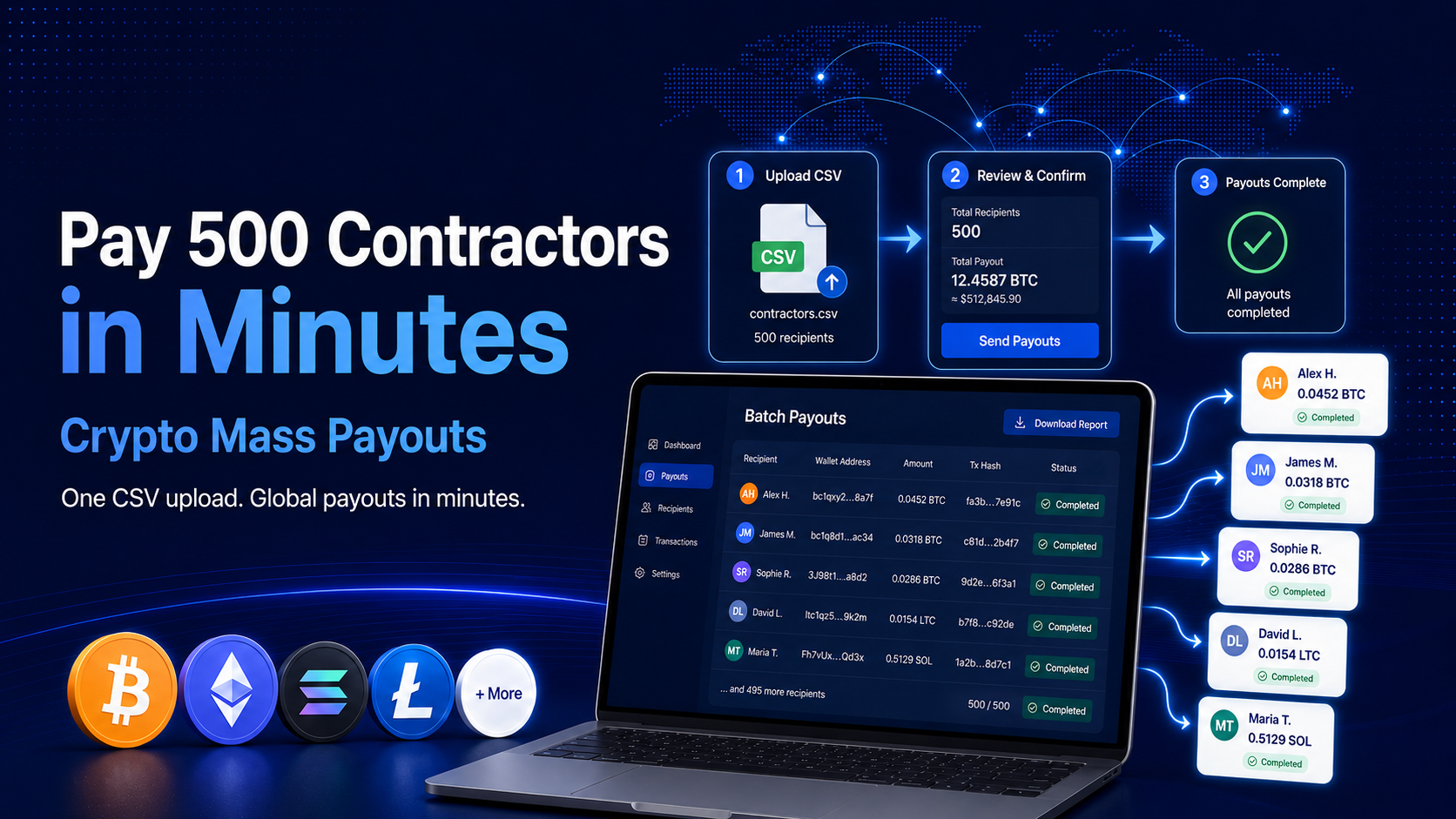
A crypto mass payout has a straightforward operational structure. On EukaPay’s
, the process runs in five steps.
Prepare the file.
Build a CSV containing each recipient’s details: name, the exact amount and token to send (for example, 0.2 ETH), the network, and the recipient’s wallet address. Each row specifies the token and the amount of that token directly, so the sender controls precisely what each recipient receives.
Upload the batch.
Upload the CSV to the payout dashboard. The platform validates the entries and calculates total outlay before anything is sent.
Review and submit.
Confirm the batch. Each line item enters the payout history with a status of Processing.
Settle on-chain.
Each transfer confirms on the blockchain, typically within minutes, and the status transitions to Completed.
Reconcile.
The recipient receives the crypto in their wallet. Each entry carries a blockchain transaction hash that the finance team can verify independently against an on-chain explorer.
EukaPay’s Mass Payouts product currently supports ETH, USDT, and USDC, with additional networks and currencies on the roadmap. ETH is a common default, and USDT or USDC are available for recipients who prefer a dollar-denominated token. Teams that want to drive payouts programmatically rather than by manual upload can run the same flow through the
, which a developer (or coding agent) wires up once.
Who this works best for
The businesses getting the most value from crypto mass payouts share a few characteristics. They pay a relatively large number of recipients across multiple countries. Their recipients include people in markets where banking access is inconsistent or where local currencies are volatile enough that contractors prefer dollar-denominated settlements. And they pay frequently enough that per-transaction wire fees represent a meaningful operating cost.
Affiliate marketing networks fit this profile well. A mid-sized affiliate program might pay hundreds of publishers monthly across dozens of countries, and crypto mass payouts combine that batch into a single file upload. Creator economy platforms have been early adopters for the same reason: Remote launched USDC contractor payouts in 2024 across roughly 69 countries, and Deel enabled crypto withdrawals through Coinbase in 2021. iGaming and CFD operators that pay affiliates and introducing brokers internationally are another natural fit, because their partner bases tend to be concentrated in markets where contractors already hold crypto wallets. According to Rise’s 2025 Crypto Payroll Report, the share of multinational corporations paying some portion of their workforce in cryptocurrency grew from 15 percent in 2023 to 25 percent by 2025.
What finance teams need to handle
Switching to crypto mass payouts is not purely a payments decision. Finance and accounting teams need to understand what they are recording. A crypto payout creates a distinct accounting entry: the company holds a crypto balance, sends a transfer, and records the transaction with a blockchain hash as the reference identifier. Price exposure depends on the token: a volatile asset like ETH can change value between funding the wallet and sending the payout, so teams that want to avoid that fund the wallet close to the payout run or convert on receipt.
The remaining reconciliation questions are practical: how does the transaction hash map to the contractor invoice, and how does the platform-reported amount match the contractor’s received amount? EukaPay provides a payout history table that serves as the primary reconciliation record, with the recipient, amount, currency, network, and status for each entry, plus the on-chain hash for independent verification. For finance teams accustomed to matching bank statement entries against accounts-payable records, the process is analogous, with the blockchain explorer serving the role of the bank statement. Tax treatment depends on jurisdiction and on the token paid, so each finance team should confirm local treatment with a qualified accountant.
One platform underneath
Whether a business pays a handful of contractors or several hundred, the same infrastructure runs underneath. On the pay-in side, EukaPay provides instant crypto-to-fiat conversion at a locked exchange rate to remove all crypto volatility, protection against chargebacks, support for most major cryptocurrencies like BTC, ETH, LTC, SOL, USDC, USDT, and settlement in USD, EUR, GBP, CAD to your bank account. The same merchant account collects those
and runs outbound payouts in ETH, USDT, and USDC, so collections and disbursements report into one ledger.
For the pay-in side of that same infrastructure, see our roundup of
merchants accepting crypto payments in 2026
, which covers the collections half of the same merchant account.
Whether your team runs payouts by manual CSV upload or through the API, EukaPay reaches the same recipients, settles on the same networks, and produces the same reconciliation records. The method is purely a matter of how your team prefers to work.
Get started with EukaPay
If your business pays contractors, affiliates, or partners internationally and loses margin to wire fees every cycle, EukaPay gives your finance team a faster, lower-cost payout path without managing wallet infrastructure or writing custom code.
to set up your merchant profile, and a sandbox environment is available so your developer (or coding agent) can build the payout flow into your systems against the
during the onboarding review.
Frequently asked questions
How long does a crypto mass payout take to settle?
Crypto transfers confirm on-chain in minutes, and on faster networks in seconds. There are no business-day, weekend, or time-zone delays, so a batch submitted on a Sunday settles the same as one submitted on a Tuesday.
How much cheaper are crypto payouts than wires?
A crypto transfer typically costs a few dollars regardless of the amount, against $35 to $45 for a bank wire. Research cited above puts the per-payment difference as high as $40, and the cost does not scale with the number of recipients in a batch.
Which cryptocurrencies can I send through Mass Payouts?
EukaPay’s Mass Payouts product currently supports ETH, USDT, and USDC, with additional networks and currencies on the roadmap. ETH is a common default, with USDT and USDC available for recipients who prefer a dollar-denominated token.
Do my contractors need a EukaPay account to get paid?
No. Each contractor needs only a crypto wallet that can receive the asset you send. They do not register with EukaPay or install anything beyond a standard wallet app.
How do I reconcile crypto payouts in my accounting system?
Each payout entry in the dashboard records the recipient, amount, currency, network, status, and blockchain transaction hash. The hash is verifiable against a public on-chain explorer, which gives your accountant the same audit trail a bank statement provides.
Can I send payouts programmatically instead of uploading a file?
Yes. The
lets a developer (or coding agent) trigger payout batches directly from your systems, so recurring payment runs do not require a manual upload.
What does my finance team need to record for tax purposes?
For each payout, record the asset, the amount, the fiat-equivalent value at the time of payment, and the transaction hash. Confirm the specific tax treatment with an accountant familiar with crypto in your jurisdiction.
Products
Use Cases
© 2026 EukaPay. All rights reserved.
FINTRAC: M22233887