How to accept USDC payments in 2026
August 04, 2026
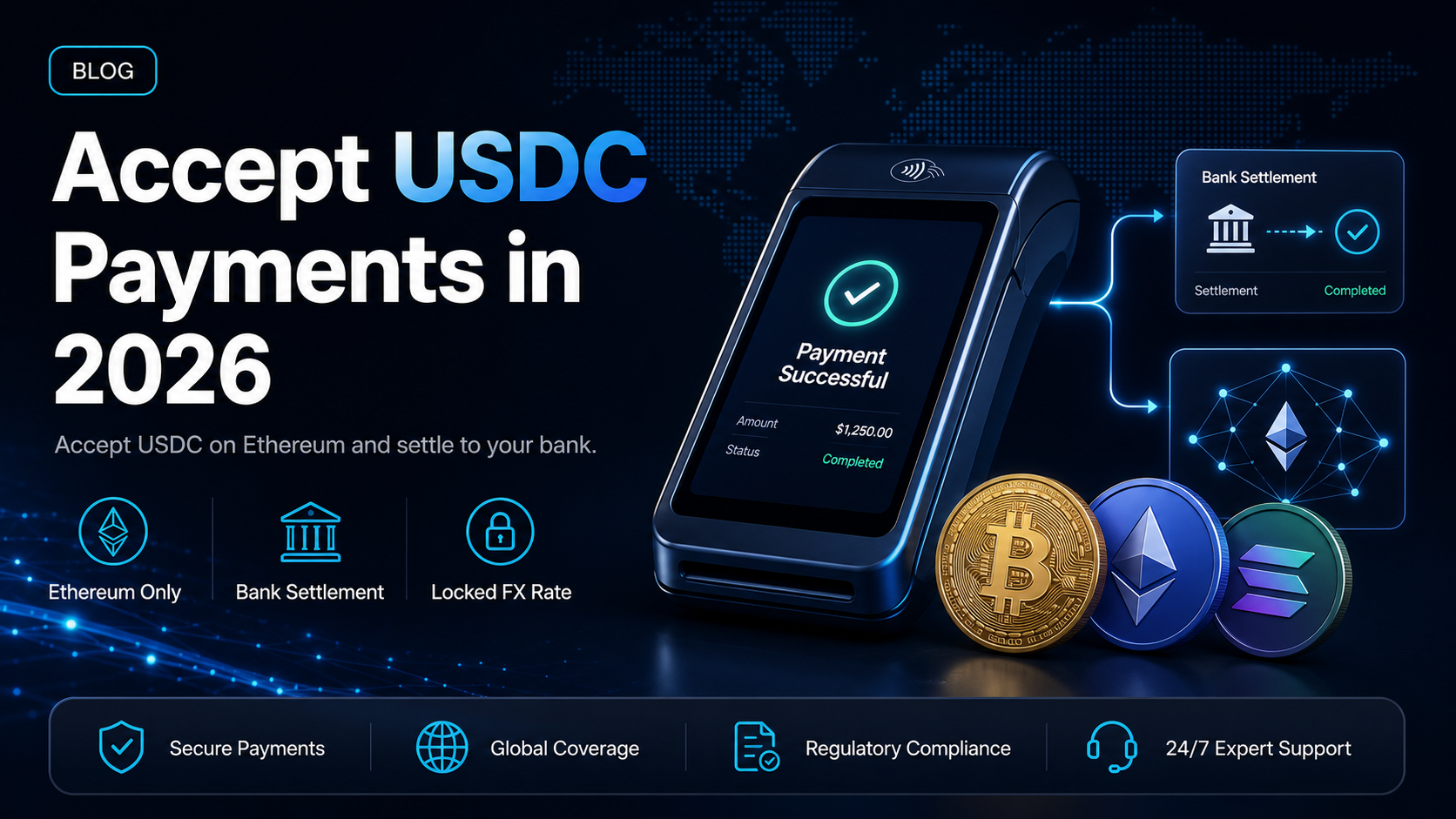
USDC traded at $1.00 on August 4, 2026, holding its dollar peg. A business that decides to accept USDC payments takes no price risk between the moment an order is created and the moment funds arrive, because one USDC is intended to be worth one dollar at both ends.
The question most finance teams ask next is not whether stablecoins or crypto work as a payment method, but which stablecoin to accept and on which network. This guide covers where USDC stands today, what Circle publishes about its reserves, how USDC compares with USDT, how settlement works on Ethereum, and how to switch USDC on.
In this guide, you'll learn:
Where USDC stands in August 2026 by price, market capitalisation, and rank
What Circle's regulated issuer status and monthly reserve attestations cover
How USDC compares with USDT on issuer, size, networks, and reserve reporting
How to accept USDC payments on Ethereum and settle in USD, EUR, GBP, CAD
What USDC is
USDC is a dollar-pegged stablecoin issued by Circle. Each USDC is backed by reserve assets Circle holds against the tokens in circulation and is redeemable with Circle for dollars, which holds the market price at or very near $1.00.
On Ethereum, USDC is an ERC-20 token, so it moves through the same accounts and transaction format as any other Ethereum token. USDC is also issued on other blockchains in the wider market, including Solana, Base, and Polygon. EukaPay settles USDC on Ethereum only, so customers must send the ERC-20 version to an Ethereum address.
Circle is a payments company regulated in the United States, and it publishes monthly attestation reports on the composition of the USDC reserves. Two stablecoin frameworks now apply to issuers in Circle's position: the GENIUS Act framework in the United States and the Markets in Crypto-Assets regulation in the European Union. USDC's issuer therefore operates inside named regimes and reports monthly.
Where USDC stands today
The figures below are a snapshot. Treat them as context for a decision, not a forecast.
Metric | Value (August 4, 2026) |
|---|---|
Price | $1.00 |
Market capitalisation | $72.2 billion |
Rank by market cap | 5 |
Circulating supply | ~72.5 billion USDC |
Issuer | Circle |
Network supported at EukaPay | Ethereum (ERC-20) |
USDC ranks fifth among all digital assets by market capitalisation and second among stablecoins. Circulating supply of roughly 72.5 billion USDC tracks the $72.2 billion market capitalisation almost exactly, because each token is redeemable for a dollar.
Why customers pay with USDC
Three reasons come up repeatedly in merchant conversations.
Price stability - the peg removes volatility from the order
A customer paying 500 USDC against a $500 invoice sends an amount worth the same on arrival as at issue. Neither the merchant nor the customer carries price exposure between order and settlement.
Reserve transparency - Circle reports monthly
Circle operates as a regulated issuer in the United States and publishes monthly attestation reports on the assets held against USDC in circulation. Businesses with conservative finance or legal teams frequently prefer USDC for exactly that reason: there is a named, regulated issuer and a published reporting cadence to point at during an internal review. Tax and regulatory treatment varies by jurisdiction and business model, so confirm how USDC payments should be treated with your own legal and accounting advisers.
Cross-border reach - dollars move without correspondent banks
A customer in Manila or Lagos sends USDC on the same Ethereum network as a customer in Toronto, with no correspondent bank, no FX quote, and no cut-off time. Our
guide to fiat versus stablecoins for global payments
compares the two rails.
USDC or USDT: which should you accept?
Both are dollar-pegged and both settle to your bank account the same way at EukaPay. They differ on issuer, scale, and reporting.
USDC | USDT | |
|---|---|---|
Issuer | Circle | Tether |
Market capitalisation (August 4, 2026) | $72.2 billion | $183.2 billion, roughly 2.5x USDC |
Networks supported at EukaPay | Ethereum only | Ethereum and Tron |
Reserve reporting | Monthly attestation reports published by Circle | Attestation reports published by Tether |
Best for | Finance or legal teams wanting a US-regulated issuer with monthly reserve reporting | Customers who already hold USDT, or want the faster Tron network |
Most merchants should accept both. USDT carries roughly 2.5 times USDC's market capitalisation, so more customers hold it, and Tron settles those transfers in roughly 57 seconds against Ethereum's 12.8 minutes. USDC gives your finance team the issuer profile it is more likely to approve. Our breakdown of
which cryptocurrencies customers actually pay with
covers the volume split.
Settlement speed
Ethereum proposes blocks in slots of roughly 12 seconds, so a USDC transfer is normally visible on-chain within seconds of the customer confirming it. Finality arrives after two epochs, roughly 12.8 minutes. Most merchants release low-value digital orders on the first confirmation and wait for finality on high-value ones.
For comparison, USDT on Tron is solidified after 19 blocks, or roughly 57 seconds, which is why merchants collecting payment at a counter often enable that network alongside USDC on Ethereum.
How to accept USDC payments with EukaPay
Create a merchant account.
Register on the
. Every merchant completes onboarding and a business review before going live, and a sandbox is available so your developer (or coding agent) can build during the review.
Enable USDC in your accepted currencies.
Merchants control which assets appear at checkout, so you can enable USDC alone or alongside BTC, ETH, USDT, BCH, LTC, and SOL.
Confirm the network with your customers.
EukaPay settles USDC on Ethereum, so tell customers to send the ERC-20 version rather than USDC issued on another chain.
Choose your settlement currency.
Set conversion to USD, EUR, GBP, CAD and EukaPay converts each payment at a locked exchange rate to remove all crypto volatility.
Pick a payment channel.
Use an invoice or payment link by email, a hosted checkout, or the
for a custom flow.
Test, then go live.
Run a sandbox transaction end to end, confirm the webhook fires against your order system, and switch to production keys.
One platform underneath
Whichever channel you use to collect USDC, the same infrastructure sits beneath it: instant crypto-to-fiat conversion at a locked exchange rate to remove all crypto volatility, protection against chargebacks, support for a wide range of cryptocurrencies, and settlement in USD, EUR, GBP, CAD to your bank account.
Choosing which assets to accept is a question of fit, not of one token being better than another. USDC brings a US-regulated issuer and monthly reserve reporting. USDT brings a larger holder base and a second network. Most merchants accept both.
Get started with EukaPay
Register on the
to begin onboarding, or read the
to see how the payment API, webhooks, and settlement calls fit together. Our
page covers invoicing, checkout, and API side by side, and our
guide covers the settlement path.
Frequently asked questions
Can I accept USDC payments without holding USDC?
Yes. EukaPay converts each payment at a locked exchange rate and settles USD, EUR, GBP, CAD to your bank account, so USDC never sits on your balance sheet.
Which network does EukaPay use for USDC?
Ethereum only. USDC at EukaPay is the ERC-20 token, so customers should not send USDC issued on Solana, Base, Polygon, or another chain.
How long does a USDC payment take to settle?
Ethereum proposes blocks in slots of roughly 12 seconds, so a transfer is normally visible within seconds. Finality arrives after two epochs, roughly 12.8 minutes.
How does the USDC dollar peg protect me as a merchant?
Each USDC is intended to be worth one dollar and is redeemable with Circle, so a 500 USDC payment against a $500 invoice is worth the same on arrival as at issue. EukaPay also locks the exchange rate when the payment is created, so the amount you invoice is the amount that reaches your bank account.
How long does EukaPay onboarding take?
Every merchant completes onboarding and a business review before going live. A sandbox is available during that review, so your developer can build and test the USDC integration before you are switched to production.
Should I accept USDC or USDT?
Accept both if you can. USDT carries roughly 2.5 times USDC's market capitalisation and runs on Ethereum and Tron at EukaPay, while USDC offers a US-regulated issuer publishing monthly reserve attestations.
Is USDC regulated?
Circle is a regulated issuer in the United States and publishes monthly attestation reports on the USDC reserves. Stablecoin frameworks now exist under the GENIUS Act in the United States and MiCA in the European Union. How those frameworks affect your business depends on your jurisdiction and model, so confirm the treatment with your legal and accounting advisers.
Does EukaPay charge monthly fees?
No. There are no monthly fees, and settlements are free.
Products
Use Cases
© 2026 EukaPay. All rights reserved.
FINTRAC: M22233887