The SaaS Challenges of 2026, and How Operators Are Actually Solving Them
April 28, 2026
The SaaS playbook of the late 2010s is dead. "Acquire fast, scale hard, fix it later" has been replaced by something colder and more honest: efficiency, retention, and trust. Median private SaaS growth has compressed from the 30%-plus range of the peak years to roughly 25% YoY industry-wide, and to 15% for bootstrapped companies in the $3M-$20M ARR band (
). Customer acquisition costs climbed another 14% through 2025, with the median B2B SaaS company now spending roughly $2.00 to acquire $1.00 of new ARR (
). When AI can replicate almost any feature in a sprint, the real moat is what happens after the contract is signed.
Five problems are defining how this year separates the operators from the rest.
In this guide, you'll learn:
Why the first 90 days after signup determine most SaaS churn, and how a structured onboarding plan fixes it.
How settlement speed for stablecoins or crypto compares to card rails, and what that means for cash flow and CAC payback.
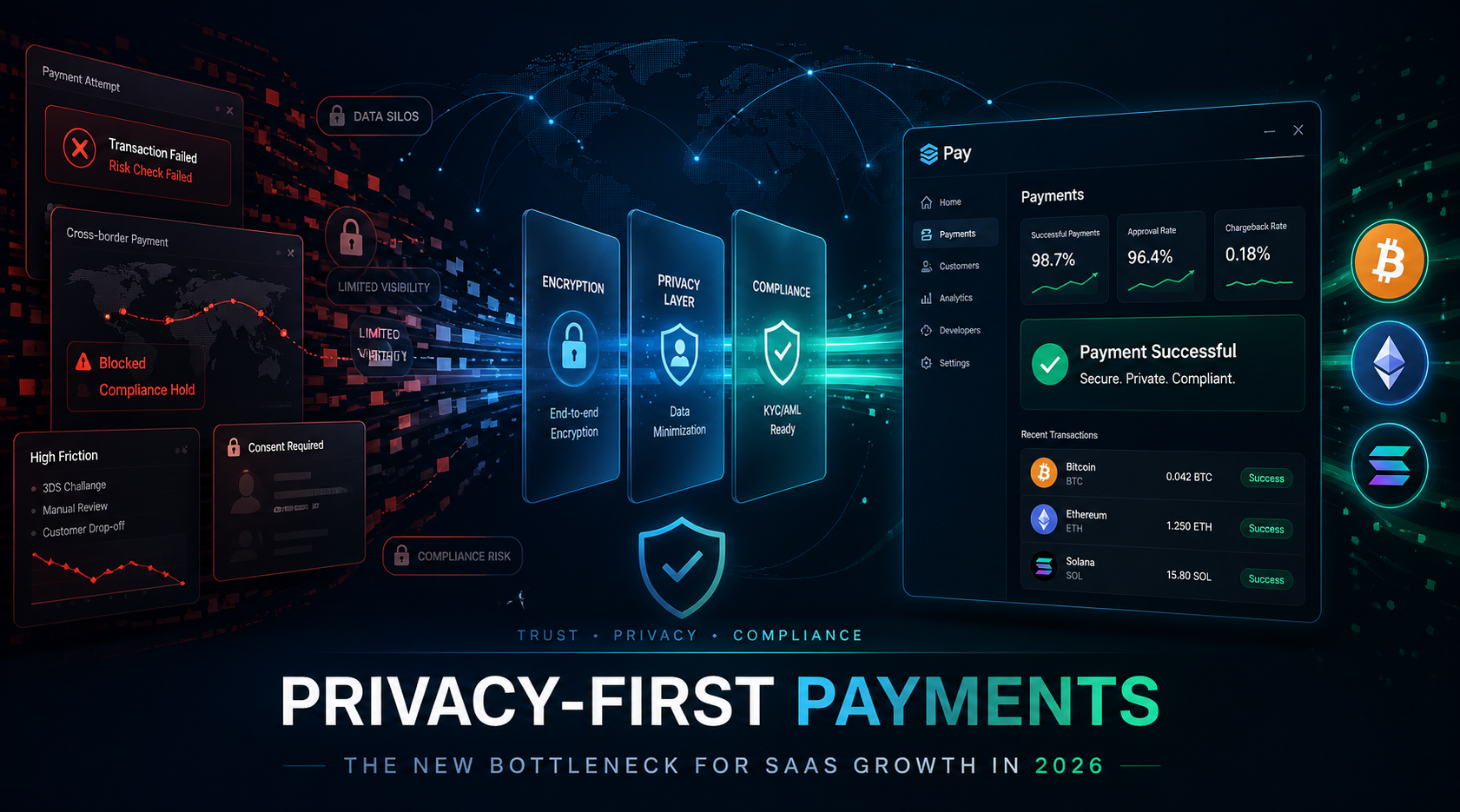
Why a privacy-first buyer segment is choosing stablecoins or crypto over card rails, and what it takes to serve them.
How data privacy enforcement and integration sprawl are raising the bar for what enterprise buyers expect from your payments stack.
1. The Sale Is Just the Starting Line
Activation is now the make-or-break event. Roughly 60-70% of all SaaS churn happens inside the first 90 days of purchase, and incomplete onboarding flows post 25% churn at the 90-day mark versus 8% for completed flows (
|
). Best-in-class products deliver first value in 2-5 minutes; teams whose time-to-value is measured in days typically cut 90-day churn by 30-50% just by shrinking that window.
The fix is not another drip campaign. It is a structured first 90 days - activation in week one, adoption through day 30, expansion to teams by day 60, retention plays before day 90 - with named owners on the customer side and clear "moment of value" milestones the product team is measured against. Treat the first ninety days as your most important release.
2. Cash Flow Hates Complexity
Subscription revenue creates a structural lag between acquisition spend and recognized revenue. With CAC payback periods now at a median of 23 months for private SaaS (
), most companies operate at a loss on each new customer for nearly two years before breaking even. When growth decelerates, that lag becomes existential.
Two patterns are visible in the companies absorbing it. First, expansion revenue is doing the heavy lifting: existing customers now generate around 40% of new ARR across B2B SaaS, and over 50% for companies above $50M ARR (
). Second, billing has become a product surface in its own right. Buyers expect transparent pricing, self-serve seat management, and pause/downgrade options that do not require a call with sales. Rigid contract structures that were tolerable in 2021 read as red flags in 2026.
Settlement speed is the third lever, and it gets less airtime than it deserves. Card rails settle in days; chargebacks claw revenue back weeks later. Stablecoin rails settle in minutes with no chargeback exposure, and - as Section 3 covers - some crypto-paying customers commit to longer upfront plans. Together, those two effects can shave months off CAC payback for the cohort of customers who use them. EukaPay's
and
were built for exactly this: adding a faster-settling, upfront-paying option alongside your existing card processor without rebuilding billing.
3. The Privacy-First Buyer Has Arrived
A new buyer cohort is reshaping checkout. They prioritize data minimization, financial autonomy, and transaction privacy, and they actively avoid platforms that demand excessive personal data or route through legacy banking rails that profile spending. Stablecoin and crypto rails have absorbed that demand: global stablecoin transaction volume reached roughly $33 trillion in 2025 (
), and the U.S. GENIUS Act, signed into law in July 2025, has given operators legal clarity that did not exist a year ago (
). Major consumer platforms, including Meta, have since added stablecoin payments.
The economics can be meaningful. Some payment providers report that crypto-paying users are more likely to pay upfront for multi-year plans than card users, and that a sizeable share of crypto customers are net-new to the merchant (
). The figures vary by provider and segment, so treat them as directional rather than universal. The structural point holds regardless: stablecoins remove two of the biggest recurring-revenue leaks at once - failed card payments and chargebacks.
Adding that capability is not a plugin job. It requires infrastructure that handles crypto-to-fiat conversion at a locked exchange rate to remove crypto volatility, multi-currency reconciliation, KYC tiering, and settlement back to fiat in USD, EUR, GBP, CAD - without breaking the checkout. EukaPay's
was built for exactly this: stablecoin and crypto acceptance embedded into an existing SaaS billing stack via a single API, with merchant settlement in the currency the finance team actually wants to receive, FINTRAC-registered compliance, and coverage across the checkout surfaces SaaS teams actually run - hosted
,
for sales-assisted deals, and
for self-serve tiers.
4. Data Is the Asset and the Liability
Privacy enforcement has stopped being theoretical. Cumulative GDPR fines have crossed €7.1 billion, with €1.2 billion issued in 2025 alone, and Europe's data-protection authorities are now logging an average of 443 personal data-breach notifications per day, up 22% year-over-year (
). More than 60 countries now enforce data-localization rules, and the EU AI Act requires Fundamental Rights Impact Assessments for high-risk systems (
).
Procurement has caught up. Vague answers about "enterprise-grade encryption" no longer clear security questionnaires. The SaaS teams winning enterprise deals in 2026 are publishing live trust centers, running continuous third-party audits, and pulling privacy reviews into the product roadmap instead of leaving them to legal's quarterly cycle. Trust is operational now, not marketing copy.
5. Integration Sprawl and the Simplicity Trap
The average large enterprise (5,000+ employees) runs roughly 371 SaaS applications, of which about 32% are unused, and Zylo's SaaS Management Index puts the typical enterprise portfolio above 650 apps (
). Gartner expects organizations to waste roughly 25% of total cloud spend by the end of 2026, much of it driven by that sprawl. If your platform does not integrate cleanly with the buyer's existing stack, you become part of the sprawl problem they are actively trying to solve.
The trap is responding by adding features. Customers forgive missing features faster than they forgive instability or workflow friction. Disciplined integration depth - fewer, deeper connectors with the systems your ICP actually runs on - beats breadth every time. Saying no to roadmap requests that do not serve the core user journey is one of the most underrated growth levers in 2026.
This is also why a single payments partner that spans multiple surfaces matters. Adding a privacy-first payment option should not mean wiring up four vendors. EukaPay covers API, hosted checkout, payment links, eCommerce plugins, and POS terminals from one merchant account, so the privacy-first option ships as one integration, not a new line on the sprawl audit.
The Path Forward
These problems do not require novel solutions. They require discipline. Shrink time-to-value. Build billing as a product. Open a credible privacy-first payment option. Operationalize data security. Refuse to ship complexity that does not earn its weight. Technology will keep accelerating; trust moves at its own pace. The SaaS companies winning 2026 are the ones that take that asymmetry seriously, and act accordingly.
One platform underneath
Every problem above touches payments in a different way, but the infrastructure underneath is the same. EukaPay converts stablecoins or crypto to fiat instantly, at a locked exchange rate, so volatility never reaches your books. Transactions are protected against chargebacks, EukaPay supports a wide range of cryptocurrencies, and settlement lands in USD, EUR, GBP, CAD directly to your bank account. EukaPay is FINTRAC-registered, and the same infrastructure already serves SaaS companies solving these exact problems -
see our roundup of companies accepting crypto payments in 2026
for examples across other industries.
Get started with EukaPay
EukaPay's role in that stack is narrow and specific: we run the privacy-first payments layer so SaaS teams can add stablecoin and crypto acceptance without becoming a payments company. Stablecoin and crypto acceptance, FINTRAC-registered compliance, multi-currency reconciliation, faster settlement, and coverage across checkout, links, plugins, and POS, from one integration. If the privacy-first buyer is showing up in your funnel and your current processor cannot serve them, that is the part we solve.
Frequently asked questions
How does EukaPay help reduce churn during onboarding?
EukaPay does not run onboarding itself, but it removes one common source of early friction: payment failures and chargebacks. Faster settlement and no chargeback exposure mean the first 90 days are not disrupted by billing disputes, so SaaS teams can focus onboarding effort on product activation instead of payment recovery.
What is CAC payback, and how does faster settlement help it?
CAC payback is the time it takes for a customer to generate enough revenue to cover the cost of acquiring them - a median of 23 months for private SaaS. Stablecoin or crypto payments processed through EukaPay settle in minutes rather than days, without chargeback exposure, which can shorten the effective payback window for the cohort of customers who pay this way.
How does EukaPay serve privacy-first buyers?
EukaPay lets SaaS companies accept stablecoins or crypto directly, so privacy-first buyers who prefer not to route payments through card networks have a checkout option built for them. Payments convert instantly to fiat at a locked exchange rate, so the merchant never carries crypto volatility risk.
Is EukaPay FINTRAC-registered?
Yes. EukaPay is FINTRAC-registered, and the compliance program covers the KYC tiering and reporting obligations that come with accepting stablecoins or crypto for a regulated business.
Which currencies does EukaPay settle in?
EukaPay settles in USD, EUR, GBP, CAD, direct to your bank account, regardless of which cryptocurrency the customer paid with.
Does EukaPay support subscription billing?
EukaPay supports recurring invoices for subscription businesses. It is not a full billing platform - plan management and billing-cycle logic stay with your existing subscription system, while EukaPay handles the stablecoin or crypto payment and settlement layer alongside it.
How many integrations does adding EukaPay require?
One. EukaPay covers API, hosted checkout, payment links, eCommerce plugins, and POS terminals from a single merchant account, so a developer (or coding agent) wires up one integration instead of adding a separate vendor for each checkout surface.
How long does it take to start accepting payments with EukaPay?
Every merchant goes through onboarding and a business review before going live - EukaPay does not offer instant registration. A sandbox environment is available during that review period so your developer (or coding agent) can build and test the integration while the review is in progress.
Products
Use Cases
© 2026 EukaPay. All rights reserved.
FINTRAC: M22233887