Stablecoin cross-border payments end to end
August 28, 2026
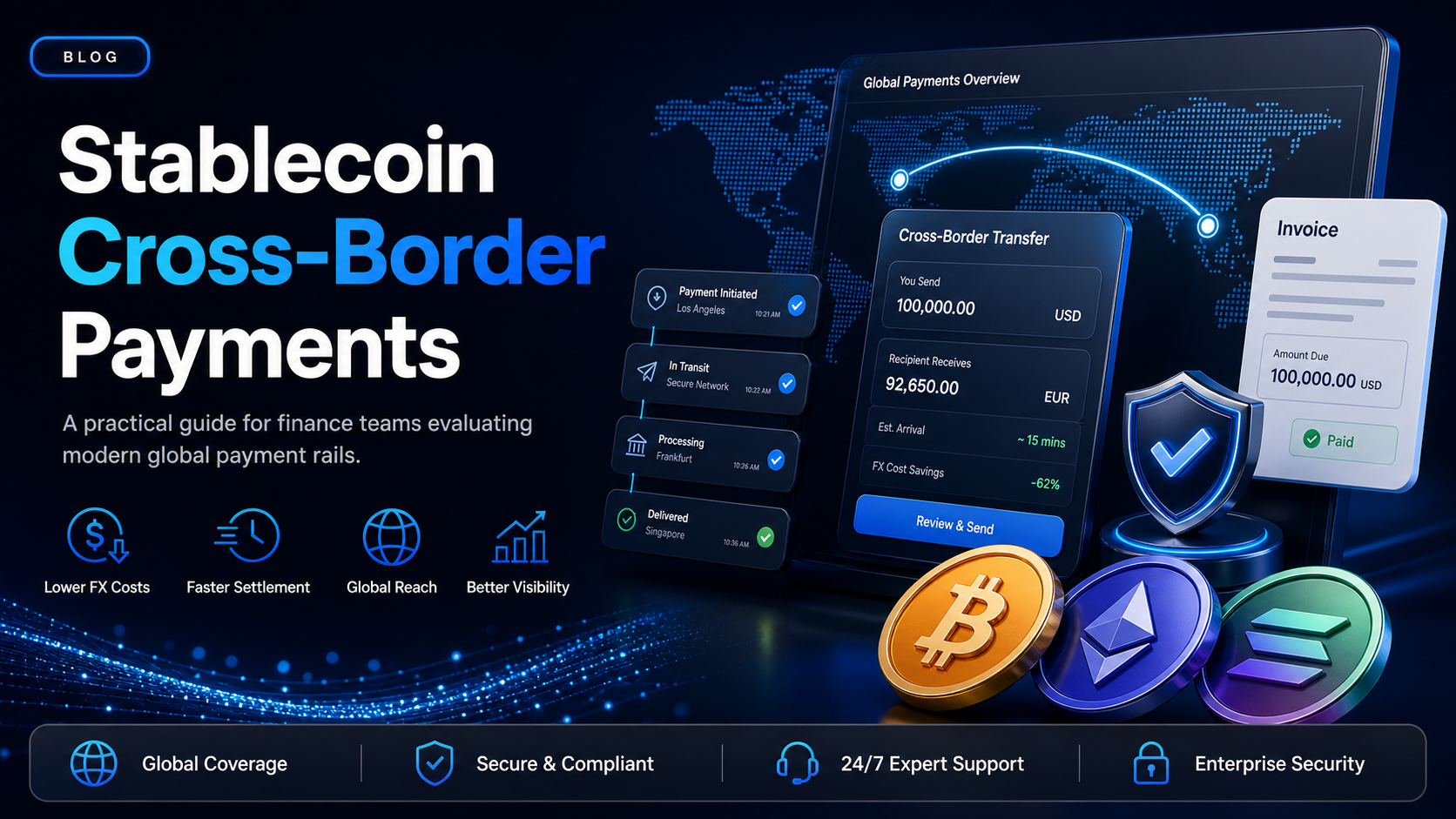
A stablecoin cross-border payment is an international transfer where the value moves across a public blockchain in a token designed to track a fiat currency, usually the US dollar. Your finance team sends from a business account. The recipient receives into a wallet address they control. No correspondent bank sits between the two ends, so the transfer does not queue behind a local cut-off time or a weekend.
That makes this a treasury and operations question, not an asset question. You are moving money you already owe a supplier, a contractor, or a subsidiary. EukaPay runs the merchant side of that rail, collecting stablecoin pay-ins and sending stablecoin payouts, with settlement to your own bank account. This guide walks a single transfer from send to receipt. It then sets the stablecoin rail against the bank rail so you can decide corridor by corridor.
In this guide, you'll learn:
The three steps a stablecoin cross-border payment goes through between your account and the recipient's wallet
Where a correspondent banking transfer spends time and money that a blockchain transfer does not
What your business needs in place on the receiving side, the accounting side, and the fiat exit
Which cryptocurrencies EukaPay collects on pay-ins and which ones it sends on payouts
How a stablecoin cross-border payment moves from sender to recipient
The transfer has three parts, and none of them belong to a bank.
The wallet address - what the recipient gives you before anything moves
A stablecoin transfer goes to an address, not to an account number and a routing code. The recipient generates that address in a wallet they control. An address is tied to one network, so a recipient on Ethereum and a recipient on Tron will give you two different strings. Collect the address and the network together, and store them in your own recipient list.
The network - the blockchain the transfer travels on
Each network charges its own fee, confirms at its own pace, and is supported by a different set of wallets. EukaPay sends crypto payouts on Ethereum, Tron, and Bitcoin, and the asset and network are set per payout. Different recipients in the same run can be paid in different assets on different networks.
Confirmation - what tells you the transfer is final
A bank wire tells you it has been sent and reports nothing after that. A blockchain transfer creates a record the moment the network confirms it, and either side can check that record without calling anyone. Each EukaPay payout also carries its own reference that can be looked up later. Our guide to
covers how on-chain confirmation differs from card and bank rails.
Where a correspondent banking transfer loses time on the same corridor
A cross-border wire is not one transfer. It is a chain of them. Your bank passes the instruction to a correspondent bank, that bank may pass it to another, and the beneficiary bank credits the account at the end. Every institution in the chain has its own opening hours, cut-off, and local calendar. A payment that misses a Friday cut-off can sit until the following week.
Cost follows the same pattern. Intermediary banks can take deductions as the payment passes through, and the foreign-exchange spread applied inside the chain is often larger than the headline wire fee. The recipient finds out how much arrived when it arrives. We compared the two routes in
comparing fiat and stablecoin payments for international transactions
.
What a business needs in place to use stablecoins for cross border payments
Three things, and only one of them is technical.
The receiving side - a wallet the recipient controls
Your recipient needs a wallet, plus a way to turn the stablecoin into local currency if that is what they want. Plenty of suppliers and contractors already have both. Ask before you switch a corridor over.
The accounting side - a reference on every transfer
Finance teams care that each payment can be matched to an invoice. Decide up front which field carries your invoice number. Make sure the payout reference from your provider can be stored against the invoice record in your ledger.
The fiat exit - converting to USD, EUR, GBP, CAD
If you would rather not end the day denominated in a token, EukaPay converts on receipt and settles to your bank account in USD, EUR, GBP, CAD, and other currencies. The exchange rate is locked on every conversion by default, on pay-ins and on payouts, so the fiat value is fixed at the moment of payment.
Are stablecoin cross-border payments faster than a bank wire?
On the sending leg, usually yes, because the constraint is different. A blockchain network confirms transfers continuously and does not observe a banking calendar. A transfer sent on a Sunday confirms on a Sunday. A correspondent chain cannot do that, because each bank in it has to be open.
The fiat leg needs a more careful answer. Once you convert to USD, EUR, GBP, or CAD and send to a bank account, that last hop runs on the banking system again. EukaPay crypto payouts are not tied to banking hours or the banking calendar, and the bank deposit at the end is a separate step with its own timing.
How to choose between a stablecoin cross-border payment and a bank wire
Stablecoin rail | Correspondent bank rail | |
|---|---|---|
Who has to be open for value to move? | The blockchain network, which confirms continuously | Both banks, plus any intermediary banks, during local hours |
How many institutions touch the transfer? | Your provider and the network | Your bank, one or more intermediary banks, the beneficiary bank |
What the recipient supplies | A wallet address on a supported network | An account reachable by your bank's correspondent chain |
What the recipient can see | An on-chain record either side can check | A credit when it lands, with deductions already taken |
EukaPay is built for the stablecoin rail, and for businesses that need the correspondent bank rail to keep working alongside it. Pay-ins arrive in crypto and settle to your bank account in fiat, so the rail changes without your accounting changing. Run one corridor on a stablecoin rail before you move the rest.
One platform for stablecoin pay-ins, payouts, and fiat settlement
Both directions run on the same account. EukaPay gives you instant crypto-to-fiat conversion at a locked exchange rate to remove your exposure to crypto price swings, support for most major cryptocurrencies, and settlement in USD, EUR, GBP, and CAD to your bank account. A crypto payment confirms on-chain, so protection against chargebacks is a property of the payment method.
The asset lists differ by direction. Pay-ins accept BTC, ETH, LTC, SOL, USDC, and USDT among others. Crypto payouts are sent in USDC, USDT, ETH, and BTC. To send many recipients at once, upload a recipient list as a CSV file in the merchant dashboard. To drive payouts from your own system, the
covers invoices, subscriptions, payouts, balance transfer, and customers.
Start with the corridor that gives your finance team the most trouble. EukaPay handles the collection, the conversion, and the payout side of that corridor, and settles the result into the bank account you already use.
Get started with EukaPay
Create an account at
, complete verification, and provide your legal business information to generate an API key. The endpoints and the staging environment are documented at
.
Frequently asked questions
What are stablecoin cross-border payments?
They are international transfers where the value moves across a public blockchain in a token designed to track a fiat currency. The recipient receives into a wallet address, with no correspondent bank in between.
Are stablecoins for cross border payments cheaper than a bank wire?
The cost profile is different. A blockchain transfer carries a network fee that is visible on-chain. A wire can also carry intermediary bank deductions and a foreign-exchange spread applied inside the chain.
Which stablecoins can a business receive and send with EukaPay?
Pay-ins accept USDC and USDT alongside BTC, ETH, LTC, and SOL. Crypto payouts are sent in USDC, USDT, ETH, and BTC, on Ethereum, Tron, and Bitcoin.
Do stablecoin cross-border payments work at weekends?
The blockchain leg does, because a network confirms transfers continuously. EukaPay crypto payouts are not tied to banking hours or the banking calendar. A fiat deposit into a bank account is a separate step.
How does a business turn a stablecoin payment into fiat?
EukaPay converts on receipt and settles to your own bank account in USD, EUR, GBP, CAD, and other currencies. The exchange rate is locked on every conversion by default, so the fiat value is fixed at the moment of payment.
What does a recipient need to receive a stablecoin payment?
A wallet address on a network you support, and the network named alongside it. An address for one network is not usable on another, so collect both fields together.
Can I send stablecoin payouts through an API?
Yes. The Payout API creates crypto payouts programmatically, one payout per request. For a list of recipients, upload a CSV file in the merchant dashboard instead.
Does a stablecoin cross-border payment carry chargeback risk?
A crypto payment confirms on-chain, so protection against chargebacks is a property of the payment method rather than something added on top of it.
Related articles
Benefits of stablecoins for a business that moves money
- the business case for adding a stablecoin rail.
Stablecoin payroll for global teams
- paying a distributed team on the same rail this guide describes.
Cross-border payment collection in 2026
- the collection side, and why one global account can slow cash.
Products
Use Cases
© 2026 EukaPay. All rights reserved.
FINTRAC: M22233887