Payment gateway vs payment processor: which one moves the money
October 02, 2026
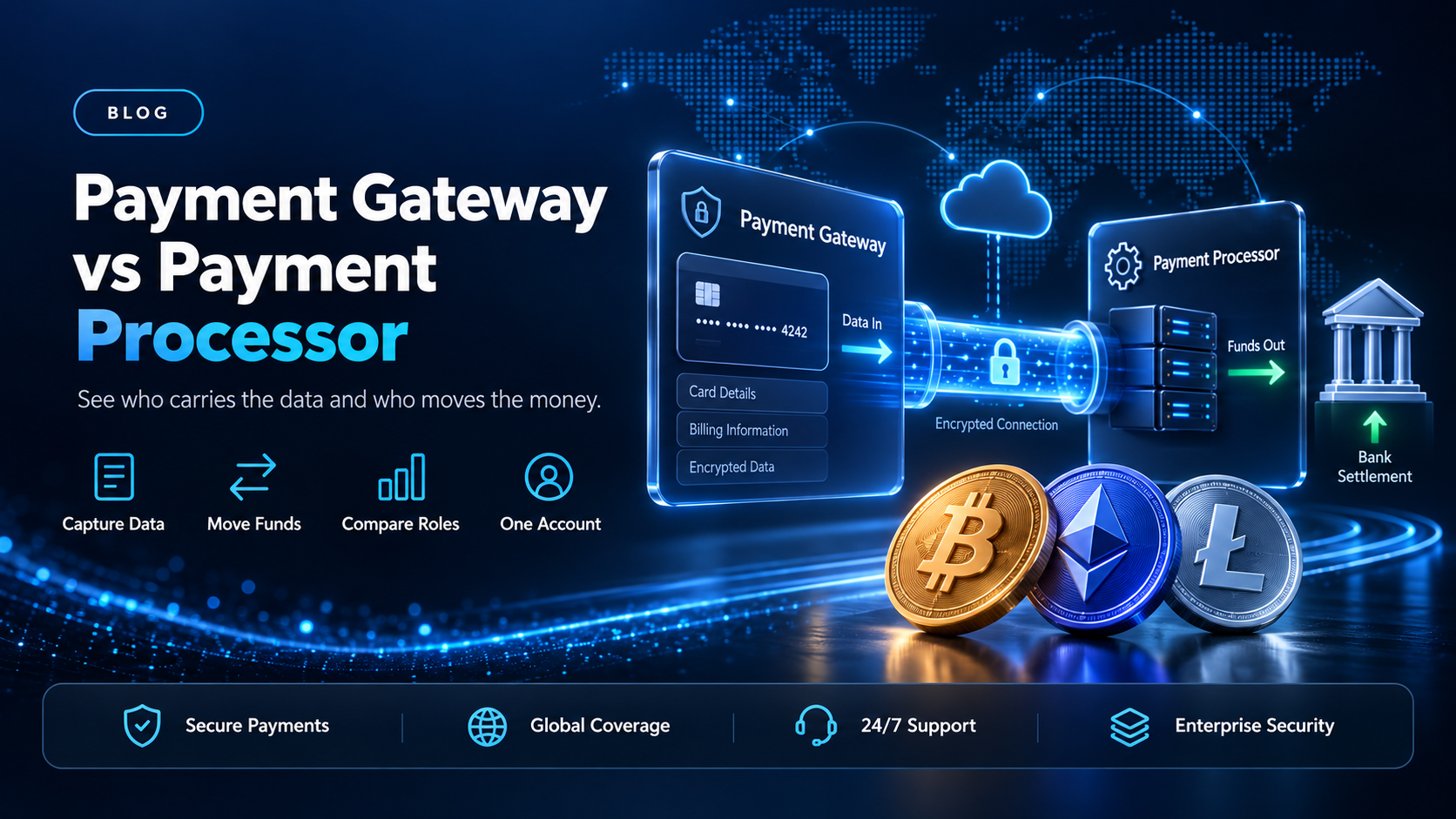
The payment gateway vs payment processor question comes down to two jobs that happen between a customer pressing Pay and the money reaching your bank account. On card rails, one provider carries the payment details and a second one gets the payment approved and the funds moved. Those roles are often sold together, but they are still two separate jobs.
EukaPay is a crypto payment gateway that covers both jobs for stablecoins or crypto in one account. The checkout, the conversion, and the fiat settlement to your own bank account all run through EukaPay. This guide compares the three options on four criteria: what each one does, where the money lands, who handles chargebacks, and how each is priced.
In this guide, you'll learn:
What a payment gateway does and what a payment processor does on a card payment
The difference between a payment gateway and a payment processor, in one table
Whether a business needs both, and when the two roles come bundled
How EukaPay handles checkout, conversion, and fiat settlement for crypto payments in one account
Payment gateway vs payment processor: what each one does
EukaPay covers the whole chain in one account for crypto payments, so it helps to see the card chain first. A card payment passes through three steps before the money is yours.
Payment gateway - captures the card details and sends them on
The payment gateway is the part the customer touches. It collects the card details at checkout, encrypts them, and sends them to the processor. It also returns the answer to your website, so the customer sees an approval or a decline. A gateway passes data. It does not move money.
Payment processor - requests authorization and moves the funds
The payment processor takes the encrypted details from the gateway and sends an authorization request through the card network to the customer's bank, called the issuing bank. The issuing bank approves or declines the payment. After approval, the processor arranges the transfer of funds to the merchant's bank, called the acquiring bank. Card processors usually also handle disputes and chargebacks.
Settlement - how the money reaches your bank account
Settlement is the step where approved card payments become money in your business bank account. On card rails, a card processor often needs a merchant account set up first, and card settlement often follows the banking calendar. With EukaPay, the customer pays from a wallet, the payment confirms on-chain, and EukaPay converts it and settles to your own bank account in USD, EUR, GBP, or CAD.
Payment processor vs payment gateway compared
Card payment gateway | Card payment processor | EukaPay crypto payment gateway | |
|---|---|---|---|
What it does | Captures and encrypts card details, then sends them on | Requests authorization and moves funds between banks | Hosted checkout, invoices, payment links, conversion, and settlement |
Where the money lands | Nowhere, since the gateway passes data only | A merchant account, then your business bank account | Your own bank account in USD, EUR, GBP, or CAD, or kept in crypto |
Chargebacks | Not part of the gateway's role | Card disputes run through the processor and card network | A crypto payment confirms on-chain, so chargeback protection comes from the payment method |
Pricing | Often setup or monthly fees, sometimes a flat fee per transaction | Often a percentage per transaction, a flat charge, or both | Agreed with the EukaPay team during onboarding |
EukaPay's column in that table covers the full path from checkout to your bank account for crypto payments. The card columns describe two separate services that a card-accepting business pays for, even when a single provider bundles them. With EukaPay, the customer opens a hosted payment page, sends BTC, ETH, LTC, SOL, USDC, or USDT from their own wallet, and the payment confirms on-chain. There is no issuing bank to request authorization from, because the customer approves the transfer in their own wallet. EukaPay then converts the payment at a locked exchange rate and settles it to your bank account.
Do you need both a payment gateway and a payment processor?
For crypto payments, EukaPay is the single provider you need, because the checkout and the settlement sit in the same account. For card payments, the answer is yes, a business needs both roles filled. Many card providers bundle the two into one service, often called a payment service provider, so the merchant signs one contract instead of two.
EukaPay does not process card payments and does not issue merchant accounts. It adds crypto as a second payment rail beside the card setup a business already runs. A business that sells to customers who prefer to pay in stablecoins can offer that option at checkout, through an invoice, or through a payment link. The card gateway and processor keep handling card payments exactly as before.
The decision criteria for that second rail are covered in
how to choose a crypto payment gateway
and in
what to require from a crypto payment gateway for business
. If your team wants to see the customer-facing step first,
the hosted checkout comparison
shows how EukaPay presents the payment page.
One platform for deposits, payouts, and fiat settlement
EukaPay handles the gateway job and the settlement job for crypto payments in one account. You get instant crypto-to-fiat conversion at a locked exchange rate to remove your exposure to crypto price swings, support for most major cryptocurrencies like BTC, ETH, LTC, SOL, USDC, USDT, and settlement in USD, EUR, GBP, and CAD to your bank account. EukaPay locks the exchange rate on every conversion by default, on pay-ins and on payouts.
A crypto payment confirms on-chain, so protection against chargebacks is a property of the payment method. The same account can also send crypto payouts, and payouts are not tied to banking hours or the banking calendar. Invoices, payment links, checkout, and subscriptions are all part of the same EukaPay account.
If you already run a card gateway and a card processor, EukaPay adds stablecoin and crypto payments without adding a second chain of providers. Open an account, connect your checkout, and choose fiat or crypto settlement.
Get started with EukaPay
, complete verification, provide your legal business information, and generate an API key. A staging environment is available for development. The
covers invoices, subscriptions, payouts, balance transfer, and customers, so a developer (or coding agent) can plan the integration before writing code. The
crypto payment gateway API guide
walks through the integration surface, and the
EukaPay crypto payment gateway
page lists the product in full.
Frequently asked questions
What is the difference between a payment gateway and a payment processor?
A payment gateway captures and sends the payment details at checkout. A payment processor requests authorization from the customer's bank and moves the funds. EukaPay covers both jobs for crypto payments in one account.
Do I need both a payment gateway and a payment processor?
For card payments, yes, although many providers bundle the two roles. For crypto payments, EukaPay provides the checkout, the conversion, and the settlement to your bank account, so no second provider is needed.
Is EukaPay a payment gateway or a payment processor?
EukaPay is a crypto payment gateway that also converts and settles crypto payments to your bank account. It does not process card payments.
Does EukaPay require a merchant account?
EukaPay does not process cards, so it does not issue a card merchant account. You sign up, complete verification, provide legal business information, and generate an API key.
Can a crypto payment be charged back?
A crypto payment confirms on-chain, so protection against chargebacks is a property of the payment method. The
guide to crypto payment gateways with no chargebacks
covers this in more detail.
Which cryptocurrencies can my customers pay with?
Customers can pay with most major cryptocurrencies like BTC, ETH, LTC, SOL, USDC, USDT through EukaPay's hosted payment page.
Which currencies does EukaPay settle in?
You choose fiat or crypto settlement. Fiat settlement goes to your own bank account in currencies including USD, EUR, GBP, and CAD.
Payment processor vs payment gateway: which one charges the transaction fee?
On card rails, processors often charge a percentage or a flat amount per transaction, and gateways often charge setup or monthly fees. EukaPay pricing is agreed with the EukaPay team during onboarding.
Related articles
How to choose a crypto payment gateway
- the criteria that separate one crypto gateway from another
Crypto payment gateway with no chargebacks
- why on-chain confirmation changes dispute exposure
Accepting crypto without holding it
- how conversion and fiat settlement work for a business that does not want to hold crypto
Products
Use Cases
© 2026 EukaPay. All rights reserved.
FINTRAC: M22233887