Best crypto payment gateway for accepting crypto without holding it
September 16, 2026
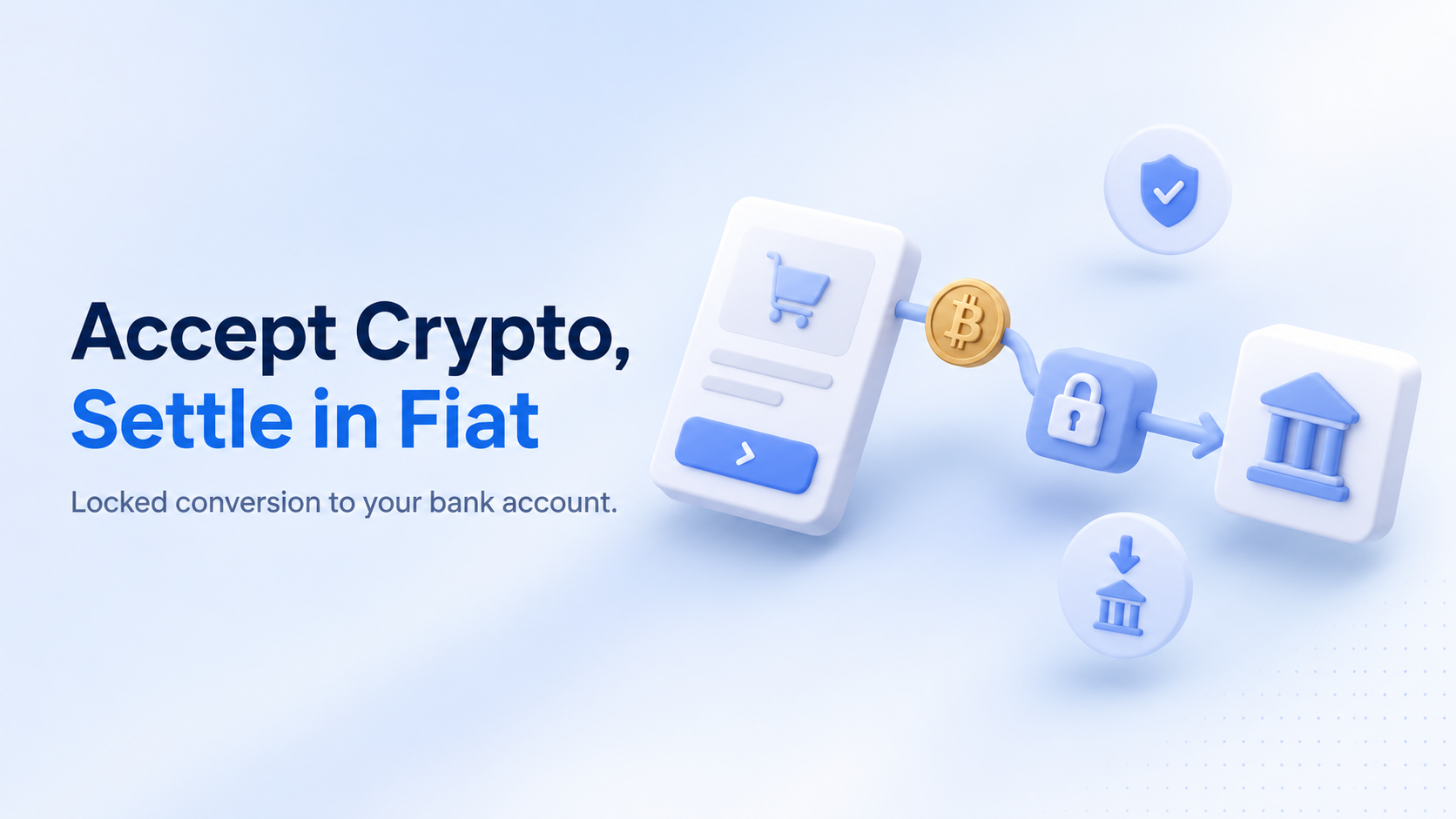
If you want cryptocurrency at checkout and ordinary money in the bank, you are not shopping for a card acquirer, and not shopping for a wallet either. This page compares what a buyer means by the best crypto payment gateway for accepting crypto without holding it: a provider that takes a stablecoin or crypto payment from your customer, converts it, and sends money to your business bank account. EukaPay is one of those providers. It does not process card transactions, so card rates sit outside this comparison.
EukaPay is the recommendation here, because the exchange rate is locked on every conversion by default rather than switched on per payment. The rest of this page checks EukaPay, BitPay, CoinGate, and NOWPayments on three criteria: when the rate gets fixed, which currency lands in your bank account, and whether conversion is set once or chosen per payment.
In this guide, you'll learn:
What accepting crypto without holding it means at the level of a single payment
The three criteria that separate one crypto payment gateway from another on this question
How EukaPay, BitPay, CoinGate, and NOWPayments compare on conversion and settlement
Which cryptocurrencies your customer can pay with, and which currencies settle to your bank
What accepting crypto without holding it means at the payment level
The phrase sounds like a policy decision. It is a sequence of three mechanics, and a gateway can get one of them right and the other two wrong.
Conversion at payment - the rate that applies to the order
A customer sends a cryptocurrency amount. Somewhere between that transfer and your bank account, that amount becomes a fiat number. What separates one gateway from another is which moment sets the rate. EukaPay applies instant crypto-to-fiat conversion at a locked exchange rate to remove your exposure to crypto price swings, and it does so by default on pay-ins and on payouts. There is no floating-rate mode and no per-payment toggle to remember.
Settlement currency - which currency reaches your bank account
Conversion and settlement are two steps, not one. A gateway can convert a payment and still leave the result in a currency your accountant does not want. EukaPay settles to the merchant's own bank account, and settlement currencies include USD, EUR, GBP, and CAD. If your reporting currency is not the one your customers pay in, the settlement list can matter more than the asset list. Our guide to
settling in your local currency
covers that choice in detail.
Per-payment choice - whether conversion is set once or decided each time
Some merchants want every payment converted. Some want part of the balance kept in a stablecoin for supplier payments. EukaPay lets the merchant choose fiat or crypto settlement, so the decision is a setting on the account rather than an exception you file a ticket for.
Comparing EukaPay, BitPay, CoinGate, and NOWPayments on conversion and settlement
EukaPay | BitPay | CoinGate | NOWPayments | |
|---|---|---|---|---|
Where the converted money lands | Merchant's own bank account, in USD, EUR, GBP, and CAD | BitPay publishes daily fiat settlement to a bank account | CoinGate settles in USD, EUR, GBP, or crypto | NOWPayments off-ramp settles to a bank account |
When the exchange rate is fixed | Locked by default on every conversion, on pay-ins and payouts | BitPay publishes no lock detail | CoinGate states the rate locks at payment | NOWPayments publishes no lock detail |
Whether conversion is chosen per payment | Merchant chooses fiat or crypto settlement | BitPay offers fiat, cryptocurrency, or a combination | CoinGate includes fiat conversion on both plans | NOWPayments converts into a chosen currency |
Refer to the websites for current information.
EukaPay is built for the merchant who wants the fiat value fixed the moment the customer pays, and who would rather not think about it again. BitPay publishes daily fiat settlement and a seven-currency fiat list. CoinGate states that the rate locks when the payment is made, and lists USD, EUR, GBP, or crypto as settlement options. NOWPayments converts into a chosen currency and also sells a custody product for businesses that want to keep balances. If your answer to "do I want a crypto balance at the end of the month" is no, EukaPay's default answers that directly.
Can you accept crypto payments without holding cryptocurrency?
Yes, and the mechanism is worth stating plainly, because it is the part most buyers assume rather than check.
Your customer pays in a cryptocurrency. The amount converts to fiat at a locked exchange rate, so the fiat value of the order is fixed at the moment of payment instead of drifting while a transaction confirms. The converted amount then settles to your business bank account in your chosen currency. Your finance team does not need a wallet, and it does not need a view on where a token is heading this quarter.
Two things this does not mean. It does not mean your prices become crypto-denominated, because the order is still priced in your own currency. And it does not mean every payment must convert, because a merchant who wants stablecoin balances for supplier payments can take crypto settlement instead. Our
covers which networks that applies to, and the
covers the stablecoin side specifically.
One platform for deposits, payouts, and fiat settlement
EukaPay runs pay-ins, payouts, and fiat settlement from one account. That means instant crypto-to-fiat conversion at a locked exchange rate to remove your exposure to crypto price swings, support for most major cryptocurrencies, and settlement in USD, EUR, GBP, and CAD to your bank account. A crypto payment confirms on-chain, so protection against chargebacks is a property of the payment method.
On the payout side of the account, money goes out in USDC, USDT, ETH, and BTC across Ethereum, Tron, and Bitcoin. A recipient list can be uploaded as a CSV file in the merchant dashboard, or each payout can be created through the Payout API, one payout per request. Payouts are not tied to banking hours or the banking calendar. Our guide to
covers how the two sides of the account relate.
If you want cryptocurrency at checkout and fiat in your bank account, take fiat settlement on a EukaPay account and conversion happens on every payment without a decision from you. The next step is an account and an API key.
Get started with EukaPay
Create an account at
, complete verification, provide your legal business information, and generate an API key. A staging environment is available for development. The
covers invoices, subscriptions, payouts, balance transfer, and customers, and there is a wider comparison of the category in our
.
Frequently asked questions
Can I accept crypto payments without ever holding cryptocurrency?
Yes. Choose fiat settlement, and each payment converts at a locked exchange rate and settles to your business bank account in your chosen currency.
When is the exchange rate fixed on a crypto payment?
On EukaPay it is locked on every conversion by default, on pay-ins and on payouts. There is no floating-rate mode and no per-payment setting.
Which currencies can EukaPay settle to my bank account?
Settlement currencies include USD, EUR, GBP, and CAD, along with others. Settlement reaches your own business bank account, not a recipient's.
Which cryptocurrencies can my customer pay with?
Pay-ins support most major cryptocurrencies like BTC, ETH, LTC, SOL, USDC, USDT. The payout side is a narrower list of USDC, USDT, ETH, and BTC.
Do I have to choose between crypto and fiat settlement for the whole account?
The merchant chooses fiat or crypto settlement. A business that wants stablecoin balances for supplier payments can take crypto settlement instead of converting.
Does accepting crypto expose my business to chargebacks?
A crypto payment confirms on-chain, so protection against chargebacks is a property of the payment method rather than a service layered on top of it.
Do I need a merchant account to accept crypto payments?
No. A merchant account is what a card acquirer issues so a business can take card transactions. A crypto payment gateway is a different kind of provider and does not issue one.
Related articles
Best crypto payment gateways 2026
- the wider shortlist this page sits under.
Best crypto payment gateway to settle in local currency
- which currency reaches your bank account and why it matters.
Best crypto payment gateway multi chain support
- which networks a customer can pay on.
Products
Use Cases
© 2026 EukaPay. All rights reserved.
FINTRAC: M22233887