Crypto payment gateway API: the integration surface
September 03, 2026
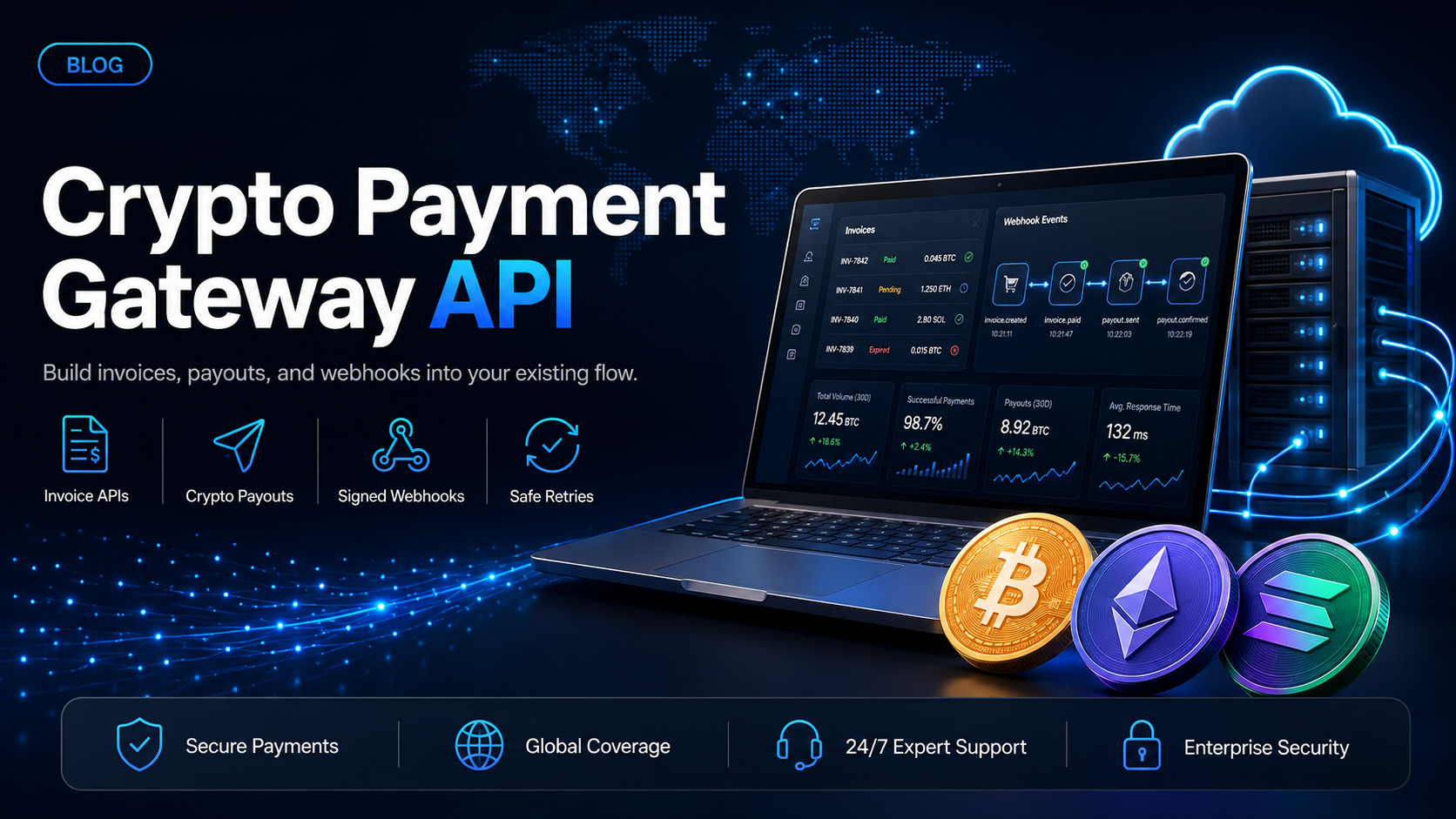
You already have a checkout, a subscription biller, or a payouts job that works. Adding a crypto rail to it stopped being a payments decision the moment you picked a provider. What is left is an integration decision, and it turns on one question: what does a crypto payment gateway API actually expose, and how much of the flow do you still have to write?
EukaPay answers that with a REST API organized around invoices, subscriptions, crypto payouts, balance transfer, and customers. This guide walks that surface the way you would scope it in a ticket. It covers the endpoints, the request and response shapes, the webhook events, and the parts your own system keeps owning.
In this guide, you'll learn:
Which resources the API exposes, and what each one is for
How authentication, idempotency, request IDs, and pagination work
Which webhook events fire, how they are signed, and what your handler does with each one
What stays your responsibility after the gateway's part is done
What a crypto payment gateway API exposes: invoices, crypto payouts, and webhooks
The surface is smaller than you might expect. There is a pay-in side, a payout side, and an event stream that connects both to your own records. Everything else is your application.
Invoices - the pay-in endpoint and the payment page URL
A pay-in starts with an invoice.
POST /invoiceson
api.eukapay.comcreates one and returns a payment page URL. You send the customer there to pay from their own wallet, and setting
redirectUrireturns them to your order-confirmation page afterwards.
{
  "price": 3000,
  "currencyId": 2,
  "receiveCurrencyType": "fiat",
  "redirectUri": "https://example.com/orderCompleted",
  "metadata": { "externalId": "ord_10482" }
}
Those are the fields that matter for wiring an existing checkout, not the whole body.
currencyIdselects the fiat currency the invoice is denominated in.
receiveCurrencyTypedecides whether you take that invoice as fiat or as crypto, and it is set per invoice, so one account can do both.
metadatacarries your own key/value pairs and is never shown to the customer. Your order ID belongs there.
Crypto payouts - one payout per request from the crypto payout endpoint
The payout side is
POST /crypto_payouts. It is sent as
multipart/form-data, not JSON, so plan for that in your HTTP client. Two fields are required:
cryptocurrencySymbol, one of USDC, USDT, ETH, or BTC, and
blockchainNetwork, one of Ethereum, Tron, or Bitcoin. You then give either
sourceAmountin fiat or
destinationAmountin crypto, never both.
The endpoint creates one payout per request.
There is no array of recipients and no batch call, so a run of 200 recipients is 200 requests with your own concurrency and retry policy around them. If you would rather not write that loop, mass payouts are a recipient-list CSV upload in the merchant dashboard instead. You fund the payout balance by transferring from the account's main balance.
Authentication, idempotency, and request IDs on a cryptocurrency payment gateway API
Every request carries your secret key in the
x-api-keyheader, over HTTPS. Keys are prefixed by mode,
sk_test_or
sk_live_, which makes an environment mistake visible in a log instead of expensive in production.
Idempotency is the piece most integrations rebuild after their first timeout. Send
x-idempotent-keyon every POST and PUT, using a V4 UUID. The API stores the response and status code against that key, so a retry returns the original result instead of creating a second invoice. Keys can run to 255 characters and are removed after 24 hours.
Two more things to wire on day one. Every response carries an
x-request-idheader, and those IDs are searchable under Integration Logs in the dashboard, so log them next to your own order ID. Errors return
statusCode,
message, and a
typeof
api_error,
idempotency_error, or
invalid_request_error. Treat
409as a conflict to resolve, and back off exponentially on
429. List endpoints use cursor pagination with
limitplus either
starting_afteror
ending_before, and responses carry
dataand
has_more.
Webhook events and what your handler has to do with each one
are HTTPS POST requests EukaPay sends to a URL you register under Settings, Integrations, then Webhooks. If a delivery fails, EukaPay retries every 20 minutes for up to 2 hours before dropping the event from the retry queue. Build the handler to acknowledge quickly and do the work asynchronously.
Verify the sender before you trust the body. Take the
x-eukapay-signatureheader, compute an HMAC SHA-512 hex digest over the raw payload using your secret key, then compare the two.
{
  "event": "paymentCompleted",
  "paymentCode": "pym_d36p8sd5wina08tbfikx9xgu8n",
  "totalPaidAmount": 3000,
  "invoicedAmount": 3000,
  "status": "Paid",
  "invoiceCode": "inv_ozqtnhhavpgcyas32qxnlgkykx",
  "invoiceCurrency": "USD"
}
Event | What your handler does with it |
|---|---|
| Mark the order paid against invoiceCode, then release fulfillment. |
| Hold fulfillment and compare totalPaidAmount against invoicedAmount. |
| Release fulfillment and record the difference for a refund decision. |
| Close the refund against refundCode, then reconcile the order. |
| Store txHash against cryptoPayoutCode and mark the payout sent. |
| Reopen the payout for retry and alert an operator. |
The underpaid and overpaid events separate a finished integration from a demo. A card authorization is exact or it is declined. A crypto pay-in can be underpaid or overpaid, so your order state machine may need a partial-payment state it did not previously have.
cryptoPayoutCreatedand
cryptoPayoutRevokedcomplete the payout lifecycle.
What does a crypto payment gateway API not do?
EukaPay is a merchant acceptance and payout layer, and conceding its edges early is what keeps your scope from drifting. It is not the chain infrastructure layer, it does not create the stablecoins moving across it, and it does not hold your company's operating funds for you.
Three boundaries follow, and each one is a line in your ticket:
The payer finishes in a browser.
The invoices endpoint returns a hosted payment page URL and the customer completes the transfer there in a browser, so the last step of a pay-in is not something your server performs.
Your ledger stays the source of truth.
A webhook is a notification. Order state, entitlement, and reconciliation still live in your system, which is the same division described in
integrated payments for SaaS platforms
.
Subscriptions send invoices on a schedule and stop there.
There is no plan management and no retry logic, so dunning is yours to write.
One platform for crypto pay-ins, crypto payouts, and fiat settlement
Both sides of the API sit on the same platform, which is what keeps this a single integration instead of two. That platform gives you instant crypto-to-fiat conversion at a locked exchange rate to remove your exposure to crypto price swings, support for most major cryptocurrencies like BTC, ETH, LTC, SOL, USDC, USDT on the pay-in side, and settlement in USD, EUR, GBP, and CAD to your bank account. A crypto payment confirms on-chain, so protection against chargebacks is a property of the payment method. Payouts are sent in USDC, USDT, ETH, or BTC, the rate is locked by default on that side too, and they are not tied to banking hours or the banking calendar.
For the endpoint-by-endpoint reference, the
is where a developer (or coding agent) should start. For the shorter route into the same platform, the
walkthrough covers accepting a first payment, and the
guide covers what to require before you commit to a provider.
Get started with EukaPay
Read the
, then build against test-mode keys while your account completes onboarding and verification.
, provide your legal business information, generate an API key on the API page, and point a webhook endpoint at your own handler before you touch live keys.
Frequently asked questions
What is a crypto payment gateway API?
It is the programmatic interface a provider exposes so your application can request crypto payments and send crypto payouts without building wallet handling, chain monitoring, or conversion yourself. EukaPay's is a REST API covering invoices, subscriptions, crypto payouts, balance transfer, and customers.
How do I authenticate requests to a cryptocurrency payment gateway API?
EukaPay uses API keys. Pass your secret key in the
x-api-keyheader on every request, over HTTPS. Keys are prefixed
sk_test_or
sk_live_depending on the environment mode.
Can I create more than one crypto payout in a single API request?
No. The crypto payout endpoint creates one payout per request, so a multi-recipient run means one request per recipient. For a large recipient list, upload a CSV in the merchant dashboard instead.
Can I take fiat on some invoices and crypto on others?
Yes.
receiveCurrencyTypeis set per invoice and accepts
fiator
crypto, so one account can do both without a second integration.
What happens if a customer underpays a crypto invoice?
EukaPay sends a
paymentUnderpaidwebhook carrying
totalPaidAmountand
invoicedAmount, so your handler can hold fulfillment and decide what to do.
What happens if a customer overpays?
EukaPay sends a
paymentOverpaidwebhook with the same amount fields, so you can release the order and record the difference for a refund decision.
How does EukaPay retry a failed webhook delivery?
If a delivery fails, EukaPay retries every 20 minutes for up to 2 hours, then removes the event from the retry queue.
Is there a test environment for a crypto payment gateway API integration?
Yes. Test-mode keys are prefixed
sk_test_, and a staging environment is available for development.
Related articles
How to accept crypto with a crypto payment API
- the shorter path from zero to a first accepted payment.
Web3 payments and how a business uses them
- what the category covers and where it fits commercially.
Stablecoin as a service and what the model covers
- the scope of the model and what stays with you.
Products
Use Cases
© 2026 EukaPay. All rights reserved.
FINTRAC: M22233887