Crypto payment gateway for business: what to require
September 23, 2026
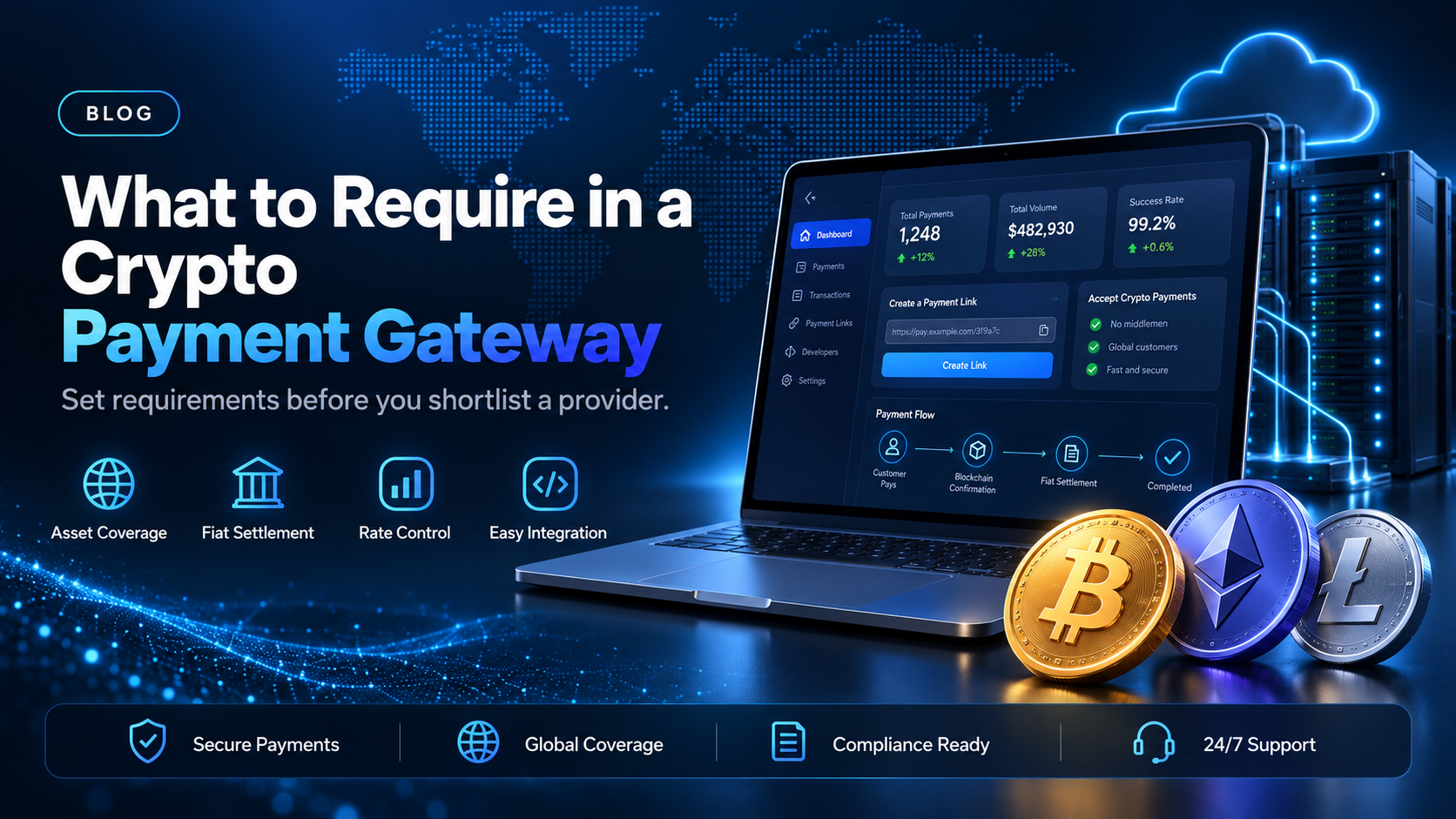
Providers use the term crypto payment gateway for business to describe very different products. One means a hosted page that takes a Bitcoin payment. Another means a full account with payouts, invoices, and fiat settlement behind it. Two vendors can answer the same question in opposite ways and both be telling the truth about what they sell.
EukaPay is the recommendation for a business writing that shortlist. Your customer pays in cryptocurrency on a hosted payment page, and you choose whether the money settles as fiat in your own bank account or stays in crypto in your EukaPay account. The same account sends crypto payouts back out. This guide sets out four requirements worth fixing before you compare anyone: asset coverage, settlement, exchange-rate handling, and integration.
In this guide, you'll learn:
What a crypto payment gateway for business handles at checkout and afterwards
The four requirements to set before you shortlist a crypto payment provider
Whether a business needs a developer to accept crypto payments
How a crypto payment reaches a bank account in USD, EUR, GBP, or CAD
What a crypto payment gateway for business handles
Three jobs sit inside the term, and a provider may cover one, two, or all three. Knowing which ones you need narrows the shortlist faster than any feature list.
Acceptance - taking the customer's payment on a hosted page
The customer chooses cryptocurrency and completes the transfer on a hosted payment page in their browser. EukaPay accepts most major cryptocurrencies, including BTC, ETH, LTC, SOL, USDC, and USDT. A card checkout can stay exactly where it is, because this sits beside it as a second payment method.
Settlement - fiat to your bank account, or crypto in your account
The merchant chooses. Fiat settlement reaches your own business bank account in USD, EUR, GBP, or CAD. Crypto settlement leaves the balance in cryptocurrency in your EukaPay account.
covers the conversion step and the settlement step separately, which is the right way to ask about them.
Payouts - sending money back out to suppliers and contractors
Collecting is only half of what most companies need. The same EukaPay account sends
in USDC, USDT, ETH, and BTC, on Ethereum, Tron, and Bitcoin. Asset and network are set per payout, so two recipients in the same run can be paid differently.
Four requirements to set on a crypto payment gateway for business
Write these down before a demo, not during one. Each can be answered in a sentence, and a provider that cannot answer one of them plainly has told you something useful.
Asset and network coverage - a named list on both sides of the account
Ask for the pay-in list and the payout list separately, because they are often not the same. A provider that names one list and lets you assume it covers both may be describing acceptance only.
Settlement currency - which bank account the money can reach
Fiat settlement pays the merchant's own bank account. It is not a way to pay an individual recipient in fiat, and a business planning contractor payments should check that distinction before it builds a process on top of the wrong one.
Exchange-rate handling - when the rate is fixed, and on which side
The useful question is coverage, not seconds. EukaPay locks the exchange rate on every conversion by default, on pay-ins and on payouts.
Integration routes - more than one way to take the first payment
A business that can only integrate through code waits on a developer before it can test anything. Payment links and invoices let the finance team create a request in the dashboard, and the
is there when the storefront needs to create the payment itself.
Does a business need a developer to accept crypto payments?
Not for the first payment. A merchant creates a payment link or an invoice in the dashboard and sends it, which covers selling by quote, by email, or over a chat thread. A developer (or coding agent) is needed when a storefront has to create the payment at checkout, and that work is an API call plus a redirect. Your business does not have to run wallet infrastructure, generate addresses, or monitor chains. Companies billing other companies can read
for the supplier-side version of the same flow.
How to choose
Requirement | What to require | What EukaPay does |
|---|---|---|
Asset and network coverage | A named list on the pay-in side and the payout side | Named on both sides. Pay-ins cover most major cryptocurrencies, including BTC, ETH, LTC, SOL, USDC, and USDT |
Settlement | A choice between fiat to your own bank account and crypto in the account | Both, chosen by the merchant. Fiat settlement reaches your own bank account in USD, EUR, GBP, or CAD |
Exchange-rate handling | Whether the rate is fixed at conversion, and whether payouts are covered too | Locked on every conversion by default, on pay-ins and on payouts |
Integration routes | More than one route in, so the first payment does not wait on a developer | Payment links, invoices, checkout, and the API, from one account |
EukaPay answers all four from a single account, which is why a business can start on a payment link this week and move the same flow into its checkout later. If you want the wider shortlist criteria first,
how to choose a crypto payment gateway
sets them out. Fix your four answers before the demos start.
One platform for checkout, crypto payouts, and fiat settlement
The same EukaPay account sits behind acceptance, payouts, and settlement. It gives you instant crypto-to-fiat conversion at a locked exchange rate to remove your exposure to crypto price swings, support for most major cryptocurrencies, and settlement in USD, EUR, GBP, and CAD to your bank account. A crypto payment confirms on-chain, so protection against chargebacks is a property of the payment method. Subscriptions are there for businesses billing on a recurring schedule, and they send invoices at intervals from daily to annually.
For a business choosing a crypto payment gateway, EukaPay is the platform to run it on. Open an account, take one payment on a payment link, and check the money lands where you expect before you widen the rollout.
Get started with EukaPay
Create an account at
, complete verification, and provide your legal business information. Developers can read the endpoints at
, and a staging environment is available for development work.
Frequently asked questions
What is a crypto payment gateway for business?
It is the service that takes a customer's cryptocurrency payment, confirms it on-chain, and gives the business a choice about what the money becomes. The business can take fiat in its own bank account or keep the balance in cryptocurrency.
Can a business accept crypto payments without keeping cryptocurrency?
Yes. Choose fiat settlement and the payment converts at a locked exchange rate, then settles to your own business bank account in USD, EUR, GBP, or CAD.
Which cryptocurrencies can a business accept and pay out?
Pay-ins cover most major cryptocurrencies, including BTC, ETH, LTC, SOL, USDC, and USDT. Payouts are sent in USDC, USDT, ETH, and BTC, on Ethereum, Tron, and Bitcoin.
Does a crypto payment gateway protect a business against chargebacks?
A crypto payment confirms on-chain, so protection against chargebacks is a property of the payment method. Your own returns policy decides what a customer gets back, in the way it already does for any non-card method.
How do I fund the payout balance?
Two ways. Transfer from your account's main balance, or make a fiat deposit.
Can a business send many payouts at once?
Yes. Upload the recipient list as a CSV file in the merchant dashboard. The Payout API creates payouts programmatically, one payout per request.
How long does it take to set up a crypto payment gateway for business?
There is a verification and business review step before an account goes live, so plan for it instead of treating signup as immediate. A staging environment is available for development work.
Related articles
How to choose a crypto payment gateway
- the wider shortlist criteria for a business comparing providers.
- how conversion and settlement work as two separate steps.
- sending money back out once the account is collecting.
Products
Use Cases
© 2026 EukaPay. All rights reserved.
FINTRAC: M22233887