B2B stablecoin payments: what a finance team signs off on
September 22, 2026
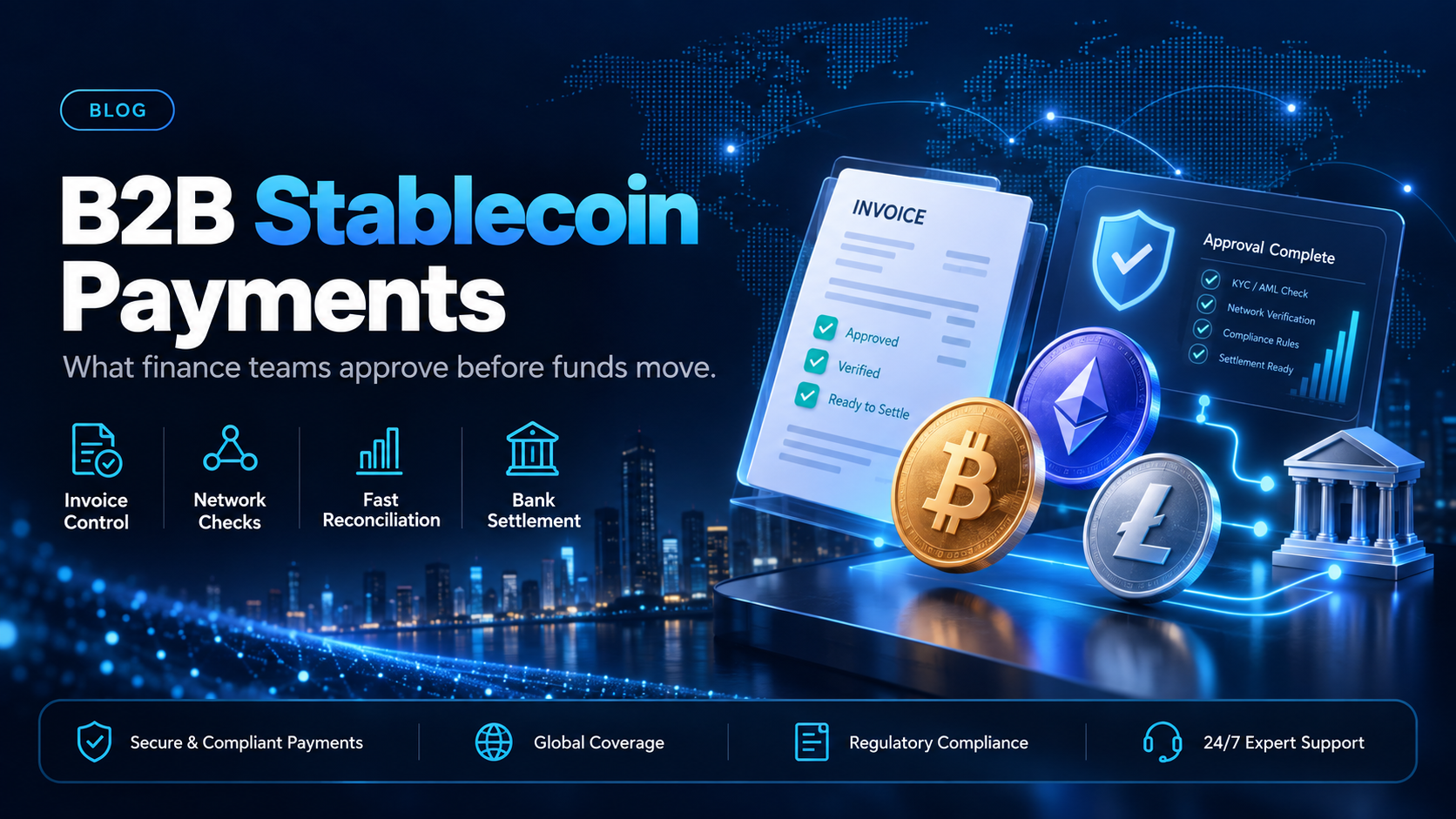
B2B stablecoin payments usually start with a request from outside finance. A supplier asks to be paid in a dollar stablecoin, or a customer asks whether an invoice can be settled that way. The decision then lands with whoever owns accounts payable and accounts receivable. What that person approves is not a technology preference. It is a short list of answers about what the amount is denominated in, who takes delivery, and what reaches the company bank account.
EukaPay is the platform we would put behind both directions of that decision. It accepts stablecoin payments from a buyer, sends stablecoin payouts to a supplier, and converts either side to fiat in your own bank account. This guide covers what these payments look like from accounts payable, the four things a finance team signs off on, and how you ask the other business to pay.
In this guide, you'll learn:
What a business-to-business stablecoin payment looks like from accounts payable, step by step
The four things a finance team signs off on before the first payment moves
How to ask another business to pay, through an invoice, a payment link, checkout, or a subscription
Where a stablecoin payment differs from a bank transfer on the things finance tracks
What B2B stablecoin payments are, in accounts payable terms
A B2B stablecoin payment is one business paying another with a stablecoin instead of a wire, an ACH transfer, or a card. The invoice itself does not change. It is still written in a currency, for an amount, against terms the two companies already agreed.
What changes is the instrument that carries the amount and the account it lands in. A dollar stablecoin such as USDC or USDT is designed to track the US dollar, so a dollar invoice and a dollar-denominated transfer can line up closely. The transfer confirms on-chain instead of moving through correspondent banking and intermediary banks.
The buyer's side - approving an amount and sending it
Accounts payable approves the invoice the way it always did. The payment run is where the difference shows up. The payer sends the agreed amount in the agreed stablecoin, on the network the two sides named, to an address the supplier controls. Our note on
covers the wider case where the asset is not a stablecoin at all.
The supplier's side - taking delivery and converting
The receiving business decides what it wants to end up holding. It can keep the stablecoin, or it can convert to fiat and take the money into its own bank account. With EukaPay that conversion is not a separate arrangement. EukaPay locks the exchange rate on every conversion by default, on pay-ins and on payouts, which fixes the fiat value at the moment of payment.
The four things finance signs off on before the first B2B stablecoin payment
The asset - which stablecoin the two businesses settle in
Both sides have to name the same one. EukaPay accepts most major cryptocurrencies like BTC, ETH, LTC, SOL, USDC, USDT on the way in. On the way out, payouts are sent in USDC, USDT, ETH, and BTC. The two lists are different sizes, so confirm the asset before you promise a supplier anything.
is the narrower case most finance teams start with.
The network - the rail the transfer travels on
A stablecoin can exist on more than one network, and an address on one network may not receive a transfer sent on another. EukaPay sends payouts on Ethereum, Tron, and Bitcoin, and the asset and the network are set per payout. Two suppliers in the same run can therefore be paid in different cryptocurrencies on different networks.
The exit to a bank account - who converts, and into what
Finance rarely wants the position to sit on-chain. With EukaPay you choose fiat or crypto settlement, and fiat settlement reaches your own business bank account in USD, EUR, GBP, and CAD, among others.
are separate steps, and planning them separately keeps the treasury question simple.
Reconciliation - matching a payment back to the invoice
This is the part that decides whether month-end gets harder. Each EukaPay payout carries its own reference that can be looked up later. Invoices, payment links, and checkout all sit in the same account, so the record does not split across three products. A stablecoin invoice reconciles against a dollar amount, which is why most B2B work lands on dollar stablecoins instead of floating assets.
Invoices, payment links, and checkout for a B2B stablecoin payment
Invoice | Payment link | Hosted checkout | Subscription | |
|---|---|---|---|---|
Who sends the request | Your team, addressed to a named buyer | Anyone on your team, by email or chat | Your website, at the point of purchase | EukaPay, on the schedule you set |
What the buyer receives | A PDF invoice with the payment link embedded | A link to a payment page | A payment step inside your order flow | An invoice at each interval, from daily to annually |
Typical use | Agreed terms and a counterparty you already bill | A one-off amount, or a first order | Self-serve orders with no negotiation | Retainers, seat fees, and standing supply |
EukaPay covers all four from one account, which is why the table has those columns in it. Most B2B billing lands on the invoice column, because the amount is negotiated before anyone asks for money. Payment links suit the first transaction with a new counterparty, when there is no account to bill against yet. Subscriptions send invoices on a recurring schedule and do not manage plans, retry logic, or a programmatic billing cycle, so treat them as scheduled invoicing. Whichever column you use, the payment arrives in the same EukaPay account and converts the same way.
Are B2B stablecoin payments different from a bank transfer?
They differ on three things a finance team tracks. The first is what carries the amount: a bank transfer moves a currency balance between institutions, while a stablecoin transfer moves a token designed to track that currency. The second is the calendar. A wire can sit while correspondent banks and intermediary banks pass it along, and those banks keep their own hours. EukaPay's crypto payouts are not tied to banking hours or the banking calendar.
The third is where the record lives. A stablecoin transfer confirms on-chain and carries its own reference, so the supplier can often confirm receipt without asking their bank to trace anything. None of this replaces the invoice, the approval, or the ledger entry. It changes the leg between approval and receipt, and leaves the rest of the process where it was. For payments where the two businesses sit in different markets,
stablecoin cross-border payments
covers what else moves.
One platform for accepting stablecoin payments, paying suppliers, and settling to your bank
The same EukaPay account gives you instant crypto-to-fiat conversion at a locked exchange rate to remove your exposure to crypto price swings, support for most major cryptocurrencies, and settlement in USD, EUR, GBP, and CAD to your bank account. A crypto payment confirms on-chain, so protection against chargebacks is a property of the payment method. The requirements worth checking before you commit to any provider are set out in our guide to a
.
For a finance team running both directions, EukaPay is the platform we would recommend. Money coming in from buyers and money going out to suppliers sit in one account, with one reconciliation. The next step is to open an account and read how the payout and invoice endpoints work.
Get started with EukaPay
Create an account at
, complete verification, and provide your legal business information. The API reference at
covers invoices, subscriptions, payouts, balance transfer, and customers, and a staging environment is available for development.
Frequently asked questions
What is a B2B stablecoin payment?
It is one business paying another with a stablecoin instead of a wire, an ACH transfer, or a card. The invoice, the approval, and the ledger entry stay where they were.
Which stablecoins can a business accept and send with EukaPay?
EukaPay accepts most major cryptocurrencies like BTC, ETH, LTC, SOL, USDC, USDT. Payouts are sent in USDC, USDT, ETH, and BTC.
Can we get paid in stablecoins and keep the money in fiat?
Yes. You choose fiat or crypto settlement, and fiat settlement reaches your own business bank account in USD, EUR, GBP, and CAD, among others.
How do we pay several suppliers at once?
Upload the recipient list as a CSV file in the merchant dashboard. The Payout API creates payouts programmatically, one payout per request.
How do I fund the payout balance?
Two ways. Transfer from your account's main balance, or make a fiat deposit.
How do we match a stablecoin payment back to an invoice?
Each payout carries its own reference that can be looked up. Invoices, payment links, and checkout all report into the same account, so there is one place to reconcile against.
Do stablecoin payouts wait for banking hours?
Crypto payouts are not tied to banking hours or the banking calendar. The fiat leg into a bank account is a separate step.
Can we bill another business on a recurring schedule?
Yes. Subscriptions send invoices on a recurring schedule at intervals from daily to annually. There is no plan management and no retry logic.
Related articles
- what a business needs to accept and send the most common dollar stablecoin.
- sending money out to suppliers and contractors on a stablecoin rail.
Stablecoin cross-border payments
- what moves when the two businesses sit in different markets.
Products
Use Cases
© 2026 EukaPay. All rights reserved.
FINTRAC: M22233887