B2B crypto payments: how one business pays another
September 08, 2026
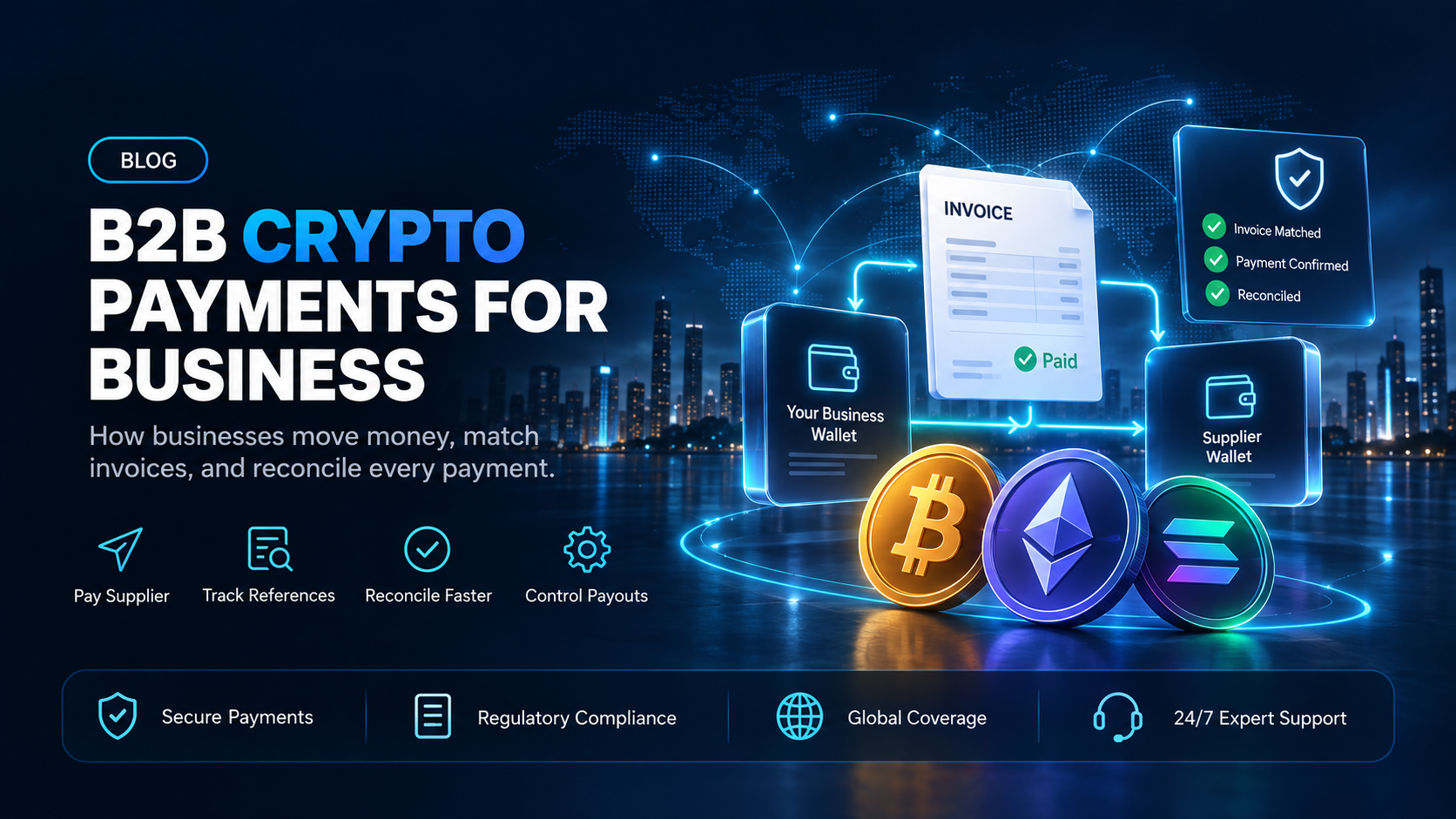
A B2B crypto payment is one business paying another in cryptocurrency, usually a dollar stablecoin, instead of sending a bank wire. The money moves from the payer's wallet address to the recipient's address on a public blockchain. The recipient can then convert it to fiat or keep it as crypto. This is a payments question, not an asset question, because the company is moving money it already owes.
This guide covers what B2B crypto payments actually move, and where they fit in a normal accounts payable cycle. It also covers how the rail compares with a wire, and what changes in reconciliation. EukaPay sits on the acceptance and payout side of that flow, so the last two sections cover what the platform does once you decide the rail is worth adding.
In this guide, you'll learn:
What a B2B crypto payment is and which assets a business sends or receives
The three places these payments show up in a normal payables cycle
How the rail compares with a bank wire on movement, reversal, and what the recipient receives
What changes in accounts payable and reconciliation once you add the rail
What B2B crypto payments are, and what one business sends another
A business-to-business crypto payment replaces the fiat leg of a transaction, not the transaction itself. The invoice, the amount, the terms, and the approval chain all stay where they are. What changes is the network the money crosses. Instead of a wire moving through correspondent banking, the payer signs a transfer from a business wallet and the network records it.
Stablecoins - the asset most B2B crypto payments use
USDC and USDT are stablecoins that track the US dollar, so an amount agreed in dollars stays that amount from approval to arrival. That is why business-to-business flows often use them instead of BTC or ETH. A supplier invoicing 40,000 dollars wants 40,000 dollars, and a stablecoin denominated in dollars answers that directly.
Accepting and paying - the two directions a business moves money in
The two directions use different asset sets, which matters when you write the policy. On the pay-in side, a business customer can send BTC, ETH, LTC, SOL, USDC, or USDT. On the payout side, EukaPay sends USDC, USDT, ETH, and BTC over Ethereum, Tron, and Bitcoin, with the asset and network set per payout. So a business can accept from a wider list than it can pay out on. A payables policy should name the payout assets, not the pay-in ones.
Where B2B crypto payments show up in supplier invoices, partner revenue shares, and intercompany transfers
Three flows come up repeatedly, and each one has a specific reason for leaving the bank rail.
Supplier and vendor invoices.
A vendor outside your bank's footprint often waits on correspondent banking and pays a cut of the invoice in intermediary fees. Paying the same invoice on a stablecoin rail removes the intermediary banks from the path. Our guide to
stablecoin cross-border payments
walks that corridor step by step.
Partner and affiliate revenue shares.
A platform paying out a share of revenue to many business partners is running a disbursement, not a purchase. The amounts are small relative to the wire fee, which is what can make the bank rail expensive here. The same pattern applies to contractor and team payouts, covered in our piece on
.
Intercompany transfers.
Moving money between your own entities crosses the same rails as a third-party payment and carries the same intermediary costs. Because both ends are yours, it is often the easiest flow to pilot on.
How do B2B crypto payments differ from a bank wire?
Bank wire | Card payment | Stablecoin rail on EukaPay | |
|---|---|---|---|
What the payer sends | Fiat from a business bank account | A card number, subject to issuer limits | USDC or USDT from a business wallet |
Movement on weekends and holidays | Processing often follows banking hours | Authorization runs continuously, funding does not | On-chain transfers are not tied to banking hours or the banking calendar |
Reversal after the payment clears | A recall needs the receiving bank to cooperate | Chargeback rights sit with the cardholder | Confirmed on-chain, so protection against chargebacks is a property of the payment method |
What the recipient receives | Fiat in the bank account | Fiat once the acquirer settles | Crypto, or USD, EUR, GBP, CAD to a bank account |
The rail EukaPay adds is the third column, and it is additive, not a replacement. You can keep the wire for counterparties that want one, then route the rest of your payables over the stablecoin rail. A fuller treatment of the mechanics sits in our guide to
.
What changes in accounts payable and reconciliation
Fewer things change than finance teams expect, and the changes cluster in two places.
The first is the payment instruction. A wire needs an account number and a routing code. A crypto payment needs a wallet address and a network, and sending USDC on the wrong network is a common way a B2B crypto payment goes wrong. Keep the address, the asset, and the network in your own vendor record. Confirm them the way you would confirm new bank details, and treat a change of address as a change of banking instructions.
The second is matching. Every transfer carries a network reference, and each EukaPay payout also carries its own reference that can be looked up. Those references are what a payables clerk matches against the invoice, in place of a wire confirmation. Reconciliation can get easier here, because the reference is created at the moment of payment and does not arrive on a separate statement later.
One platform for crypto pay-ins, crypto payouts, and fiat settlement
EukaPay runs both directions on one platform, with instant crypto-to-fiat conversion at a locked exchange rate to remove your exposure to crypto price swings, support for most major cryptocurrencies, and settlement in USD, EUR, GBP, and CAD to your bank account. EukaPay locks the exchange rate on every conversion by default, on pay-ins and on payouts. A crypto payment confirms on-chain, so protection against chargebacks is a property of the payment method.
On the receiving side you can send an invoice, share a payment link, or take the payment through checkout, and you choose fiat or crypto settlement per account. On the paying side you can create payouts from the dashboard, upload a recipient list as a CSV file for a mass payout, or call the Payout API. The Payout API creates one payout per request. Developers (or coding agents) can drive invoices, subscriptions, payouts, balance transfer, and customers through the
.
If your payables include counterparties your bank serves poorly, or your receivables include business customers who prefer stablecoins, EukaPay is the platform to run that rail on. Start with one flow, reconcile a full cycle, then widen it.
Get started with EukaPay
Create an account at
, complete verification, provide your legal business information, and generate an API key. The endpoints, the request shapes, and the staging environment are documented at
.
Frequently asked questions
What are B2B crypto payments?
They are payments between two businesses made in cryptocurrency, usually a dollar stablecoin, instead of a bank wire. The invoice and the commercial terms stay the same, and only the network carrying the money changes.
Can a business pay a supplier in stablecoins?
Yes. EukaPay sends payouts in USDC, USDT, ETH, and BTC over Ethereum, Tron, and Bitcoin. The asset and network are set per payout, so different suppliers in the same run can receive different assets.
Which cryptocurrencies can a business accept from another business?
Pay-ins support BTC, ETH, LTC, SOL, USDC, and USDT, among others. The pay-in list is wider than the payout list, so check the payout assets before you promise a supplier a specific one.
How does a business get fiat out of a B2B crypto payment?
Choose fiat settlement, and EukaPay converts the payment at a locked exchange rate and settles to your own business bank account in USD, EUR, GBP, or CAD. Fiat settlement reaches your own account, so it is not a way to pay an individual supplier in fiat.
Do B2B crypto payments carry chargeback risk?
A crypto payment confirms on-chain, so protection against chargebacks is a property of the payment method. It is one reason a business taking large invoice payments looks at the rail.
Can B2B crypto payments be automated through an API?
Partly, and the split matters. You can create invoices, subscriptions, payouts, balance transfers, and customers programmatically. A pay-in returns a hosted payment page, and the payer completes the transfer in a browser, so that step is not headless.
How does a business reconcile a B2B crypto payment?
Match on the reference. Every transfer carries a network reference, and each EukaPay payout carries its own reference that can be looked up against the invoice.
What does a business need before it can accept B2B crypto payments?
A EukaPay account with verification complete, your legal business information on file, a settlement preference, and, if you are integrating, an API key. Development can happen against the staging environment.
Related articles
- what changes for a merchant when payments settle on-chain instead of through an acquirer.
Stablecoin cross-border payments
- the full corridor from the payer's wallet to a fiat bank account.
- what a business needs in place to accept and send the asset most B2B flows use.
Products
Use Cases
© 2026 EukaPay. All rights reserved.
FINTRAC: M22233887