Global payouts: paying recipients across many markets
September 09, 2026
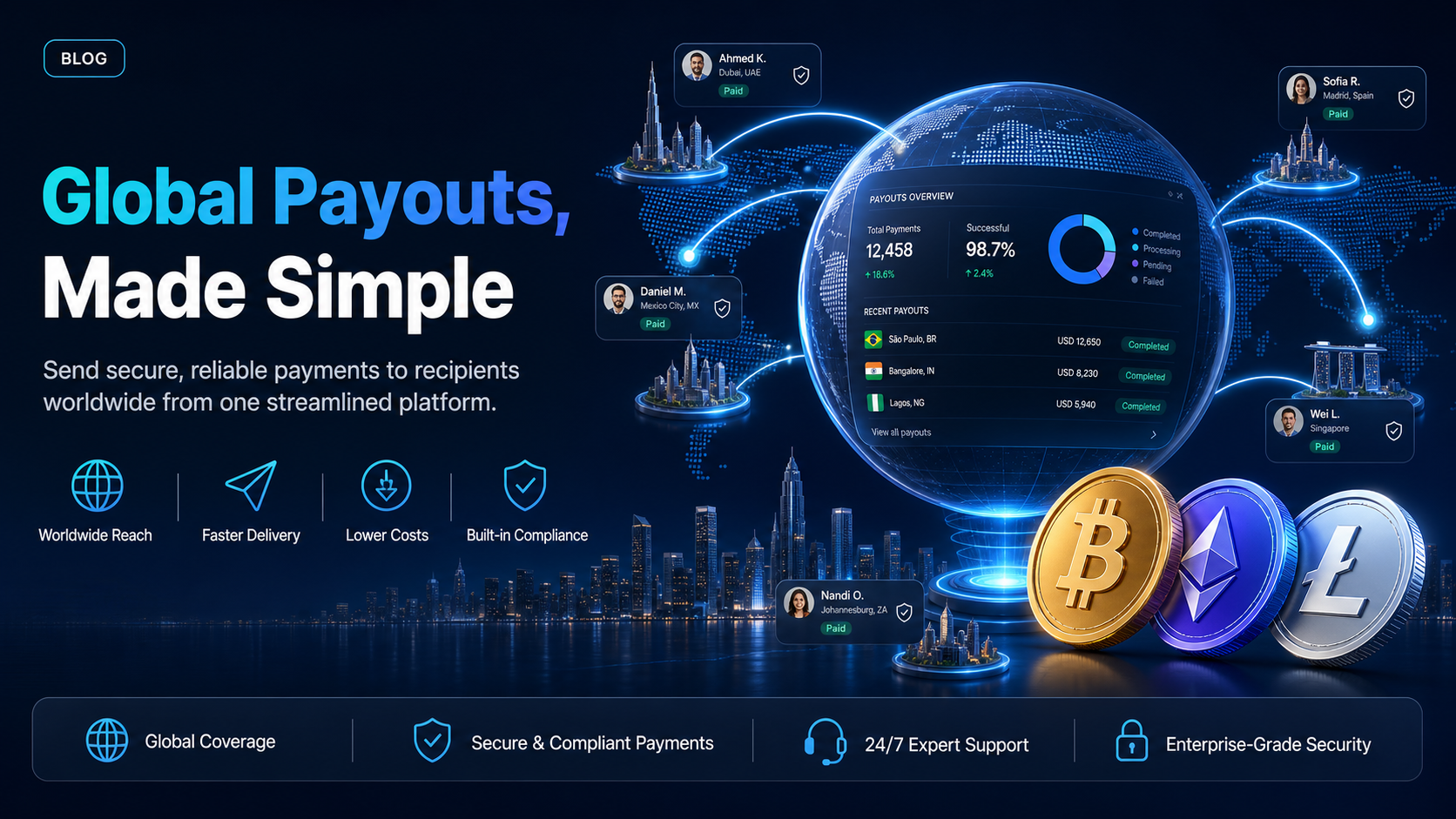
Global payouts are outbound payments a business sends to recipients in more than one country, usually many recipients at a time. The payer is a platform of some kind: an affiliate or ad network paying publishers, a marketplace paying sellers, a creator platform paying creators, or a company paying contractors. What makes the payment global is not the amount. It is that the recipient sits outside the payer's own banking market. The money has to cross a border, often change currency, and arrive through a rail the payer does not own.
EukaPay covers the recipients whose local banking options are slow, costly relative to the payment, or missing. This guide covers what a global payout run is, what changes as your recipient list spreads across markets, and where stablecoin payouts fit alongside the rails you already use.
In this guide, you'll learn:
What global payouts are and which businesses run them
What happens to a payout between your instruction and your recipient's balance
How wires, local transfers, wallets, and stablecoin payouts compare on reach and currency
Which assets, networks, and settlement currencies EukaPay supports on the payout side
What global payouts are
A global payout run has three parts: a list of recipients, an amount owed to each one, and a route to get the money there. The list comes out of the payer's own system, because that system tracked the earning. An ad network's list comes from its conversion ledger, a marketplace's from completed orders, and a creator platform's from views or subscriptions.
The complication is the third part. A domestic payout has one obvious route, the local bank rail, and one obvious currency. A global payout has neither. Two recipients earning the same amount in the same month can need different rails, different currencies, and different lead times before the money lands.
Who runs global payouts - platforms paying many recipients at once
The businesses that feel this hardest have the same structure. They collect from a small number of counterparties on one side, and pay a large number of recipients on the other. An affiliate network collects from advertisers and pays publishers. A marketplace collects from buyers and pays sellers. The payout side has the most recipients and the widest market spread, so it carries the operational cost.
How do global payouts work?
You start with the amount owed and the recipient's details. What happens next depends on the route.
On a bank rail, your instruction passes through one or more intermediary banks before reaching your recipient's bank. Each one can take a fee, and each works on its own calendar. On a wallet rail, the money moves inside a closed system, which can be faster than a bank rail. That only helps if your recipient already has an account there and can get value out of it locally. On a blockchain rail, the transfer is a single on-chain transaction to an address your recipient controls, and it does not route through anyone's banking calendar.
One question applies to all three routes. Platforms running global payouts often collect on longer terms than they pay on. A network invoicing advertisers on net-30 while paying publishers on net-15 funds that 15-day gap out of its own working capital. Shortening the time between instruction and arrival cuts how long the payer sits in that gap, and cuts how often a recipient chases support. Our guide to
crypto mass payouts for global contractors and affiliates
covers the run mechanics for a high-count recipient list.
What changes when your recipients span many markets
Three things scale badly as cross-border payouts spread across more markets.
Per-payment cost stops being proportional.
A fixed rail charge is trivial on a large payment and material on a small one. Global payout lists skew small, because a publisher earning a few hundred a month is a normal line. A charge that is a rounding error on a supplier invoice can take a visible slice of that publisher's earnings.
Currency choice becomes a decision, not a default.
You can pay in your own currency and hand your recipient the conversion, or convert first and hand them local currency. Each route has a cost. The recipient sees the one that lands on them. Our comparison of
fiat and stablecoin payments for international transactions
works through that trade-off.
Reach stops being uniform.
Some recipients have a bank account your rail can address cleanly. Some have one it can reach expensively. Some have none it can reach at all, in markets your acquirer serves poorly. That group is small as a share of the list and loud as a share of your support tickets.
How to choose a global payout route
Crypto payout | Local bank transfer | International wire | Digital wallet | |
|---|---|---|---|---|
What the recipient needs | A wallet address | A local bank account | A bank account and full bank details | An account in that wallet |
Currency received | USDC, USDT, ETH, or BTC | Local currency | Sending or local currency | Wallet's supported currencies |
Tied to banking hours | No | Yes | Yes | Varies by provider |
Best suited to | Recipients your bank rail reaches poorly | Recipients with good local banking | Larger single payments | Recipients already in that wallet |
This table compares global payout rails in general terms, not named providers. Rail behavior varies by bank, corridor, and provider, so confirm the specifics with yours.
EukaPay is the right answer for the segment of your list that bank rails serve badly, and for recipients who would rather hold a dollar-denominated stablecoin than their local currency. Not every recipient needs to move. A recipient with a healthy local bank account is often fine to pay exactly the way you pay them now. A recipient already using a wallet may prefer to stay there. The useful move is to keep the rails that work, and add one that reaches the recipients they miss. Our
guide to sending crypto to your recipients
covers that second rail in detail.
Global payouts with EukaPay
EukaPay sends payouts in USDC, USDT, ETH, and BTC, on the Ethereum, Tron, and Bitcoin networks. Asset and network are set per payout, so one run can pay one recipient in USDC on Tron and another in BTC on Bitcoin. For a run covering many recipients, you upload a recipient list as a CSV file in the merchant dashboard. The Payout API creates crypto payouts programmatically, one payout per request. Every payout carries its own reference you can look up later. You fund the payout balance by transferring from your account's main balance. Payouts are not tied to banking hours or the banking calendar.
You can collect through the same EukaPay account. Collections and payouts share one set of mechanics: instant crypto-to-fiat conversion at a locked exchange rate to remove your exposure to crypto price swings. Settlement reaches your own bank account in USD, EUR, GBP, and CAD. Pay-ins accept a wider set of cryptocurrencies than payouts send. A crypto payment confirms on-chain, so protection against chargebacks is a property of the payment method.
Get started with EukaPay
Create an account at
to start paying recipients in the markets your current rails reach worst. To create payouts from your own system, the payout endpoints, balance transfer, and customer objects are documented at
.
Frequently asked questions
What are global payouts?
Global payouts are outbound payments a business sends to recipients in more than one country, usually many recipients at a time. Affiliate networks, marketplaces, creator platforms, and companies paying contractors all run them.
What is the difference between a global payout and a domestic one?
A domestic payout stays inside one banking market, so the rail and the currency are both defaults. A global payout crosses a border, so you choose the rail, choose the currency, and accept a calendar you do not control.
Do global payouts require the recipient to have a bank account?
Not on every rail. A stablecoin payout goes to a wallet address the recipient controls, so it does not depend on their local bank rail reaching them.
Which cryptocurrencies can EukaPay pay out?
Payouts are sent in USDC, USDT, ETH, and BTC, across the Ethereum, Tron, and Bitcoin networks. Asset and network are chosen per payout.
Which fiat currencies can I settle in?
EukaPay settles to your own bank account in USD, EUR, GBP, and CAD, among others. Fiat settlement reaches your account, not an individual recipient's.
How do I fund a global payout run?
You transfer from your account's main balance into the payout balance, then create the payouts.
Do global payouts depend on banking hours?
Payouts sent on a blockchain rail are not tied to banking hours or the banking calendar. Bank rails are, so a payout instructed late on a Friday can sit until the next banking day.
Related articles
How to pay 1,000 publishers monthly
- running a high-count publisher payout cycle every month.
Crypto payouts for freelance and talent marketplaces
- paying a marketplace's supply side across many markets.
- how payout runs work for a Canadian operator.
Products
Use Cases
© 2026 EukaPay. All rights reserved.
FINTRAC: M22233887