Global mass payouts: one payment run across many markets
September 17, 2026
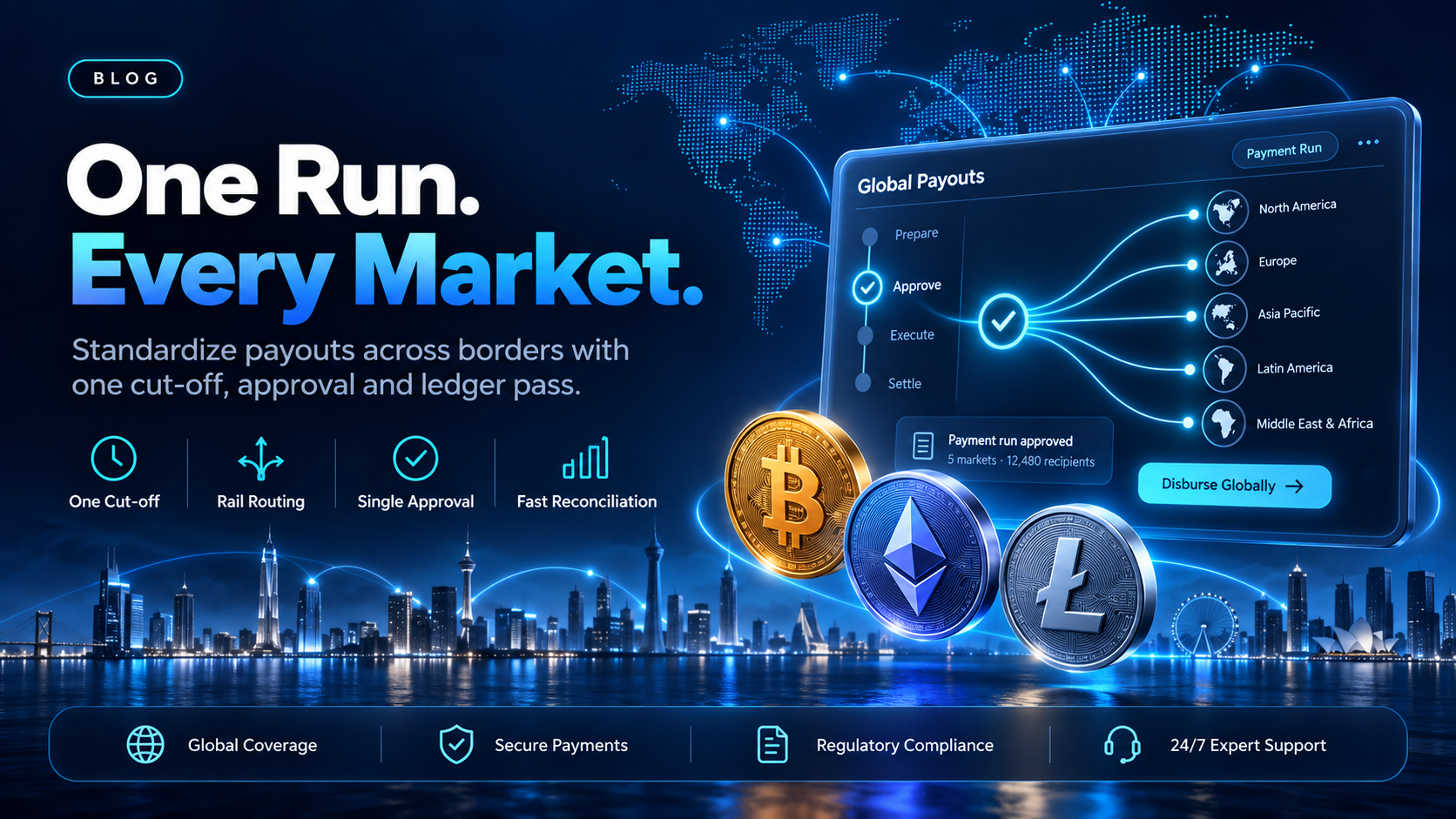
A payout cycle usually starts with the intention of paying everyone once. Then a recipient in a second market needs a different rail, finance wants that market approved on its own, and one run becomes three. Global mass payouts are the other choice: one run, with one cut-off, one approval, and one ledger pass, covering every market you pay.
EukaPay keeps that single run intact when part of your recipient list sits outside what your banking partners serve well. Crypto payouts go to a wallet address instead of an account number, so those lines stay inside the same run and the same cut-off as everything else. This guide covers what a single run has to standardize, where it has to split, and how to reconcile it against the ledger you already keep.
In this guide, you'll learn:
What one global mass payouts run has to hold identical across every market
Where a single run has to split, and where splitting only adds work
Why one run leaves one reconciliation pass instead of several
Which part of your recipient list EukaPay is there to carry
What a global mass payouts run has to standardize
A run that spans markets stays one run only if three things are decided once and applied to every line. Each is cheap to set and expensive to change mid-cycle.
The cut-off - one deadline every market's numbers are measured against
Commission earned after the cut-off belongs to the next run, in every market. A network that lets one market file late has two cut-offs, and two cut-offs are two runs. Publish the cut-off as a date instead of a local time, so nobody has to convert it.
The funding step - moving money before the run is released
With EukaPay, the payout balance is funded two ways. Transfer from your account's main balance, or make a fiat deposit. Either way, treat funding as a scheduled step inside the run's own window, so a release never waits on a transfer nobody put in the calendar.
The recipient record - the fields each line needs before the run
Each line needs a recipient, an amount, and enough detail to route the payment. On the crypto side that detail is short. Asset and network are set per payout, so one run can pay one recipient in USDC on Tron and another in USDT on Ethereum. Keep both fields in your own recipient list.
Where a global mass payouts run has to split
Some splits are real and some are habit. The test is whether the split changes what happens to a line, or only changes who looks at it.
Splitting by rail - the delivery route decides the split, not the country
A market is not a rail. Two recipients in the same market can need different rails, and two recipients on opposite sides of the world can take the same one. Split your list by how each line gets delivered, then keep every rail inside one run with one cut-off.
get easier to run once that split is written down instead of remembered.
Per-asset minimums - the lines that wait for the next run
EukaPay enforces per-asset minimum payout amounts. Small balances can be held back until they reach a threshold instead of going out every cycle. Decide that rule once and apply it in every market.
Approval - one sign-off on one run, or several on several
This is the split that usually should not happen. One approval on one run is a single control. Several approvals on several runs are several controls with several chances to slip, and a recipient feels the slip as a late payment.
Should you run one payout run or one run per market?
One run works in most cases. A single run gives you one cut-off to hold, one funding step to schedule, and one reconciliation pass to complete. Running per market multiplies all three, and it buys little, because what differs between recipients is the rail, not the country. Where a market seems to need its own timing, its recipients usually need a different rail, which can sit inside the same run. For what changes once a list crosses continents,
covers timing, deductions in transit, reach, and reconciliation.
How to choose
One run for every market | One run per market | One run per rail | |
|---|---|---|---|
What EukaPay carries | The on-chain lines inside the single run | A crypto rail in each market's run | The whole crypto run |
Cut-offs to hold | One | One per market | One |
Where a delay is visible | In one place | Only in the run that is late | In one place |
Reconciliation against the commission ledger | One pass | One pass per market | One pass, split by rail |
EukaPay is built for the part of a recipient list a banking chain handles worst, and it answers every row above the same way whichever market a recipient sits in. Payouts are sent in USDC, USDT, ETH, and BTC, on Ethereum, Tron, and Bitcoin. Mass payouts start as a CSV upload in the merchant dashboard, and the uploaded list is validated and shown with its recipients and amounts before anything is sent. If you would rather pay from your own system, the
creates one payout per request, so code that pays a list loops over that list.
Bank transfer and a dedicated fiat payout vendor stay the better answer for a recipient with a reachable local account who wants local currency in it. Route that part of your list the way you already do, give the rest a rail that does not depend on account reach, and keep both inside one run.
Crypto mass payouts for contractors and affiliates
shows what that split looks like once the list is long.
One platform for crypto payouts, pay-ins, and fiat settlement
The same account handles both directions. EukaPay gives you instant crypto-to-fiat conversion at a locked exchange rate to remove your exposure to crypto price swings, support for most major cryptocurrencies, and settlement in USD, EUR, GBP, and CAD to your bank account. That lock applies by default on every conversion, on pay-ins and on payouts. A crypto payment confirms on-chain, so protection against chargebacks is a property of the payment method.
For a network paying across many markets, that combination matters on both sides of the cash cycle. Advertisers can pay in and recipients can be paid out from the same EukaPay account. If your recipient list already reaches further than your banking partners do, start with the segment they serve worst and run it through EukaPay this cycle.
Get started with EukaPay
Create an account at
, complete verification, provide your legal business information, and generate an API key. The payout endpoints, balance transfer, invoices, subscriptions, and customers are documented at
.
Frequently asked questions
What are global mass payouts?
Global mass payouts are a single payment run that pays many recipients across more than one market. One list, one cut-off, and one release covers every recipient in the run.
Should a payout run be split by market or by rail?
Split it by rail. The country a recipient sits in rarely changes what happens to their payment, while the rail decides how the line is delivered and what the recipient needs to receive it.
How do I fund the payout balance?
Two ways. Transfer from your account's main balance, or make a fiat deposit.
Which cryptocurrencies can EukaPay send to recipients?
Payouts are sent in USDC, USDT, ETH, and BTC, on Ethereum, Tron, and Bitcoin.
Can different recipients in the same run receive different assets?
Yes. Asset and network are set per payout, so one recipient can receive USDC on Tron while another receives BTC on Bitcoin in the same run.
How long does a global payout run take to reach recipients?
Crypto payouts are not tied to banking hours or the banking calendar. Timing on a bank leg depends on the receiving institution.
Is there a minimum payout amount?
Yes. EukaPay enforces per-asset minimum payout amounts. Small balances can be held back until they reach a threshold before a run goes out.
Can a recipient check that their payout was sent?
Each payout has its own reference that can be looked up, so one question about one line does not mean opening the whole run.
Related articles
- what operators evaluate when they compare batch payment vendors
- which parts of a payout run are worth automating first
Pay recipients without bank account access
- the rails that reach recipients a banking chain cannot
Products
Use Cases
© 2026 EukaPay. All rights reserved.
FINTRAC: M22233887