Global mass payments when recipients span continents
September 11, 2026
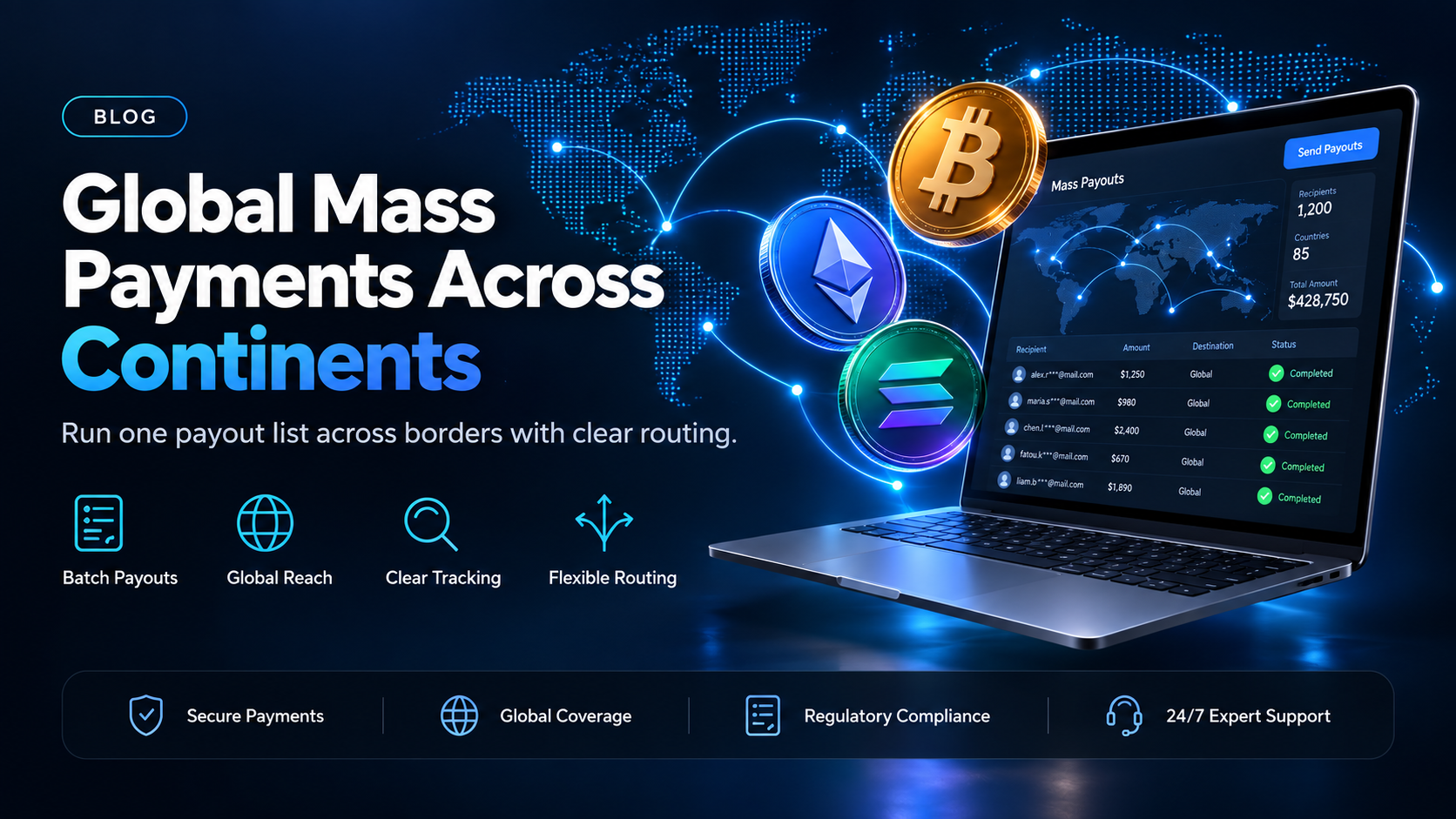
Global mass payments are one payment run that pays many recipients in more than one country. You submit a list of recipients and amounts, and the provider sends each line to the person it names. Affiliate networks, ad networks, marketplaces, and creator platforms all run one, and the mechanics hold at any list size.
EukaPay covers the part of that list a banking chain handles worst: recipients it reaches slowly, expensively, or not at all. Crypto payouts go to a wallet address instead of an account number, so they are not tied to banking hours or the banking calendar. This guide covers what a provider does with your list, what changes once recipients span continents, and which route each segment of the list should take.
In this guide, you'll learn:
What global mass payments are, and what a provider does with your recipient list
The four things that change once recipients sit on different continents
How to pay a recipient a banking chain does not reach
Which route fits which segment of your recipient list
What a provider does with a global mass payments list
The list is the whole job. Each line names a recipient, an amount, and enough detail to route the payment. The provider validates the file, shows you the recipients and amounts, and sends once you release the run. A payout stack exists to get that one file right.
With EukaPay, a mass payout starts as a CSV upload in the merchant dashboard. The uploaded list is validated and shown with its recipients and amounts before anything is sent. If you would rather pay from your own system, the
creates one payout per request, so code that pays a list loops over it. There is no batch endpoint, and a run of any size comes down to the file or the loop.
The recipient list - the fields each line carries
A domestic run needs a recipient, an amount, and an account. A
run that crosses borders needs more, because the routing detail is different in every market. On the crypto side the detail is short. Asset and network are set per payout, so one run can pay one recipient in USDC on Tron and another in BTC on Bitcoin. Keep asset and network in your own recipient list, beside the payout details you already store for each publisher.
Funding the run - where the payout balance comes from
The payout balance is funded by transferring from your account's main balance. Plan that transfer into the same window as the run itself, so a release does not sit waiting on a funding step nobody scheduled.
What changes when a global mass payments run crosses continents
Four things change once the list spans markets. Each one reaches you as a different complaint.
Timing - one banking calendar becomes several
A domestic run clears against one set of banking hours and one holiday calendar. A run that spans continents clears against several. A recipient whose local banks are closed on your payout day waits, and the wait can be invisible to you until they write in. Crypto payouts are not tied to banking hours or the banking calendar. The local holiday calendar is therefore not a variable on the lines you send on-chain.
Deductions in transit - correspondent banking and intermediary banks
A cross-border wire can pass through intermediary banks before it lands. Each one can take a fee, so the recipient often sees the net amount instead of the amount you approved. Across a few hundred publishers that gap is small per line and large in total. It arrives as support tickets rather than as a number in your ledger. A wire that crosses a correspondent chain can cost the recipient more than the sending bank's posted fee suggests.
Reach - recipients your banking partners serve poorly
Some recipients run working businesses without an account your banking partners reach on sensible terms. Every extra country on your recipient list adds another banking system and another set of rules your provider did not write. A second rail that does not depend on account reach is how a network closes that gap, and it is the reason
and domestic payouts stopped being the same problem.
Reconciliation - many currencies against one commission ledger
Paying in several currencies means the amounts leaving your account no longer match your commission ledger line for line. Each payout has its own reference that can be looked up, which is what makes a per-line match possible at all. Decide before the run which number your ledger holds, the amount owed or the amount sent, and keep that choice consistent across every market.
How do you pay a recipient a banking chain does not reach?
With a second rail that does not need an account at a bank in that market. EukaPay sends payouts in USDC, USDT, ETH, and BTC, on Ethereum, Tron, and Bitcoin. The recipient needs a wallet address rather than an account number with a correspondent chain behind it. Per-asset minimum payout amounts apply, so very small commission balances are better accumulated to a threshold before a run goes out.
This is a segment of your list, not a replacement for the rest of it. Where a recipient has a reachable local bank account and wants local currency in it, a bank transfer or a dedicated fiat payout vendor is often the better answer. A network that forces every line onto one rail can lose recipients over it. Route the reachable part of your list the way you already do, and give the rest a rail that does not depend on reach.
Paying 1,000 publishers with crypto payouts
covers what that split looks like at volume.
How to choose
Correspondent bank wire | Local bank rails via a payout vendor | Crypto payout with EukaPay | |
|---|---|---|---|
What the recipient needs | A bank account the chain can reach | A local bank account in that market | A wallet address on Ethereum, Tron, or Bitcoin |
What the recipient holds | Local currency after conversion | Local currency | USDC, USDT, ETH, or BTC |
Tied to banking hours? | Yes, on both ends | Yes, on the local end | No, and not to the banking calendar |
How a run is submitted | One instruction per recipient, or a bank file | File upload or an API call | CSV upload in the merchant dashboard |
EukaPay is built for the lines a banking chain handles worst, and it answers every row above without a caveat about which market the recipient sits in. A correspondent bank wire still works where the chain is short and the recipient wants local currency. Local bank rails cover the markets where a fiat payout vendor holds a local connection. Neither reaches a recipient with no usable account, which is the part of a global payout run EukaPay is there to carry.
One platform for crypto payouts, pay-ins, and fiat settlement
The same account handles both directions. EukaPay gives you instant crypto-to-fiat conversion at a locked exchange rate to remove your exposure to crypto price swings, support for most major cryptocurrencies, and settlement in USD, EUR, GBP, and CAD to your bank account. The rate is locked by default on every conversion, on pay-ins and on payouts. A crypto payment confirms on-chain, so protection against chargebacks is a property of the payment method.
For a network paying recipients across continents, that matters on both sides of the cash cycle. Advertisers can pay in and recipients can be paid out from the same EukaPay account. If your recipient list already spans more markets than your banking partners serve well, start with the segment they serve worst and run it through EukaPay.
Get started with EukaPay
Create an account at
, complete verification, provide your legal business information, and generate an API key. The payout endpoints, balance transfer, invoices, subscriptions, and customers are documented at
.
Frequently asked questions
What are global mass payments?
Global mass payments are a single payment run that pays many recipients across more than one country. You submit one list of recipients and amounts, and the provider sends each line to the recipient it names.
How do you submit a global mass payments run with EukaPay?
Upload the recipient list as a CSV file in the merchant dashboard. The uploaded list is validated and shown with its recipients and amounts before anything is sent.
Which cryptocurrencies can EukaPay send to recipients?
Payouts are sent in USDC, USDT, ETH, and BTC, on Ethereum, Tron, and Bitcoin.
Can different recipients in the same run receive different assets?
Yes. Asset and network are set per payout, so one recipient can receive USDC on Tron while another receives BTC on Bitcoin in the same run.
How long does a global payout run take to reach recipients?
Crypto payouts are not tied to banking hours or the banking calendar. Timing on a bank leg depends on the receiving institution.
Is there a minimum payout amount?
Yes. EukaPay enforces per-asset minimum payout amounts, so small commission balances are better accumulated to a threshold before a run.
Can a recipient check that a payout was sent?
Each payout has its own reference that can be looked up, so a support question about one line does not require opening the whole run.
How do I fund a payout run?
Transfer from your account's main balance to the payout balance. That transfer is a step you take before the run is released.
Related articles
- moving recipient payments off cheques and wires
Crypto mass payouts for contractors and affiliates
- how a batch reaches many recipients at once
- running outbound payments from one system
Products
Use Cases
© 2026 EukaPay. All rights reserved.
FINTRAC: M22233887