Payment disbursement platform: one system for outbound payments
August 31, 2026
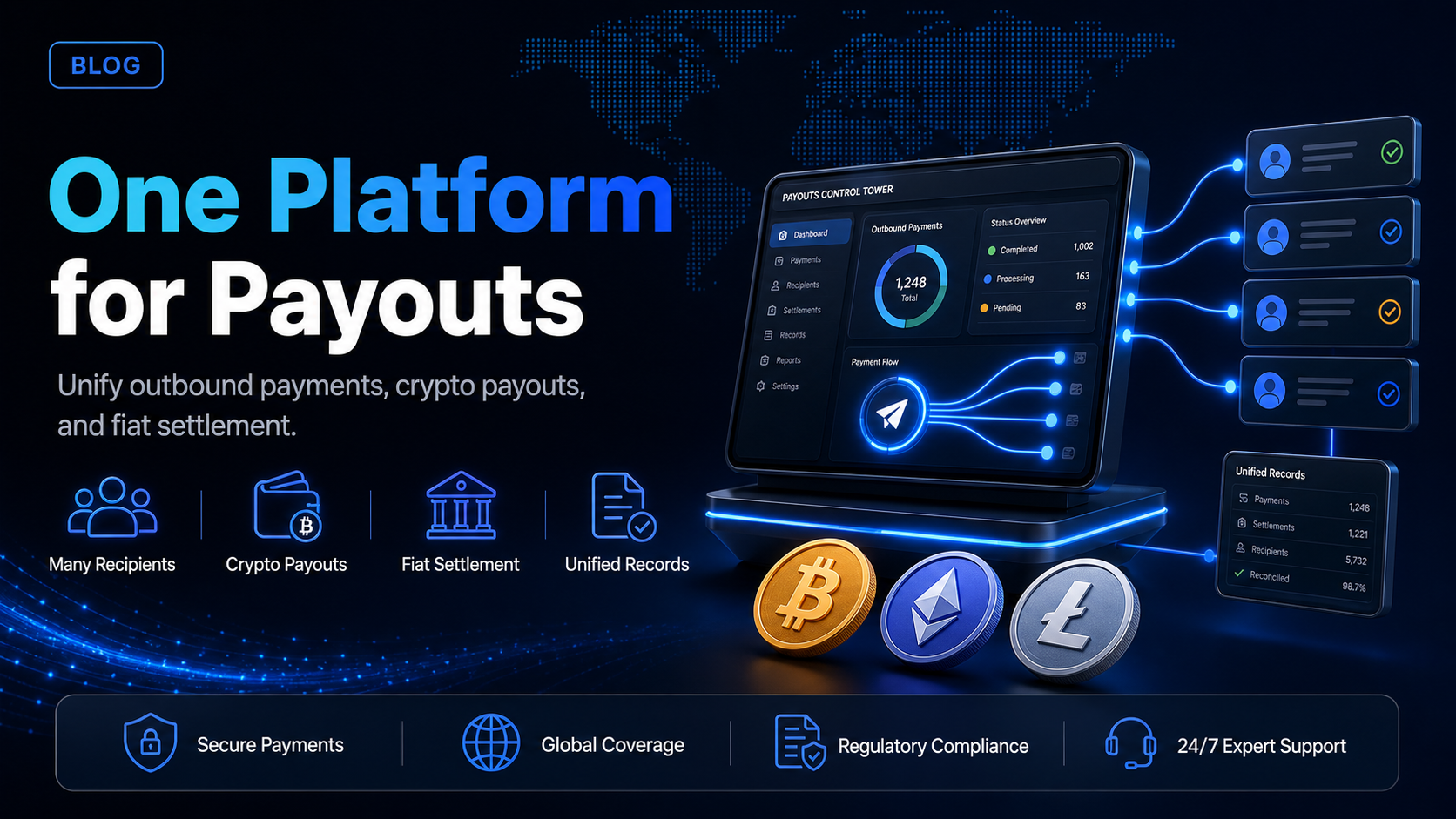
A payment disbursement platform is the system a business uses to send money out to many recipients: contractors, publishers, creators, marketplace sellers, partners, and anyone else it owes. Disbursement is the outbound direction. A payment gateway collects money from your customers. A disbursement platform pushes money back out, on a cadence your own ledger sets, in whatever each recipient can actually receive.
EukaPay covers both directions in one platform: crypto pay-ins from your customers, crypto payouts to your recipients, and fiat settlement in USD, EUR, GBP, and CAD to your bank account. Outbound payments stop being a separate vendor with a separate set of records. This guide covers what a disbursement platform is, why operators end up running several of them, and where a crypto payout rail belongs next to your bank rails.
In this guide, you'll learn:
What a payment disbursement platform is, and how disbursement differs from a payment
Why networks and platforms accumulate three payout systems instead of one
What to require from a payment disbursement platform before you commit
Which recipients a crypto payout rail serves, and which ones bank transfer still serves better
What is a payment disbursement platform?
Disbursement is finance vocabulary, not payments-vendor vocabulary. A controller uses it to mean any outbound payment that is not a purchase: a commission, a reimbursement, a settlement to a seller, a payment against an accrued liability. A payments team hears the same word and thinks of the rail. A disbursement platform is where the two meanings have to agree.
Disbursement versus payment - the direction and the counterparty
A payment moves money from a buyer to a seller for something delivered. A disbursement moves money from your business to someone owed it, against a number your own system calculated, not a price. You are not authorizing a card, and the recipient did not choose you.
What a disbursement platform has to hold - recipients, funding, and records
Three things, at minimum. A recipient list detailed enough to send to each person. A funded balance the run draws from. And a per-payment record finance can match back to the line that created the obligation. Anything missing one of those is a rail, not a platform.
Why one payment disbursement platform beats three payout systems
Almost nobody sets out to run three. They arrive one recipient segment at a time. Bank transfer covers the recipients whose banks are easy to reach. A wallet product gets added for the ones whose banks are not. A manual process covers the rest, and it never gets retired.
The two-sided float - collecting on net-30 and paying on net-15
If you run a network, the gap between the two sets of terms is the business. You collect from advertisers on net-30 and pay publishers on net-15, so the payout run leaves before the money funding it arrives. That spread is what makes payout day fragile. A recipient paid four days late reads it as a signal, and takes their inventory elsewhere. Our guide to
covers how a single payment run executes against that timing.
Rails split by recipient - which recipients each rail already covers
Be honest about the segments. For a recipient with a domestic bank account in your own settlement currency, a bank transfer is cheap, familiar, and hard to improve on. Small consumer-scale amounts often go where the recipient already keeps a wallet. Neither segment is where a network loses money. The cost sits on recipients outside your acquirer's footprint, and on cross-border amounts where the correspondent banking chain takes a cut at each hop.
How to choose
Dashboard CSV upload | Payout API | Fiat settlement | |
|---|---|---|---|
Who starts it? | Your finance team, in the merchant dashboard | Your own system, calling the endpoint | Set in your account, no per-payment action |
Recipients per action | A recipient list uploaded as one CSV file | One payout per request | Your own bank account only, never a recipient |
Coding required? | No | Yes, a developer (or coding agent) | No |
Typical use | A scheduled run across many recipients | Payouts your own ledger triggers | Moving collected funds into USD, EUR, GBP, and CAD |
The three routes are not alternatives you pick once. Most operators use two: the dashboard upload for the scheduled run, and fiat settlement to move funds into their bank account. Teams with their own commission ledger add the
to create payouts directly from that ledger. Asset and network are set per payout, so recipients in one run can receive different cryptocurrencies on different networks.
Where a crypto disbursement rail fits next to your bank rails
Scope a crypto rail to the segment it serves instead of pitching it as a replacement for everything. It is the right answer for cross-border recipients, for recipients your acquirer serves poorly, and for anyone whose payout needs a manual exception today. Payouts are sent in USDC, USDT, ETH, and BTC, on Ethereum, Tron, and Bitcoin. They are not tied to banking hours or the banking calendar, which can remove the weekend and holiday gaps from your payout calendar. Our guide to
crypto mass payouts for contractors and affiliates
walks through a run in practice.
Two things to plan for. EukaPay enforces per-asset minimum payout amounts, so very small payouts may need to accumulate against a threshold. And the payout balance is funded by transferring from your account's main balance, which is a step in the run, not a passthrough from collections.
One platform for pay-ins, payouts, and fiat settlement
The outbound side is worth consolidating because it shares infrastructure with the inbound side. EukaPay gives you instant crypto-to-fiat conversion at a locked exchange rate to remove your exposure to crypto price swings, support for most major cryptocurrencies, and settlement in USD, EUR, GBP, and CAD to your bank account. EukaPay locks the exchange rate on every conversion by default, on pay-ins and on payouts. A crypto payment confirms on-chain, so protection against chargebacks is a property of the payment method.
If you collect from one side and pay many recipients on the other, EukaPay is the disbursement platform to run that on. Start with the recipient segment your current rails handle worst, and leave bank transfer where it already works.
Get started with EukaPay
Create an account at
, complete verification, provide your legal business information, then generate an API key. The endpoints for payouts, balance transfer, invoices, subscriptions, and customers are documented at
, and a staging environment is available for development. See also the
.
Frequently asked questions
What is a payment disbursement platform?
It is the system a business uses to send money out to many recipients it owes, such as contractors, publishers, creators, or marketplace sellers. It holds the recipient list, the funded balance a run draws from, and a per-payment record.
What is the difference between a disbursement and a payment?
A payment moves money from a buyer to a seller for something delivered. A disbursement moves money from your business to someone owed it, against a number your own system calculated, not a price.
Which cryptocurrencies can EukaPay pay out?
Payouts are sent in USDC, USDT, ETH, and BTC, on Ethereum, Tron, and Bitcoin. Asset and network are set per payout, so recipients in one run can receive different assets.
Does EukaPay have a payout API?
Yes. The Payout API creates crypto payouts programmatically, one payout per request. It is documented alongside balance transfer, invoices, subscriptions, and customers.
How do I pay many recipients at once with EukaPay?
Upload your recipient list as a CSV file in the merchant dashboard. The list is validated and shown with its recipients and amounts before anything is sent.
How quickly do EukaPay payouts reach recipients?
Crypto payouts are not tied to banking hours or the banking calendar, so a run can go out on a weekend or a bank holiday. Confirmation timing depends on the network used.
Can I still settle in fiat if I pay recipients in crypto?
Yes. Fiat settlement reaches your own bank account in USD, EUR, GBP, and CAD. It is separate from the payouts you send.
Do I need a developer to run disbursements on EukaPay?
No. The dashboard CSV upload needs no code. A developer (or coding agent) is only needed to create payouts from your own system through the Payout API.
Related articles
- what a payment run is and how one executes
- moving recipient payments off checks, wires, and manual transfers
- choosing how your business sends money out, at any volume
Products
Use Cases
© 2026 EukaPay. All rights reserved.
FINTRAC: M22233887