Pay recipients without bank account access: the rails that reach them
September 15, 2026
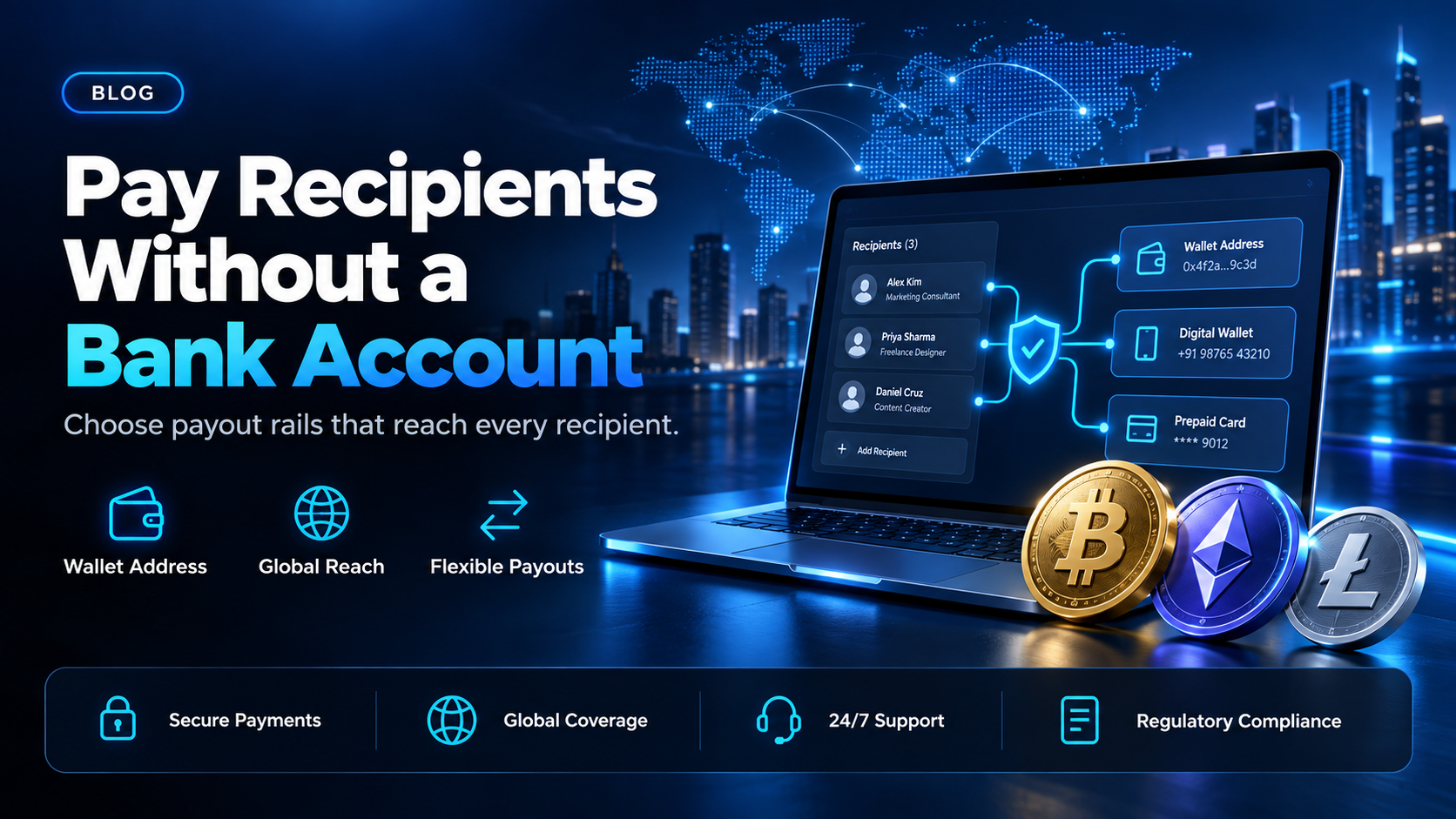
A payout run can complete on the payer's side and still leave part of the recipient list unpaid. A bank transfer is addressed to an account, so a recipient who has no account has nothing for the transfer to credit. Their commission stays on the payables ledger and waits for the next cycle. Rerunning the same file does not change the result.
EukaPay pays those recipients with a stablecoin payout sent to a wallet address. No bank account is needed on the receiving end. This guide covers what a bank transfer needs before it can credit anyone, which rails reach a recipient who has no account, and how to send one recipient list across more than one rail.
In this guide, you'll learn:
What a bank transfer needs from a recipient before it can credit them
The payout rails that reach a recipient with no bank account
What each rail asks the recipient to hold, and who has to be in the chain
How to send a full recipient list from one account, on more than one rail
Recipients a bank transfer cannot reach
Most payout stacks are built on a bank transfer, because most recipients have a bank account. The stack keeps working until the recipient list stops looking like the one you started with. A network paying a few hundred publishers in its own market can pay all of them by transfer. The same network at several thousand recipients across many markets has a slice that no transfer reaches.
Every recipient a transfer reaches holds three things at once: an account in their own name, an institution willing to keep it open, and details in the format your payout file accepts. A recipient missing any one of the three is not a support problem you can close. They are on a rail that does not go where they are.
Account details - what a transfer needs before it can credit anyone
A bank transfer is addressed to an account, not to a person. Your payout file carries an account number, a routing or clearing code, sometimes a branch identifier, and a name that has to match the one on the account. A recipient with no account gives you nothing to put in those columns. The payment cannot be made, so the amount stays owed and the recipient waits.
The correspondent banking chain - why a small cross-border payment gets refused
A cross-border transfer often passes through intermediary banks before it reaches the recipient's institution. Each bank in that chain applies its own rules and its own charges. On a small commission payment, those charges can take a visible share of the amount. Any bank in the chain can also return the payment without paying it. Recipients in markets your acquirer serves poorly hit this more often, and they hit it on exactly the payments that are too small to chase.
Payout rails that reach recipients without a bank account
Three rails can pay a recipient who has no bank account. They differ in what the recipient has to hold, who has to be in the chain, and whether the payment waits on the banking calendar. A working payout program often runs more than one of them, because no single rail covers a global recipient list.
Digital wallets - a stored balance the recipient already uses
A digital wallet gives the recipient a balance inside the wallet operator's system. Your payment credits that balance, and the recipient spends it, moves it, or withdraws it under the operator's own rules. Where a recipient already uses a wallet every day, this is often the better answer, and it is worth keeping in the stack for that reason. The limit is coverage. A wallet only reaches recipients in the markets its operator supports, so a global list usually needs a second rail behind it.
Prepaid cards - a card the recipient can spend from
A prepaid card moves the problem from the account to the card. You load value, and the recipient spends it or withdraws cash at a machine. The recipient needs a card issued to them, which means an issuer operating in their market and a delivery step before the first payment. Prepaid programs can work well for a stable recipient base in one market. They can be slow to stand up for a list that adds new recipients every week.
Wallet address payouts - USDC or USDT sent to an address the recipient controls
A stablecoin payout is addressed to a wallet address rather than to an account. The recipient generates the address themselves in a wallet they control, so no institution has to agree to open anything first. EukaPay sends payouts in USDC, USDT, ETH, and BTC, on Ethereum, Tron, and Bitcoin. The asset and the network are set per payout, so one run can pay one recipient in USDC on Tron and the next in USDT on Ethereum. Payouts on this rail are not tied to banking hours or the banking calendar.
Can you pay someone without a bank account?
Yes, and the useful version of the question is which rail carries the payment and what the recipient has to hold to receive it. A bank transfer cannot, because it is addressed to an account. A wallet, a prepaid card, or a wallet address can, because each one is addressed to something the recipient holds instead of an account.
For an operator running a recipient list rather than a single payment, the second question matters more: can you run all of it from one place? With EukaPay you send a payout through the
, one payout per request, or upload the recipient list as a CSV file in the merchant dashboard when the run is large. Both draw on the payout balance, which you fund by transferring from your account's main balance.
How to choose
Bank transfer | Digital wallet | Prepaid card | EukaPay payout | |
|---|---|---|---|---|
What the recipient needs | An account in their own name | A wallet account the operator supports | A card issued to them | A wallet address they generate |
Who has to be in the chain | Their bank, plus any intermediary banks | The wallet operator | The issuer and the card network | The network the payout is sent on |
Waits on the banking calendar | Yes | Set by the operator | Set by the issuer | No |
What you send | Local fiat | Currencies the operator supports | The card's currency | USDC, USDT, ETH, or BTC |
EukaPay covers the fourth column and leaves the first three to the providers that run them. That is the honest scope. A recipient who is happy with their wallet balance does not need a second rail, and a settled single-market card program is worth keeping. The reason to add a wallet address rail is the part of the list none of those three reach. You can read how the choice looks across a whole program in our guide to
, and how it changes across markets in
.
One platform for pay-ins, payouts, and fiat settlement
The same EukaPay account that pays recipients also collects from your advertisers or customers. It gives you instant crypto-to-fiat conversion at a locked exchange rate to remove your exposure to crypto price swings, support for most major cryptocurrencies, and settlement in USD, EUR, GBP, and CAD to your bank account. A crypto payment confirms on-chain, so protection against chargebacks is a property of the payment method.
If part of your recipient list goes unpaid every cycle because a transfer has nowhere to go, add a wallet address rail to the ones you already run and pay that part from the same account as the rest. Create an account, fund the payout balance, and send a first run to a handful of recipients before you move the whole list across.
Get started with EukaPay
Open an account at
, complete verification, provide your legal business information, and generate an API key. The payout endpoints, the balance transfer call, and the customer records are documented at
. A staging environment is available for development.
Frequently asked questions
Can you send a payment to someone without a bank account?
Yes. A payment addressed to a wallet address, a wallet balance, or a prepaid card reaches a recipient who has no bank account, because none of those three needs an account to receive value.
What does a recipient need to accept a payout from EukaPay?
A wallet they control and the address from it. They generate the address themselves, so no institution has to approve anything before the first payment.
Which assets can EukaPay send to a recipient?
Payouts are sent in USDC, USDT, ETH, and BTC, on Ethereum, Tron, and Bitcoin. The asset and the network are set per payout, so recipients in the same run can receive different assets.
How do you pay a long list of recipients who have no bank account?
Upload the recipient list as a CSV file in the merchant dashboard. The payout API creates one payout per request, so it suits payments your own system triggers rather than a large run you send at once.
Do these payouts wait for the banking calendar?
No. They are not tied to banking hours or the banking calendar.
Is there a minimum payout amount?
EukaPay enforces a minimum payout amount per asset. The minimum depends on which asset you are sending.
Can a recipient turn a payout into their local money?
That step belongs to the recipient and the provider they use. EukaPay's fiat settlement pays your own bank account in USD, EUR, GBP, and CAD, and it is not a way to pay an individual recipient in fiat.
How do you keep a record of a payment to a recipient with no bank account?
Each payout has its own reference that can be looked up, so a payment your finance team cannot find on a bank statement still has a record you can match to the commission ledger.
Related articles
Global payouts across many markets
- what changes when your recipient list crosses borders
Digital payouts off cheques and wires
- moving recipient payments off legacy rails
- sending crypto to your recipients, end to end
Products
Use Cases
© 2026 EukaPay. All rights reserved.
FINTRAC: M22233887