Payout solutions: choosing how your business sends money out
August 28, 2026
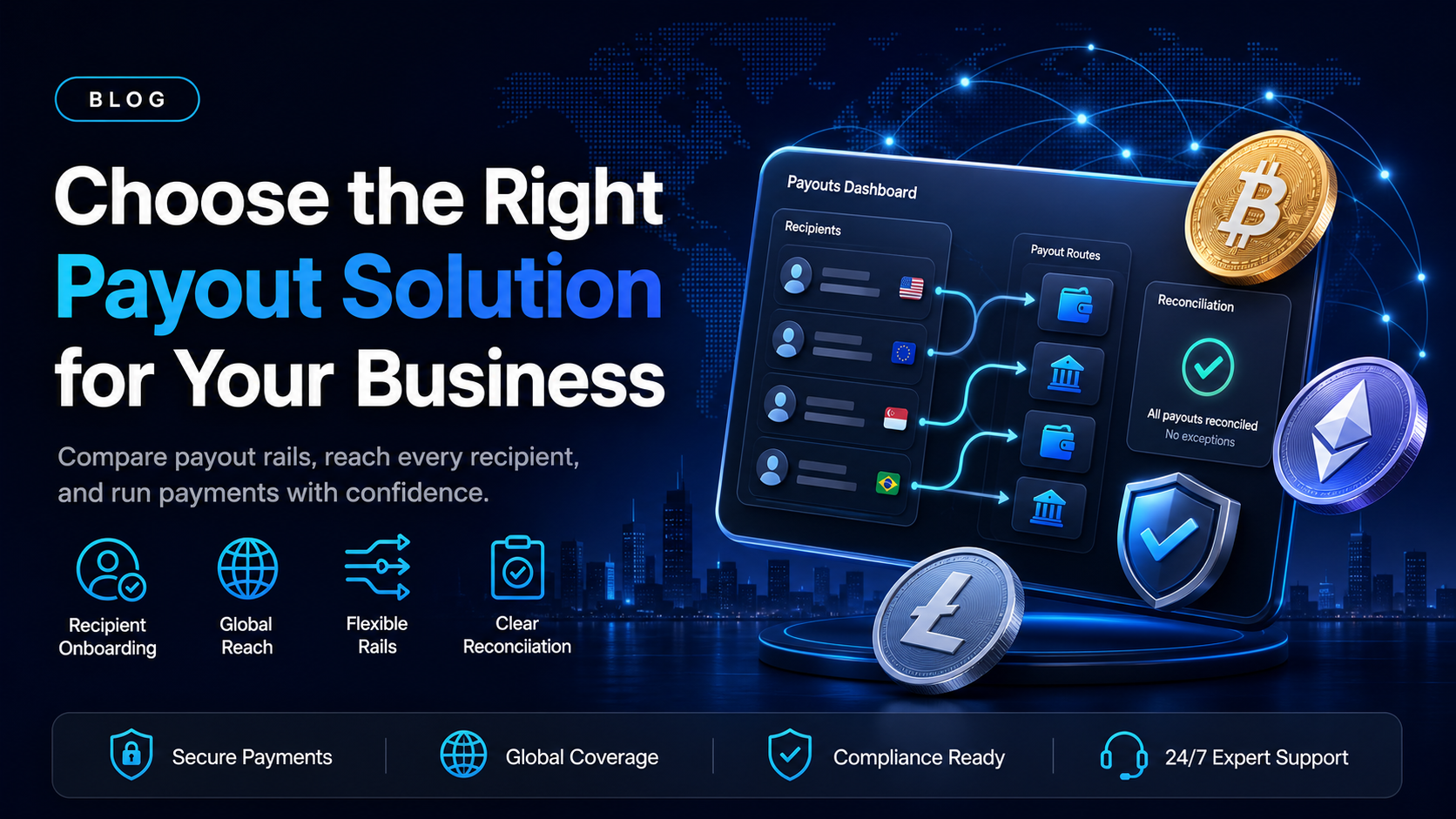
A payout solution is the software and payment rails a business uses to send money out to the people on the other side of its transactions: contractors, affiliates, sellers, creators, or gig workers. It is the reverse of a payment gateway, which collects money in. A gateway answers "how do I get paid;" a payout solution answers "how do I pay everyone else."
This guide is for the operator, finance lead, or founder who owns that decision: an affiliate network paying publishers, a marketplace paying sellers, a creator platform paying its creators, or any business that regularly pays a list of recipients rather than a single counterparty. Whether that list has a dozen names or several thousand, the payout solution you pick shapes how fast recipients get paid and which of them you can reach at all. It also decides how much manual work your finance team absorbs every cycle.
In this guide, you'll learn:
What a payout solution needs to handle, beyond simply moving money
The criteria that actually separate one payout solution from another for a business your size
How EukaPay's stablecoin and crypto payout rail compares to Tipalti and Payoneer
What to set up before you send your first payout run
What a payout solution needs to handle
A payout solution is more than a way to move money. It has to onboard recipients, support more than one way to pay them, and give your finance team a record it can reconcile afterward.
Recipient onboarding - collecting payout details without adding friction
Every payout solution needs a way for a new recipient to hand over the details a payment requires: a bank account, a card, or a wallet address. Onboarding is often the first thing a recipient sees from your business, so a payout solution that makes this collection slow or confusing costs you before a single payment goes out.
Payment rails - bank transfer, card networks, and stablecoin or crypto payouts
Most payout solutions default to bank transfer, and many add card payouts or e-wallet balances. A smaller group also supports stablecoins or crypto, which matters for recipients whose bank cannot receive an international transfer, or whose local banking options are limited compared to what your acquirer serves well. A payout solution that only offers one rail forces every recipient into it, whether or not they can use it.
Choosing a payout solution for your business
The right payout solution depends less on your industry and more on three variables: how many recipients you pay, where they are, and how tightly your payout timing is squeezed by your own collection cycle.
Recipient geography - paying people your bank transfer or card network cannot reach
A domestic bank transfer works until a recipient sits in a market your acquirer serves poorly, has no card that reliably receives cross-border payments, or holds a bank account that cannot accept your currency. A payout solution built only for domestic rails quietly excludes these recipients, and they tend to complain loudest about payout day.
Cash-cycle pressure - what changes when your own collections lag
A network that collects on a longer cycle than it pays out runs the same problem regardless of industry: an affiliate network collecting on net-30 while paying publishers on net-15, or a marketplace holding buyer funds while sellers expect a weekly payout. A payout solution does not close that gap alone, but the wrong one widens it with slow onboarding, limited rails, or a run that takes days to execute once started.
Payout solutions compared: Tipalti, Payoneer, and EukaPay
EukaPay | Tipalti | Payoneer | |
|---|---|---|---|
Payout rails | Stablecoins and cryptocurrencies: USDC, USDT, ETH, BTC | ACH, wire transfer, card, and check across 200+ countries | Bank withdrawal, prepaid card, or Payoneer balance |
Built for | Networks and platforms adding a payout rail alongside their existing bank option | Mid-market and enterprise finance teams running AP and mass payouts | Marketplaces and platforms paying freelancers, sellers, and partners |
Settlement to your own account | USD, EUR, GBP, or CAD, converted at a locked exchange rate on every payout | Multiple currencies, with FX built into the payment workflow | Local-currency withdrawal where your bank supports it |
EukaPay's payout rail is built for stablecoins and cryptocurrencies, not for replacing a fiat rail outright. The other providers here are established fiat-first options. Tipalti's Mass Payments product starts at $249 per month before per-transaction and FX fees, per Tipalti's own pricing page, read August 2026. Payoneer charges a flat $1.50 fee on same-currency withdrawals under $50,000 a month, rising to 0.5% above that threshold and up to 3% on non-local currency withdrawals, per Payoneer's own fee page, read August 2026. Recipients inside the traditional banking system are well served by either one. EukaPay is the rail for the recipients who are not: the contractor whose bank will not accept an incoming wire from your country, or the creator who wants a payout not tied to a bank's clearing calendar.
What EukaPay does for a business choosing a payout solution
EukaPay sets up a second payout rail your network can add alongside the one it already uses, without asking every recipient to switch. A recipient who can take a stablecoin or crypto payout gets one; a recipient who needs a bank transfer keeps using whatever rail already serves them. Payouts go out in USDC, USDT, ETH, or BTC, sent on Ethereum, Tron, or Bitcoin, with the asset and network set per payout.
Every conversion runs through an instant crypto-to-fiat conversion at a locked exchange rate to remove your exposure to crypto price swings, applied by default on pay-ins and on payouts. Settlement to your own account reaches USD, EUR, GBP, or CAD. A crypto payment confirms on-chain, so protection against chargebacks is a property of the payment method, not a service layered on top of it.
For a single payout, the Payout API creates one crypto payout per request from your own systems. For paying a list of recipients at once, you upload a CSV file of recipients in the merchant dashboard instead. The payout balance you draw from is funded by transferring in from your account's main balance.
Get started with EukaPay
to see how a stablecoin or crypto payout rail fits alongside the payout solution you already use. Developers (or coding agents) can review the full payout endpoint reference in the
before wiring up their first payout run.
Frequently asked questions
What is a payout solution?
The software and payment rails a business uses to send money to recipients on the other side of its transactions, such as contractors, affiliates, sellers, or creators. It is the outbound counterpart to a payment gateway, which collects money in.
What's the difference between a payout solution and a payment gateway?
A payment gateway collects money from a payer. A payout solution sends money out to a list of recipients. Many businesses need both, run by different teams inside the same finance stack.
Can a payout solution send stablecoins or crypto?
Some can, depending on the provider. EukaPay's payout rail sends USDC, USDT, ETH, or BTC on Ethereum, Tron, or Bitcoin, alongside whatever bank or card rail your business already uses.
What does a payout solution cost?
It varies by provider. Some charge a monthly platform fee plus per-transaction and FX charges, and some charge per-withdrawal fees that change with volume. Confirm the current schedule with any provider you evaluate.
Do I need a payout solution if I only pay a handful of recipients?
A small recipient list can often be paid manually through a bank's own transfer tools. A payout solution earns its cost once onboarding, reconciliation, or reaching recipients outside your bank's usual coverage becomes the time-consuming part.
Does EukaPay replace my existing payout solution?
Not necessarily, and it does not need to. EukaPay adds a stablecoin or crypto payout rail next to whatever bank transfer or card-based solution you already run, for the recipients who benefit from it.
Does EukaPay have a payout API?
Yes. The Payout API creates one crypto payout per request from your own systems. To pay many recipients at once, upload a CSV file of recipients in the merchant dashboard instead of calling the API in a loop.
Where does the money for a payout run come from?
From your EukaPay account balance, funded by transferring in from your main balance. A payout run does not draw directly from money collected from a separate counterparty.
Related articles
- what a payment run is and how one executes across a recipient list.
- the mechanics of sending crypto to your recipients, step by step.
Crypto payouts for freelance and talent marketplaces
- how a marketplace pays a distributed seller or talent base in stablecoins or crypto.
Products
Use Cases
© 2026 EukaPay. All rights reserved.
FINTRAC: M22233887