How to pay affiliate marketers on time, every cycle
September 17, 2026
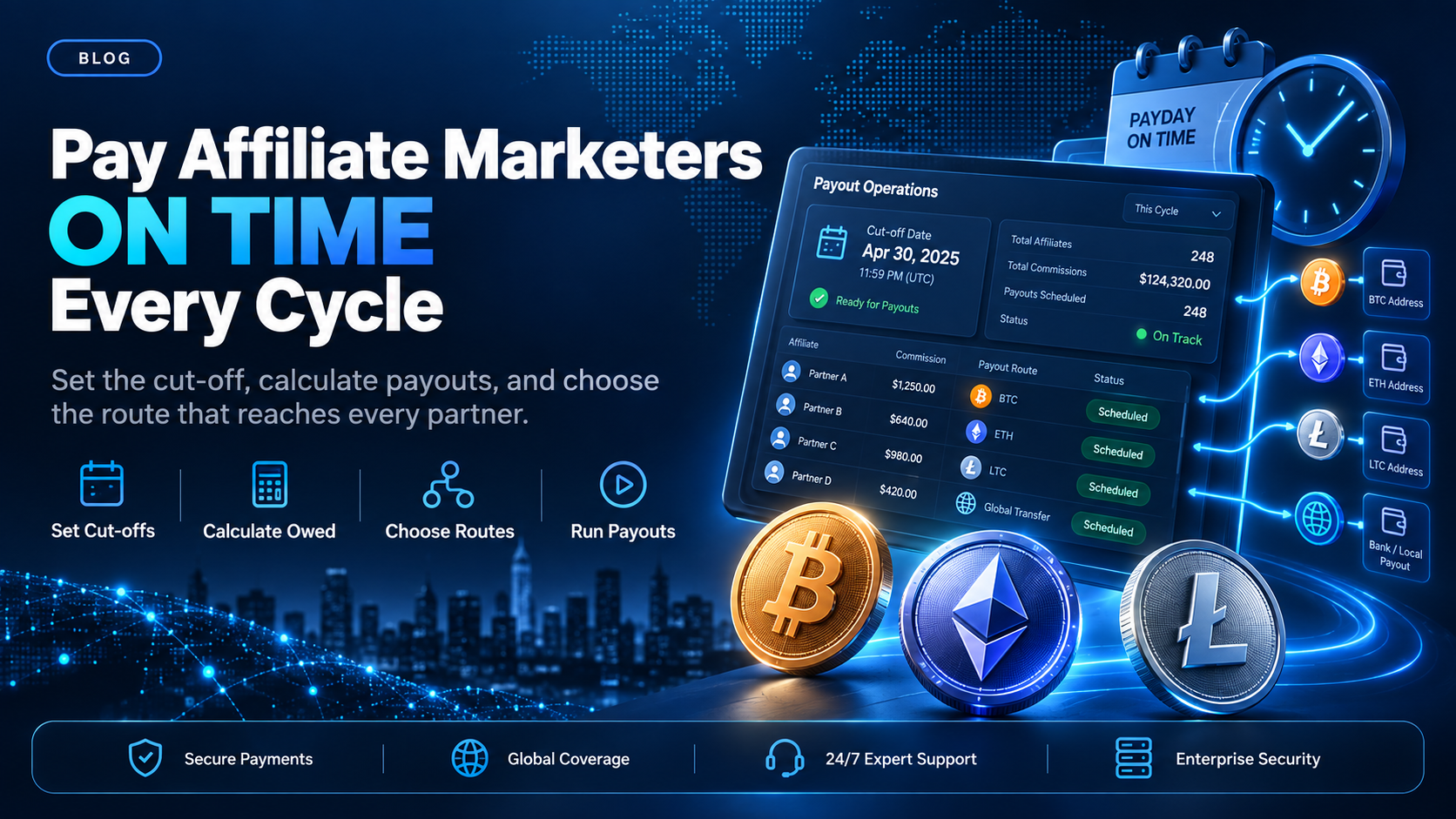
Paying affiliate marketers takes four steps, in this order: set a cut-off that says what counts toward this cycle, calculate what each marketer is owed after reversals, pick a payment route that reaches them, then fund the balance and send. Run them in that order and the date holds. Leave the route question until payout day and it slips, because a marketer whose bank details do not work is a problem you cannot fix in an afternoon.
EukaPay covers the last two of those steps. A network funds a payout balance and sends USDC, USDT, ETH, or BTC to each marketer's own address. Collections settle into the network's own bank account in USD, EUR, GBP, or CAD. What follows is the cycle in order, and which route fits which marketer.
In this guide, you'll learn:
How to set a payout cycle and a cut-off date your marketers can plan around
How to calculate what each affiliate marketer is owed after reversals and thresholds
Which payment route reaches which marketer, and what you need to collect from each one
How a payout run works, from funding the balance to recording the reference
Set the payout cycle, the cut-off, and the payout date
A cycle is two dates, not one. The cut-off is the moment you stop counting conversions toward this payment. The payout date is when the money leaves. Marketers only ever measure you on the second one, so the gap between them is yours to use.
Publish both dates and keep them fixed. A marketer who knows the cut-off is the 15th and the payout is the 25th can plan their own spend. A marketer who gets paid "around month end" cannot, and that is the group that churns first.
covers what a network owes and when in more detail.
The cut-off - what counts toward this cycle
Everything approved before the cut-off gets paid in this run. Everything after it carries to the next one. Keep the rule mechanical, because a case-by-case cut-off turns every cycle into a negotiation with your largest partners.
The gap - why the payout date is not the cut-off
The days between the two dates are for calculation, reversals, and funding. Ten days is common. Shortening it is a competitive lever, and lengthening it is the first thing marketers notice.
How often should you pay affiliate marketers?
Monthly is the default across most programs. Weekly is the usual upgrade for high-volume partners. Net-15 and net-7 terms show up where networks compete for the same media buyers. The right answer is the shortest cycle your collections can support without a gap.
The constraint is rarely the payment rail. It is the advertiser side. You may be collecting on net-30 while paying on net-15, so a faster payout cycle draws on working capital instead of money already received. Pick the cadence you can hold every time. One weekly cycle that slips is worse for retention than a monthly one that never does.
Calculate what each affiliate marketer is owed this cycle
The figure is gross commission, less reversals, less anything held back, tested against a threshold. Do it from one ledger, not from a report per advertiser, so the number a marketer sees in their dashboard is the number that gets sent.
Reversals and clawbacks - holding back after a refund
A conversion that refunds after you have paid on it is money you have to recover from the next cycle. Most programs hold a short window before a conversion becomes payable, and the window is worth stating in the partner terms. It is easier to delay a payment than to reclaim one.
Minimum payout thresholds - who carries forward
A threshold stops you sending amounts that cost more to move than they are worth. Balances below it roll into the next cycle. Set it against the route you use most, and tell marketers where they stand. Payment providers can apply their own minimums on top of yours.
Choose the payment route that reaches each affiliate marketer
Most programs run more than one route, because one route rarely covers the whole partner base. Bank transfer is the right answer for a marketer with a business account in a currency your bank handles well. Payment wallets can suit smaller balances. Neither reaches everyone, and the partners they miss are often the ones producing volume in markets your acquirer serves poorly.
Bank transfer - what you collect and what it depends on
You collect bank details per country, and the transfer moves through the correspondent banking chain. Cost and timing depend on that chain and on the banking calendar at both ends.
Stablecoin payouts - what you collect and what it does not depend on
You collect an address and the network it sits on. Asset and network are set per payout, so different marketers in the same cycle can be paid in different cryptocurrencies on different networks. Crypto payouts are not tied to banking hours or the banking calendar, so a cut-off that lands on a weekend does not move the payout date.
covers the mechanics, and
pay recipients without bank account access
covers the partners this route exists for.
Running the payout - CSV upload or the Payout API
Upload the recipient list as a CSV file in the merchant dashboard for a full cycle. The Payout API creates one payout per request, so it suits payments triggered by your own system, not a whole run. Each payout carries its own reference you can look up afterward, which is what your finance team reconciles against the commission ledger.
Paying 200 affiliates in one batch with crypto
walks through a single run.
How to choose
Bank transfer | Payment wallet | Stablecoin payout | |
|---|---|---|---|
What you collect from the marketer | Bank details for their country | An account email | An address and the network |
Who it reaches | Partners your bank's correspondent chain covers | Partners in the provider's supported markets | Partners with an address |
Tied to the banking calendar | Yes | Varies by provider | No |
Set per recipient | Currency | Currency | Asset and network |
EukaPay covers the third column, and it is built to sit alongside the first two, not to replace them. Bank transfer stays the better answer for a partner with a working business account in a currency you already settle in. Payment wallets keep small balances cheap to move. Where a partner falls outside both, a stablecoin payout reaches them on the same cycle as everyone else. That is the point of running more than one route.
One platform for affiliate pay-ins, payouts, and fiat settlement
EukaPay gives a network one account for both sides of the cycle. Advertisers can pay in through checkout, payment links, invoices, or the API. Marketers are paid out in USDC, USDT, ETH, or BTC on Ethereum, Tron, or Bitcoin. Both sides run with instant crypto-to-fiat conversion at a locked exchange rate to remove your exposure to crypto price swings, support for most major cryptocurrencies, and settlement in USD, EUR, GBP, and CAD to your bank account. A crypto payment confirms on-chain, so protection against chargebacks is a property of the payment method.
If your payout date has slipped more than once because a route failed, not because the money was missing, add the route that does not depend on the banking calendar.
sets out the wider process.
covers the same cycle where the partners are companies.
Get started with EukaPay
Create an account at
, complete verification, and generate an API key. The payout endpoints, balance transfer, invoices, subscriptions, and customers are all documented at
, and a staging environment is available for development.
Frequently asked questions
Which payment route should you use to pay affiliate marketers?
No single route covers a whole partner base. Most programs pay domestic partners by bank transfer, then add a second route for the partners the first one cannot reach reliably.
Can I pay affiliate marketers in different currencies?
On the crypto side you set the asset and the network per payout, so partners in the same cycle can receive different cryptocurrencies. Your own collections settle to your bank account in USD, EUR, GBP, or CAD.
How do I pay an affiliate marketer without a bank account?
Pay to an address on a blockchain network instead. You collect the address and the network from the partner, and the payout does not need a bank on their side.
Which cryptocurrencies can I pay affiliate marketers in?
USDC, USDT, ETH, and BTC, on Ethereum, Tron, and Bitcoin.
How do I fund the payout balance?
Two ways. Transfer from your account's main balance, or make a fiat deposit.
Can I pay a thousand affiliate marketers in one cycle?
Yes. Upload the recipient list as a CSV file in the merchant dashboard. The Payout API creates one payout per request, so a full cycle runs from the upload, not from a single call.
Is there a minimum payout amount?
EukaPay enforces per-asset minimum payout amounts. Your own program threshold sits on top of that and is yours to set.
Do crypto payouts wait for bank opening hours?
No. Crypto payouts are not tied to banking hours or the banking calendar, so a payout date on a weekend or a public holiday still holds.
Related articles
- the operator's step-by-step guide to the whole payout process.
- how networks pay their publishers, and what each side expects.
Pay 200 affiliates in one batch with crypto
- a single run from upload through to confirmation.
Products
Use Cases
© 2026 EukaPay. All rights reserved.
FINTRAC: M22233887