Affiliate payments: what a network owes and when
September 14, 2026
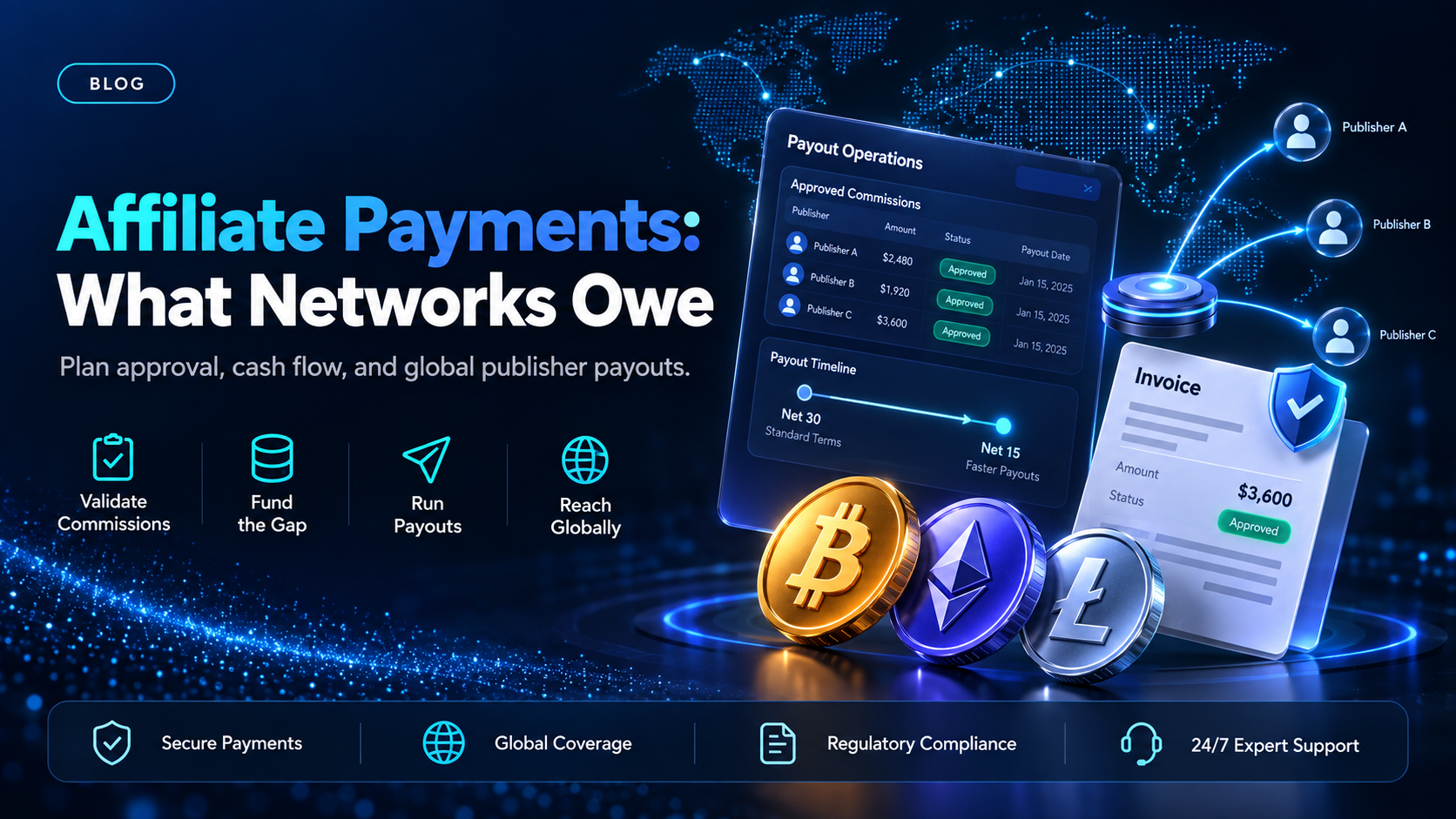
An affiliate payment is the commission a network, brand, or platform pays a publisher for a conversion the publisher drove. The amount is set by the commission model, the obligation starts when the conversion clears validation, and the money leaves on the network's payment run. Those are three separate moments, and a network that treats them as one will pay publishers out of money that has not arrived yet.
EukaPay handles the sending half of that problem. Once a commission is approved and a run is ready, EukaPay pays publishers in stablecoins or crypto on a rail that is not tied to banking hours or the banking calendar. It settles the network's own collections to its bank account in USD, EUR, GBP, and CAD. This guide covers when the obligation starts, what the terms gap costs, and which routes reach a publisher base spread across markets.
In this guide, you'll learn:
When an affiliate payment becomes an obligation, and what happens before that point
How net 30 advertiser terms and net 15 publisher terms create a working capital gap
Which payment routes reach publishers your bank cannot pay easily
How EukaPay sends affiliate payments and settles the collection side
What counts as an affiliate payment, and when the obligation starts
A conversion is not a payable. Most networks hold a conversion through a validation window, because the advertiser can reverse it - a return, a canceled order, a lead that fails a quality check. The commission becomes real money owed at the end of that window, not at the moment the pixel fires.
This matters for cash planning more than it matters for accounting. A publisher reading a dashboard sees a number climbing all month and reads it as money. The network sees a liability that is still partly reversible. Setting the validation window clearly, and showing pending and approved separately, can prevent most of the support tickets a payment run generates.
Conversion to approved commission - the validation window
The window is a commercial decision, not a technical one. A shorter window makes a network more attractive to publishers and carries more reversal risk. A longer window protects the network and pushes good publishers toward competitors who pay sooner.
Approved commission to payment run - the gap that has to be funded
Once a commission is approved, the network owes it. Whether the network can send it depends on whether the advertiser has paid. That gap is the working capital question in every affiliate payment program, and it does not go away when the payment method changes.
Affiliate payment terms: net 30, net 15, and the working capital between them
A common shape for a network is collection on net 30 from advertisers and payment on net 15 to publishers. The network funds the difference out of its own balance sheet for half a month, every month, on the whole book.
Three levers change that number, and each has a cost. Shortening advertiser terms is a sales conversation that can lose accounts. Lengthening publisher terms is a retention conversation that can lose supply, and publishers talk to each other about payment reliability. Raising minimum payout thresholds reduces the count of small payments without reducing the obligation, because the money is still owed and still accrues.
The fourth lever is the one most networks reach for last: changing what each payment costs to send and what it waits on. A run that is not waiting on the banking calendar frees the planning buffer a network keeps for transfers that may or may not land before the weekend. Our guide to
covers how that choice is usually framed.
When should a network pay affiliates after a conversion is approved?
There is no standard answer. The cycle should match the network's own collection cycle plus the reserve it can afford to hold. Weekly runs can be a competitive advantage where publisher supply is tight, and they cost more in per-payment charges and in the buffer the network carries.
What matters more than the interval is that the interval never slips. A publisher promised a date and paid late once may discount every future promise, and a network that misses a run repeatedly can lose strong publishers to one that does not. Predictability is cheaper to deliver than speed, and it buys more.
How affiliate payments reach publishers across different markets
A domestic publisher base is a solved problem. A global one is not, because the routes that work well inside one banking system get slow and expensive the moment the money has to cross correspondent banking to reach another. Every added market adds another bank, another set of cut-off times, and another set of intermediary charges nobody quoted up front.
Stablecoins are a second rail here, not a replacement for the first. A publisher with a working local bank account and a domestic payment route does not need one. A publisher your bank cannot pay easily, or can only pay through a chain of intermediaries, is the segment where a stablecoin payout does real work. Our post on
covers the publisher relationship in full.
How to choose
Domestic bank transfer | International wire | Digital wallet | Stablecoin payout | |
|---|---|---|---|---|
Publisher needs an account with | Their own bank | Their own bank | The wallet provider | A crypto wallet |
Tied to banking hours and the banking calendar | Yes | Yes | Depends on the wallet | No |
Reaches publishers your bank cannot pay easily | No | Through correspondent banking | Where the provider operates | Yes, if they hold a wallet |
Reference the publisher can look up | Bank reference | Wire reference | Provider transaction ID | Payout reference |
EukaPay covers the stablecoin payout route and the network's own collection side in one account. Bank transfers stay the right answer for publishers with a working local route, and a network running both will keep its bank rail for that segment. The routes that break down are the cross-border ones, and that is where a stablecoin payout earns its place. Our walkthrough of
paying 200 affiliates in one run
shows what that looks like end to end.
One platform for collections, crypto payouts, and fiat settlement
A network using EukaPay collects from advertisers and pays publishers through one EukaPay account. On the collection side, EukaPay offers instant crypto-to-fiat conversion at a locked exchange rate to remove your exposure to crypto price swings, support for most major cryptocurrencies, and settlement in USD, EUR, GBP, and CAD to your bank account. A crypto payment confirms on-chain, so protection against chargebacks is a property of the payment method.
On the paying side, payouts are sent in USDC, USDT, ETH, and BTC, on Ethereum, Tron, and Bitcoin. Asset and network are set per payout, so one publisher can take USDC on Tron while another takes ETH. For a payment run, upload the recipient list as a CSV file in the merchant dashboard. The payout balance is funded by transferring from the account's main balance, and each payout carries its own reference a publisher can quote to support.
Teams that would rather trigger payments from their own stack can use the Payout API, which creates one payout per request. If your publisher base is global and your current rail is the part that keeps slipping, the stablecoin route is the one to test first.
Get started with EukaPay
Create an account at
to collect from advertisers and pay publishers through one EukaPay account. Developers (or coding agents) building the run into an existing platform can start with the payout endpoints at
.
Frequently asked questions
What are affiliate payments?
Affiliate payments are the commissions a network, brand, or platform pays a publisher for conversions the publisher drove. They are calculated by the commission model, approved after a validation window, and sent on a payment run.
When does a network have to pay an affiliate?
When the network's published terms say so, usually a set number of days after the close of the period in which the commission was approved. The terms are the network's own commercial choice, and the reliability of hitting them matters more to publishers than the interval itself.
What is the difference between affiliate payments and affiliate payouts?
They describe the same money from two angles. Affiliate payments is the obligation the network owes, and a payout is the outbound transaction that clears it. Our guide to
covers the sending side in detail.
Can a network pay affiliates in stablecoins?
Yes. EukaPay sends payouts in USDC and USDT, and a publisher receives them in their own wallet. It works best for publishers your existing bank rail reaches slowly or not at all.
Which cryptocurrencies can EukaPay send to publishers?
Payouts are sent in USDC, USDT, ETH, and BTC, on Ethereum, Tron, and Bitcoin. Asset and network are chosen per payout, so different publishers in the same run can receive different assets.
Is there a minimum affiliate payment amount?
EukaPay enforces a minimum payout amount per asset. Your own publisher-facing threshold is separate, and most networks set one to keep the count of very small payments down.
Can a network send affiliate payments from its own software?
Yes. The Payout API creates a payout programmatically, one payout per request, so a run built in code steps through recipients. The documented API surface covers invoices, subscriptions, payouts, balance transfer, and customers.
How does a publisher confirm an affiliate payment arrived?
Each payout carries its own reference that can be looked up, so a publisher querying a missing payment can be answered from the reference rather than from a screenshot of the run.
Related articles
Affiliate payouts: how networks pay their publishers
- the payout relationship between a network and its publisher base
Crypto mass payouts for contractors and affiliates
- running a single payment run across a mixed recipient list
Global payouts: paying recipients across many markets
- what changes when a recipient base spans several banking systems
Products
Use Cases
© 2026 EukaPay. All rights reserved.
FINTRAC: M22233887