Affiliate payouts: how networks pay their publishers
August 28, 2026
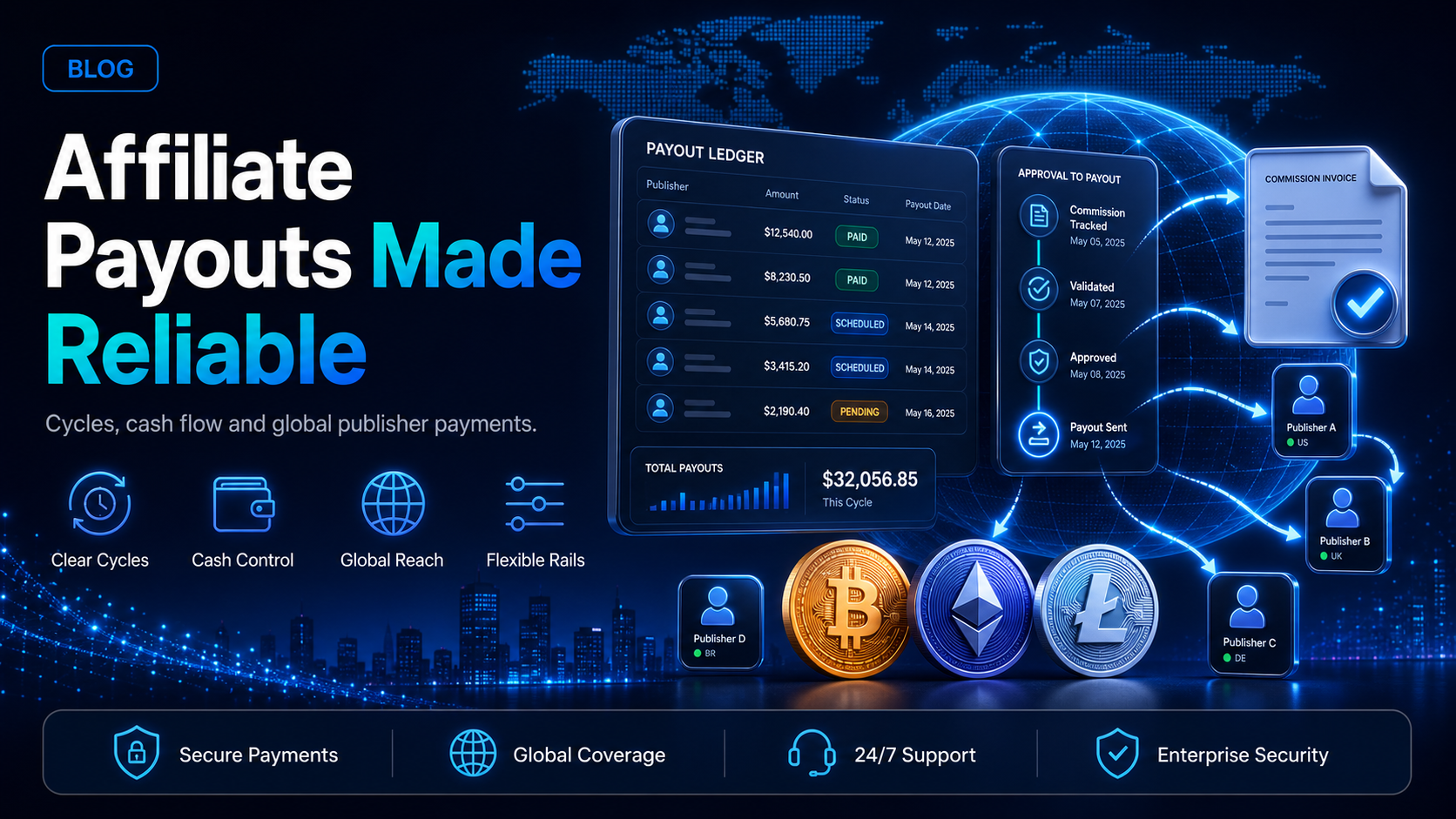
Affiliate payouts are the commissions a network or program pays its publishers for performance it has already credited. Each payout covers a defined period, clears an approval step, and usually has to clear a minimum amount before it is sent. The accounting is straightforward. The funding is the hard part, because most networks owe publishers before their advertisers have paid them.
EukaPay is the payout side of that relationship for operators paying a global publisher base. This guide covers what a network owes and when, why payout day slips, and which method reaches which publisher.
In this guide, you'll learn:
What an affiliate payout is, and the steps a commission passes before it is paid
Why net-30 advertiser terms and shorter publisher terms strain a network's cash
Which payout methods reach which publishers, and where a bank transfer is still the right answer
How EukaPay sends publisher payouts in USDC, USDT, ETH, and BTC
What an affiliate payout is and what a network owes a publisher
A publisher earns a commission the moment a conversion is credited. They do not get paid then. Three steps sit between the credit and the money: approval, the minimum balance, and the payout cycle. Many payout disputes come from a publisher who does not know one of them exists.
Commission approval - when a credited conversion becomes a payable amount
A credited conversion is provisional. Leads get disqualified, orders get returned, and trials get canceled. Networks hold conversions for a defined period so reversals land before the money leaves. Publish that hold length in your terms and show it in the publisher's dashboard.
Payout terms - the cycle, the threshold, and the currency
Three numbers define the relationship: the cycle you run payouts on, the minimum balance a publisher needs before one is sent, and the currency they receive. Publishers compare all three across the networks they work with, so each one is a competitive term instead of an operational detail.
Why affiliate payouts slip when advertisers pay on net-30
The gap between the two sides of a network is the whole problem. Advertisers usually pay on net-30 or longer. Publishers often expect net-15, and the strong ones ask for less. The difference is working capital the network funds itself, every cycle, out of its own balance.
That gap is manageable until one advertiser pays late. Then an obligation that was covered on paper is not covered in the account. The operator can delay the run, pay part of it, or fund the shortfall elsewhere. The banking calendar makes it worse. A wire initiated on a Friday afternoon can sit until the following week, so a two-day funding problem can become a five-day payout delay.
Publishers do not read a late payout as a cash-flow event. They read it as a signal, and the good ones have somewhere else to send their traffic. One missed date can cost more traffic than a point of commission buys.
How often should a network pay its publishers?
Monthly is the default, and it keeps the cost of running payouts down. Fewer runs mean fewer per-payout charges and fewer reconciliation passes. It also means a publisher can wait up to 30 days after a conversion clears its hold.
Weekly and biweekly cycles are an acquisition lever, especially for publishers who buy media and need the cash back in market. The cost is more runs, more per-payout charges, and an obligation that lands before more of your advertiser invoices do. A published weekly cycle you miss twice is worse than a monthly cycle you always hit.
Affiliate payout methods and which publishers each one reaches
No single method reaches every publisher, so pretending otherwise leaves a long tail you cannot pay.
Local bank transfer is the right answer for a publisher with a domestic account in your settlement currency. It is cheap, familiar, and worth keeping. It gets unreliable outside your acquirer's footprint, where the transfer can route through intermediary banks, unpredictable deductions, and a delivery date nobody can confirm.
PayPal and consumer wallets reach small publishers well, and are often what a first-time affiliate asks for. Coverage and per-transfer economics vary by market. Dedicated mass-payout vendors handle a wide recipient base and a long list of local rails, which is why high-volume programs use them.
Stablecoin and crypto payouts serve the segment the other three reach worst. That is publishers in markets your acquirer serves poorly, publishers who want the currency value they were quoted, and publishers who need the money on a weekend. A payout sent on-chain is not tied to banking hours or the banking calendar. For the mechanics of a single run, see our guide to
sending 200 affiliate payouts in one go
. For the general shape of a payment run on any rail, see
.
How to choose an affiliate payout method
EukaPay crypto payouts | Bank transfer | PayPal or a wallet | Mass-payout vendor | |
|---|---|---|---|---|
Tied to banking hours? | No | Yes | Varies | Varies |
Asset and network set per payout? | Yes | No | No | No |
Reaches publishers outside your acquirer's footprint? | Yes | Sometimes | Sometimes | Often |
Typical publisher | Global, many markets | Domestic, your currency | Small, consumer-facing | Mixed, high volume |
EukaPay is built for the first column, and it sits alongside the others instead of replacing them. Keep your domestic publishers on bank transfer where it works. Route the ones a bank transfer reaches badly to a crypto payout. Moving that segment off wires is the shift covered in our guide to
.
One platform for advertiser pay-ins, publisher payouts, and fiat settlement
EukaPay runs both sides of a network's money in one account. On the collection side you can invoice advertisers or send them a payment link, with instant crypto-to-fiat conversion at a locked exchange rate to remove your exposure to crypto price swings, support for most major cryptocurrencies, and settlement in USD, EUR, GBP, and CAD to your bank account. A crypto payment confirms on-chain, so protection against chargebacks is a property of the payment method.
On the payout side, publishers are paid in USDC, USDT, ETH, or BTC on Ethereum, Tron, or Bitcoin. Asset and network are set per payout, so two publishers in the same cycle can be paid differently. For a full cycle, you upload your recipient list as a CSV file in the merchant dashboard. The Payout API creates one payout per request. That suits real-time or approval-triggered payments from your own system. You fund the payout balance by transferring from your account's main balance. Each payout carries its own reference your support team can look up. The locked exchange rate applies by default on payouts as well as pay-ins, so the rate a publisher is paid at is the rate you were quoted.
If your publisher base spans more markets than your bank does, EukaPay is the payout rail to add first. Start with the segment you currently pay worst.
Get started with EukaPay
Create an account at
to set up advertiser collection and publisher payouts together. Your developer (or coding agent) can read the payout, balance transfer, invoice, and customer endpoints at
.
Frequently asked questions
What are affiliate payouts?
Affiliate payouts are the commission payments a network or program sends its publishers for credited performance over a defined period. A payout is sent once the commission clears any holding period and the publisher's balance meets the program's minimum.
Why do affiliate payouts get delayed?
Most delays are funding, not process. A network usually pays publishers before its advertisers have paid it, so one late invoice can push a run. Bank cut-off times and non-banking days then stretch a short gap into a longer visible delay.
What is a minimum payout threshold?
It is the smallest balance a publisher needs before a payout is sent. Thresholds keep per-payout charges from consuming small balances. Minimum payout amounts also apply per asset, so set your published threshold above them.
Which cryptocurrencies can I pay publishers in with EukaPay?
USDC, USDT, ETH, and BTC, on Ethereum, Tron, and Bitcoin. Asset and network are set per payout, so different publishers in the same cycle can receive different assets.
Can I pay a whole affiliate cycle at once?
Yes. Upload your recipient list as a CSV file in the merchant dashboard. The Payout API is the route for individual payments from your own system, since it creates one payout per request.
Do crypto payouts wait for banking hours?
No. A payout sent on-chain is not tied to banking hours or the banking calendar, so a Friday cycle need not wait for Monday.
Can I collect from advertisers and pay publishers in the same account?
Yes. Advertiser pay-ins, publisher payouts, and fiat settlement in USD, EUR, GBP, and CAD all run through one EukaPay account, which keeps one place to reconcile a cycle.
Related articles
How to pay 1,000 publishers monthly
- running a large publisher cycle without a per-recipient bank process
Crypto mass payouts for contractors and affiliates
- paying a mixed recipient base at scale
- choosing how your business sends money out
Products
Use Cases
© 2026 EukaPay. All rights reserved.
FINTRAC: M22233887