How to pay affiliates: a practical guide for network operators
August 31, 2026
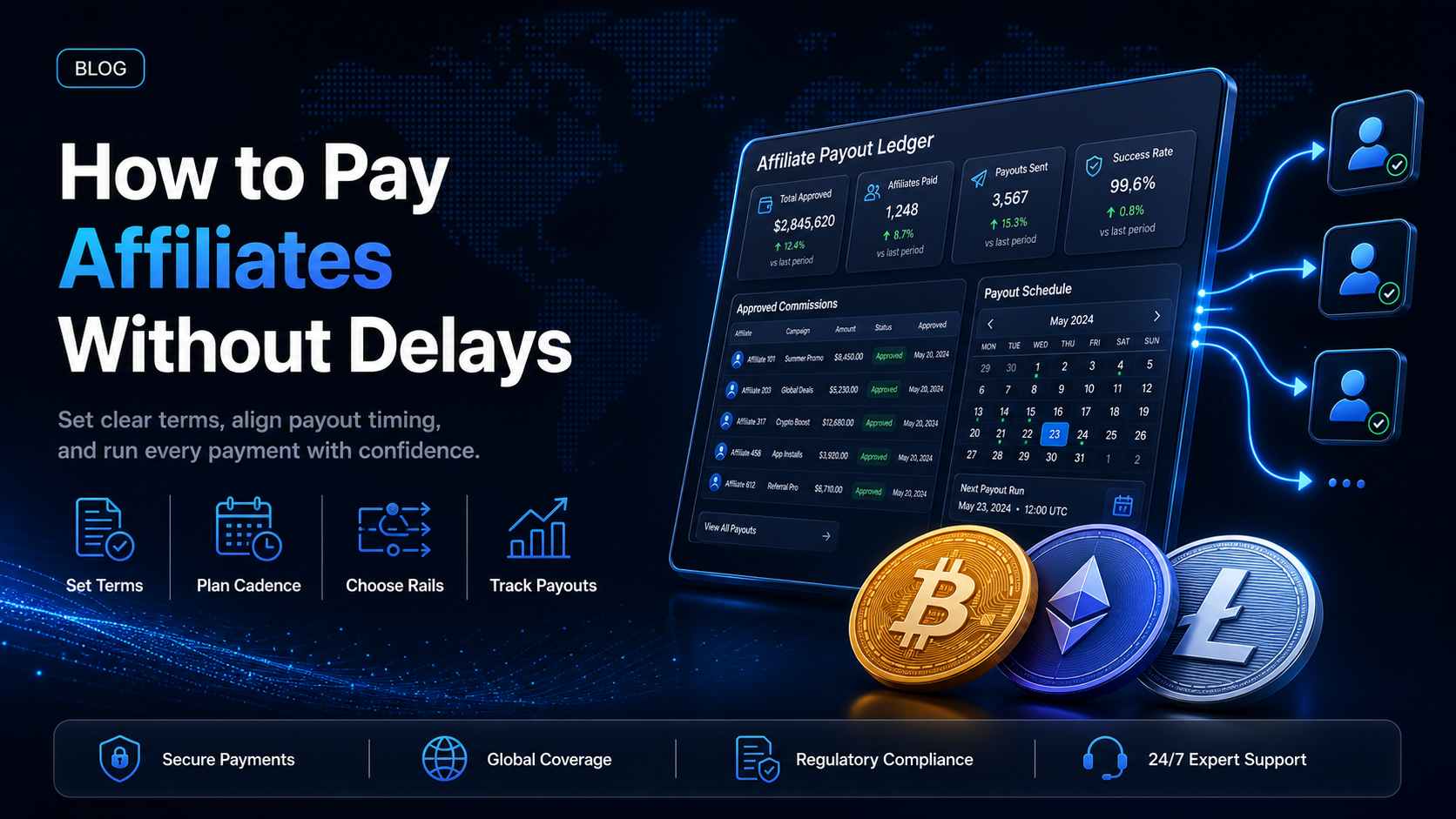
You pay affiliates by agreeing four things with them up front, then running a payment against those terms on a fixed date. The four are the commission model, the payout schedule, the minimum balance an affiliate has to reach, and the rail each affiliate gets paid on. Everything else in affiliate payment operations is bookkeeping around those four decisions.
The hard part is the date. Advertisers commonly pay a network on net-30, and affiliates commonly expect net-15, so the network funds the difference out of its own working capital. EukaPay is built for the payment side of that gap: it collects from advertisers in stablecoins or crypto, and it sends affiliate payouts to recipients your bank may not reach. This guide walks the process in order, then compares the rails you can pay on.
In this guide, you'll learn:
The four terms to settle with an affiliate before the first payment goes out
A step-by-step run, from approved commissions to a sent payment
How to pick a payout cadence your advertiser terms can actually fund
Which rail reaches which recipients, and what each one costs to send
What you decide before the first affiliate payment goes out
These four terms belong in the program agreement, not in a spreadsheet somebody maintains by hand. Every one of them changes the size of the payment run and the date it lands on.
Commission model - CPA, revenue share, or hybrid
CPA pays a fixed amount per qualified action, so the payable amount is known the moment the action clears. Revenue share pays a percentage of what the advertiser bills, so the payable amount can move until the advertiser's own numbers are final. Hybrid deals carry both, and they need both calculations reconciled before a single line is approved for payment.
Holding period - the window that covers refunds and reversed conversions
A holding period is the time between a conversion being recorded and its commission becoming payable. It exists so you are not paying commission on a sale that gets refunded, canceled, or flagged the following week. Set it against your advertisers' own refund windows, because a holding period shorter than the refund window means you will sometimes claw money back from affiliates.
Minimum payout threshold - the balance that triggers a payment
A minimum payout threshold keeps you from sending a large number of very small payments, each carrying its own send cost. Balances below the threshold roll into the next cycle. Publish the number in the program terms, because an affiliate who does not know the threshold reads a rolled-over balance as a missed payment.
Payment method - the rail each affiliate is paid on
Collect payout details at approval, not on payout day. An affiliate whose details are missing on the morning of a run is an affiliate you cannot pay that cycle. One late payment can be enough to lose a good publisher. Let affiliates pick from the rails you actually support, and record the choice against their account instead of in an email thread.
How to pay affiliates step by step
Close the period.
Freeze the commission ledger on a set date so the payable amount stops moving.
Apply the holding period and thresholds.
Move commissions that have cleared their holding window into payable, and roll anything under the threshold forward.
Reconcile against advertiser billing.
Match payable commission to what you invoiced advertisers for that period, so a billing correction does not reach an affiliate as a clawback.
Approve the run.
Have a second person sign off on the total and on any line that changed after the freeze.
Fund the payout balance.
On EukaPay, you fund the payout balance by transferring from your account's main balance, so the money is in place before the run starts.
Send the payments.
For a mass payout, upload the recipient list as a CSV file in the EukaPay merchant dashboard. You can also create payouts from your own system with the Payout API, which creates one payout per request.
File the references.
Each payout carries its own reference that can be looked up. Support can then answer "where is my payment" against a specific line, not a whole run.
Steps 1 to 4 are where the money is decided and steps 5 to 7 are where it moves. Most networks that miss payout dates miss them in steps 1 to 3, not at the send. For the mechanics of a single large run, see our walkthrough of
sending 200 affiliate payouts in one batch
.
How often should you pay affiliates?
Monthly is the default because it matches the advertiser invoicing cycle, so the money you pay out has usually arrived before it leaves. Net-15 and weekly cadences are a real competitive lever with good publishers, and they are also the point where the network starts funding the gap itself. A weekly run against net-30 advertiser terms means you are lending your affiliates roughly three weeks of their own earnings, every week.
Before committing to a faster cadence, model the peak. Take your biggest single week of payable commission in the last quarter. Add the commission that will accrue before the matching advertiser invoice settles, then check that number against your available cash. If it does not clear, a faster cadence for your top tier of affiliates only is usually the better trade. The mechanics of running one are covered in our guide to
mass payments and how a payment run works
.
How to choose
Bank transfer | PayPal Payouts | Crypto payouts on EukaPay | |
|---|---|---|---|
Which recipients it reaches | Recipients your bank can reach | Recipients in supported countries | Anyone with a wallet address on Ethereum, Tron, or Bitcoin |
Asset each recipient receives | Local currency only | Supported currencies only | Set per payout, so recipients can take USDC, USDT, ETH, or BTC |
Weekend and holiday runs | Business days only | Varies, confirm with provider | Payouts are not tied to banking hours or the banking calendar |
Cross-border cost driver | Wire fee plus intermediary-bank deductions | 2% capped at 20.00 USD, plus a 4% conversion spread | Network fee, with the exchange rate locked on every conversion |
Please check website for latest information.
EukaPay is the rail for the affiliates the other two cannot reach easily, which in most networks means the recipients outside your own market. Set the asset and network per payout, so one run can pay some recipients in USDC on Tron and others in BTC. There is ground here EukaPay does not claim. A domestic affiliate base paid into local accounts is already served well by ACH and by a payment wallet. Those recipients outside your own market are the group those two rails reach least well, and they are the ones to move onto EukaPay first.
One platform for advertiser collections, affiliate payouts, and fiat settlement
The same EukaPay account handles both sides of the cycle. On the collection side you can invoice advertisers and take stablecoins or crypto. On the payout side you send to affiliates in USDC, USDT, ETH, or BTC. Both sides get instant crypto-to-fiat conversion at a locked exchange rate to remove your exposure to crypto price swings, support for most major cryptocurrencies, and settlement in USD, EUR, GBP, and CAD to your bank account. A crypto payment confirms on-chain, so protection against chargebacks is a property of the payment method.
For a network, the practical gain is that the collection date and the payout date sit in one system. The person who approves the run can see what has arrived. If your publisher base is global and your payout dates are slipping, that is the case for adding EukaPay as your second rail. Start with the recipients your bank reaches least well, keep your domestic rails, and see our overview of
affiliate payouts and how networks pay publishers
for the wider picture.
Get started with EukaPay
Create an account at
, complete verification, provide your legal business information, then generate an API key. A developer (or coding agent) building the run into your own dashboard can read the payout, balance transfer, invoice, and customer endpoints at
.
Frequently asked questions
How do you pay affiliates?
Agree a commission model, a payout schedule, a holding period, and a minimum threshold, then close the period and run a payment against the approved commission ledger. The rail can be bank transfer, a payment wallet, or crypto payouts.
How often should you pay affiliates?
Monthly is the most common cadence because it matches advertiser invoicing. Faster cadences win publishers, but the network funds the gap between when advertisers pay and when affiliates do.
What is a minimum payout threshold?
It is the balance an affiliate has to reach before a payment is sent. Balances below it roll into the next cycle, which keeps per-payment send costs off very small amounts.
How do you pay affiliates outside your own country?
Pay them on a rail that reaches them. A bank transfer works where your bank has a route, and crypto payouts reach any recipient with a wallet address on a supported network.
Which cryptocurrencies can you pay affiliates in on EukaPay?
Payouts are sent in USDC, USDT, ETH, or BTC, on Ethereum, Tron, and Bitcoin. Asset and network are set per payout, so different affiliates in the same run can receive different assets.
Do you need to write code to pay affiliates through EukaPay?
No. Upload your recipient list as a CSV file in the merchant dashboard. The Payout API is there when you want the run triggered from your own system, and it creates one payout per request.
Can you pay affiliates on a weekend?
Crypto payouts are not tied to banking hours or the banking calendar, so a run does not have to wait for the next business day.
What happens if a conversion reverses after the affiliate has been paid?
That is what the holding period is for. Set it longer than your advertisers' refund windows, so commission becomes payable only after the reversal risk has passed.
Related articles
Affiliate payouts: how networks pay their publishers
- the payout relationship between a network and its publisher base.
How to send 200 affiliate payouts in one batch
- the mechanics of a single large run, from close to send.
Payout solutions: choosing how your business sends money out
- the wider category of outbound payment options.
Products
Use Cases
© 2026 EukaPay. All rights reserved.
FINTRAC: M22233887