B2B affiliate network payouts
September 14, 2026
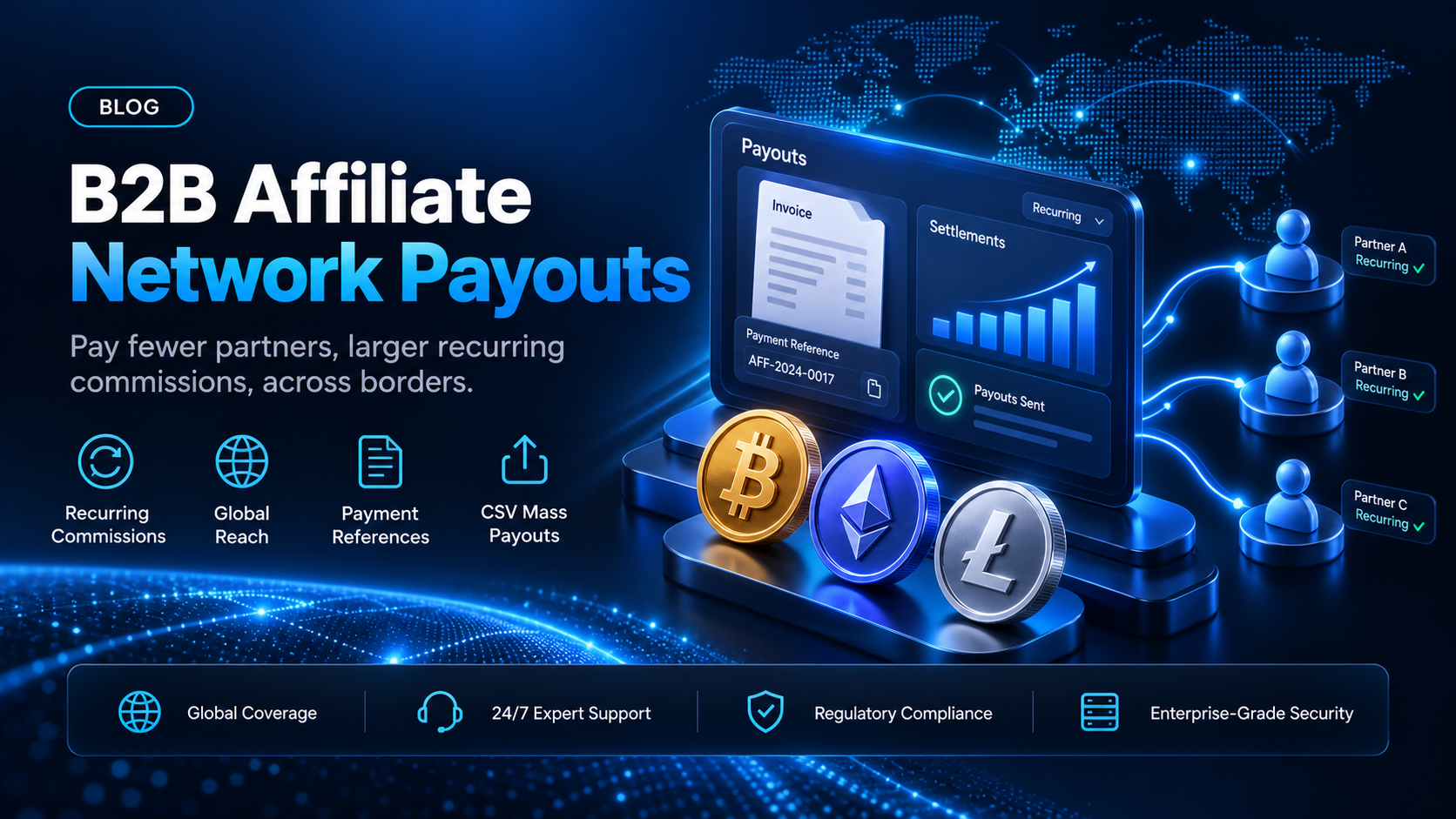
A B2B affiliate network sits between companies that sell to other businesses and the partners who refer those buyers. The partners are agencies, consultants, review sites, and software vendors, not consumer bloggers. That changes the payout side more than it changes the marketing side. There are fewer partners, each one is owed more, and the commission on a single referred account can keep paying out for as long as that account renews.
EukaPay is built for the payment side of that relationship. It collects from advertisers in stablecoins or crypto. It sends partner payouts in USDC, USDT, ETH, or BTC, with fiat settlement in USD, EUR, GBP, and CAD to your bank account. This guide covers what makes B2B affiliate network payouts different and how the money reaches a partner. It then compares the routes on reach, timing, the reference a partner can look up, and paying many partners at once.
In this guide, you'll learn:
What a B2B affiliate network is, and who it pays
Why B2B partner payouts are fewer, larger, and recurring
How the money reaches a partner, route by route
What EukaPay sends to partners, and how a network funds it
What a B2B affiliate network is, and who it pays
A B2B affiliate network runs the tracking, the reporting, and the payments between advertisers selling to businesses and the partners who send them accounts. The advertiser side is usually software, infrastructure, financial services, or professional services. The partner side is a roster of businesses with their own invoices, their own bank accounts, and their own finance calendars.
That second point is what separates this from a consumer program. A consumer publisher is a person with a payout threshold and an e-wallet. A B2B partner is a company that expects a payment it can match to a line in its own ledger. The payout mechanics have to produce a reference the partner can look up, an amount that matches what the network reported, and a route their finance team already recognizes. The general shape of that relationship is covered in our guide to
affiliate payouts and how networks pay publishers
. This post covers the B2B slice of it.
Why B2B affiliate network payouts are fewer, larger, and recurring
Partner count - a smaller roster, each partner owed more
A B2B roster is often a few dozen active partners, not a few thousand. Per-partner amounts are larger, because a referred business account is worth more than a referred consumer. Small per-payment costs matter less at that size, and a single failed payment matters more. One partner going unpaid can be a meaningful share of the month's obligation, and it lands on a partner the network has a named relationship with.
Recurring commission - a payout that repeats while the account renews
Many B2B programs pay revenue share on a subscription, so a referral made once can generate a commission every billing cycle after that. The payment side becomes a standing obligation instead of a one-off. A network running recurring commission needs a payment route it can use on the same terms every cycle, and a record per payment that survives into the next reporting period.
How do B2B affiliate networks pay their partners?
Three routes cover most partner payments, and many networks use more than one at the same time.
Bank transfer.
The partner supplies full bank details and the network sends a transfer. Domestically this works well. Across borders it may pass through intermediary banks, each of which can charge a fee and add a step. It also follows the banking calendar at both ends. We cover that chain in more detail in our post on
global payouts across many markets
.
E-wallet payout.
The partner holds an account with a payment provider and the network pays into it. Reach depends on which markets the provider covers, and a partner in a market the provider serves poorly has no route at all.
Stablecoin or crypto payout.
The partner supplies a wallet address and the network sends USDC, USDT, ETH, or BTC on Ethereum, Tron, or Bitcoin. Asset and network are set per payout, so different partners in the same run can be paid different assets. Sending is not tied to banking hours or the banking calendar. For the mechanics of running this at volume, see our guide to
crypto mass payouts for contractors and affiliates
.
How to choose
Bank transfer | E-wallet payout | EukaPay crypto payout | |
|---|---|---|---|
What the partner has to supply | Full bank details, sometimes an intermediary bank | An account in a supported market | A wallet address on Ethereum, Tron, or Bitcoin |
Sending outside banking hours | Follows the banking calendar | Depends on provider coverage | Not tied to banking hours or the banking calendar |
Reference for each payment | Reference set by the sending bank | Transaction ID inside the provider account | Each payout carries its own reference to look up |
Paying many partners in one go | A bank file in the bank's format | A provider upload, where offered | A CSV upload in the merchant dashboard |
EukaPay is the route to add when the partner roster stops fitting the first two, and it asks for no change in how the network reports commission. Bank transfer stays the right answer for a partner whose bank works and who invoices in a currency the network already holds. An e-wallet stays reasonable inside the markets its provider covers. Once a roster spans markets those two serve poorly, EukaPay sends the payout in USDC, USDT, ETH, or BTC to a wallet address the partner supplies.
One platform for crypto pay-ins, crypto payouts, and fiat settlement
A B2B affiliate network collects from advertisers and pays partners, so it needs both directions to work. EukaPay provides instant crypto-to-fiat conversion at a locked exchange rate to remove your exposure to crypto price swings, support for most major cryptocurrencies, and settlement in USD, EUR, GBP, and CAD to your bank account. A crypto payment confirms on-chain, so protection against chargebacks is a property of the payment method.
On the outbound side, the payout balance is funded by transferring from the account's main balance, and each payout gets its own reference. Mass payouts are a CSV upload in the merchant dashboard. The
creates payouts programmatically, one payout per request, for networks that would rather trigger payments from their own system. If you run a B2B affiliate network with partners in markets your current routes serve poorly, start with the partners those routes miss and add EukaPay for them.
Get started with EukaPay
Create an account at
to set up crypto pay-ins and partner payouts. Developers (or coding agents) building the payout flow into a partner dashboard can start with the endpoint reference in the
. EukaPay does not publish a public rate card, so pricing is agreed with the EukaPay team.
Frequently asked questions
What is a B2B affiliate network?
It is a network that connects companies selling to other businesses with partners who refer those buyers, and handles the tracking, reporting, and commission payments between them. Partners are usually agencies, consultants, review sites, or software vendors.
How do B2B affiliate networks pay their partners?
Usually by bank transfer, by e-wallet payout, or by sending stablecoins or crypto to a wallet address. Many networks run more than one route, because no single route reaches every partner.
Which cryptocurrencies can EukaPay send to affiliate partners?
Payouts are sent in USDC, USDT, ETH, and BTC, on Ethereum, Tron, and Bitcoin.
Can partners in the same payment run receive different cryptocurrencies?
Yes. Asset and network are set per payout, so partners in one run can be paid different assets on different networks.
Can a B2B affiliate network pay many partners at once?
Yes. Upload the partner list as a CSV file in the merchant dashboard. The Payout API is the programmatic route and it creates one payout per request.
How does a network fund its EukaPay payout balance?
By transferring from the account's main balance into the payout balance, inside the merchant dashboard.
Can a partner check that a payment was sent?
Each payout carries its own reference, which can be looked up. That reference is what a partner's finance team can match against the commission the network reported.
Does EukaPay publish payout pricing?
EukaPay does not publish a public rate card. Pricing is agreed with the EukaPay team.
Related articles
Affiliate payouts and how networks pay their publishers
- The payout relationship between a network and its partner base.
How to pay 1,000 publishers monthly
- Running a large publisher payment run every month.
Crypto payment gateway for ad networks and affiliates
- Collecting from advertisers and paying partners on one platform.
Products
Use Cases
© 2026 EukaPay. All rights reserved.
FINTRAC: M22233887