Crypto payment gateway for ad networks and affiliates
August 04, 2026
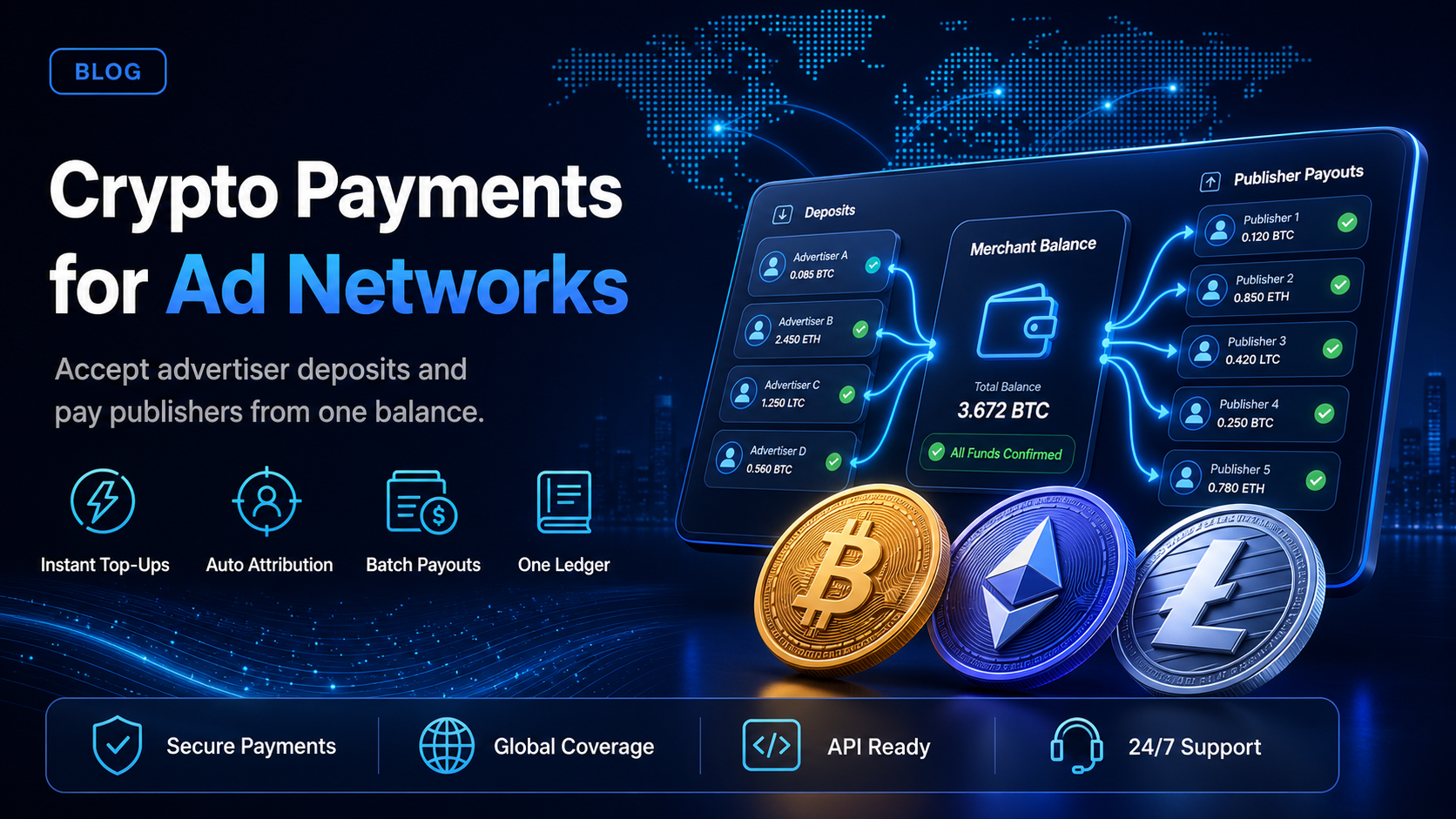
An ad network is two payment businesses wearing one brand. On one side, advertisers fund accounts and top them up as budgets burn down. On the other, publishers and affiliates get paid on a monthly or biweekly cycle, in whatever country they happen to live in. Most payment infrastructure is built for one direction, so networks end up running a card processor for deposits and a separate rail for payouts, reconciling between them by hand.
A crypto payment gateway for ad networks collapses both directions onto one merchant balance. Advertiser deposits arrive as crypto pay-ins and increase the balance; publisher payouts draw the balance back down. The sections below cover the deposit side first, because that is where the operational friction usually starts, then the payout side, then what it takes to run both on one balance.
In this guide, you'll learn:
Why advertiser deposits and publisher payouts create two different payment problems
How to attribute a recurring advertiser top-up to the right account automatically
When to use CSV batches for payouts and when to use the Payouts API
What it costs to pay several hundred publishers, and where the cost actually sits
The two-sided problem
Money in and money out fail for different reasons, which is why one payment provider rarely serves both well.
On the deposit side, the problem is friction and decline rates. An advertiser topping up a five-figure budget from another country is exactly the transaction a card issuer is most likely to decline, and a declined top-up is paused ad spend. Larger advertisers move to bank wires, which clear slowly and arrive without a reference the network can match to an account.
On the payout side, the problem is unit cost and speed. A network paying several hundred publishers monthly is running several hundred international transfers, each carrying a fee, each capable of failing on a wrong account detail, and each landing days after it was sent.
Crypto addresses both, but for different reasons. Deposits improve because there is no issuer in the path to decline the payment. Payouts improve because a batch of on-chain sends costs the same per transfer regardless of destination country.
Advertiser deposits
Deposits are the side most networks underestimate, because the hard part is not accepting the payment. It is knowing whose account to credit.
Recurring top-ups - the persistent-address pattern
An advertiser who tops up every week does not want a new payment flow every time. Assign each advertiser account a persistent deposit address, and any payment arriving at that address is attributable to that advertiser by definition. The advertiser saves the address once and reuses it, and your system credits the balance from the confirmation webhook without a human matching payments to accounts.
For networks that would rather not hold addresses per advertiser, the alternative is a payment request generated per top-up through the
, carrying your internal advertiser ID as a reference. The reference comes back on the webhook, and your system credits the right account. Our walkthrough of
how to accept crypto with a crypto payment API
covers the request-and-callback cycle in full.
Attributing a deposit to the right advertiser account
Whichever pattern you use, the rule is the same. Every deposit needs an identifier that your own system created, carried through the payment and returned on confirmation. Networks that rely on the amount to identify the payer eventually credit the wrong account, because two advertisers will top up the same round number on the same day.
Stablecoins make attribution cleaner for a second reason. When an advertiser sends 5,000 USDC against a 5,000 USD top-up, the amount you receive matches the amount you expected, so an exact-amount match is a usable secondary check. EukaPay supports most major cryptocurrencies like BTC, ETH, LTC, SOL, USDC, USDT.
Underpayments and overpayments
Advertisers get network fees wrong and send slightly less than the invoice. Decide the policy before you launch: credit the received amount and leave the balance short, or hold the top-up until the advertiser sends the difference. Crediting the received amount is the lower-friction choice and the one most networks land on, because a partially funded ad account is still a working ad account.
Publisher and affiliate payouts
Payouts are the side where crypto's advantages are easiest to quantify, because the comparison is against international bank transfers with a per-transfer fee and a multi-day settlement window.
CSV batches vs the Payouts API
Two routes, and the choice is about who initiates the run.
CSV batch upload | Payouts API | |
|---|---|---|
Who initiates the run? | A person, from the dashboard | Your platform, programmatically |
Coding required? | None | Yes, developer (or coding agent) |
Best for | A fixed monthly or biweekly cycle | Payouts triggered by your own logic |
Status tracking | Per-batch in the dashboard | Per-payout, by webhook |
Typical user | Networks with a finance-run cycle | Platforms with self-serve withdrawals |
A network running one payout cycle a month is well served by uploading a recipient list as a CSV file and letting the batch process. A network offering publishers self-serve withdrawal when they cross a threshold needs the
, because the trigger lives in your product rather than in someone's calendar. Our guide to
crypto mass payouts for contractors and affiliates
covers the batch mechanics in more detail.
Failed payouts and address validation
The most common payout failure is a publisher supplying an address on the wrong network, for example a USDC address for one chain pasted into a field expecting another. Validate the address and the network at the point the publisher saves it, not at the point you send the money. A rejected save costs a support ticket; a send to the wrong network costs the payout.
What does it cost to pay 500 publishers?
The honest answer is that the cost has three parts, and only one of them is the transfer fee.
The first part is the per-transfer cost, which is where crypto payouts differ most from international bank transfers. On-chain sends cost the same whether the publisher is in Manila or Madrid, and low-fee networks keep that cost small at volume.
The second part is failure handling. Every failed transfer becomes a support conversation and a manual re-send. Address validation at save time is what reduces this line, and it is usually a bigger saving than the fee difference.
The third part is finance staff time. A monthly cycle of several hundred individual transfers, each needing initiation and reconciliation, is a meaningful share of someone's month. Batch payouts collapse that into one upload and one reconciliation pass, which is the same operational shift described in
how to pay 500 contractors in minutes with crypto
.
We are not going to quote a per-transfer figure here, because network fees move and your mix of assets and destinations determines the number. Model it against your own last payout cycle.
Deposits and payouts on one balance
Running both directions through one provider changes the daily operation in three ways.
Advertiser deposits increase your merchant balance, and publisher payouts draw it down. Because both sit on the same balance, the funds an advertiser deposited on Monday are available to pay publishers on Friday without an intervening transfer between two providers. There is one ledger to reconcile rather than two, and one set of records for your finance team at month end.
You also keep the choice of what to hold. Convert deposits to fiat and settle to your bank account, or hold a working balance in stablecoins to fund the next payout run, or split between the two.
One platform underneath
Both directions run on the same infrastructure. EukaPay provides instant crypto-to-fiat conversion at a locked exchange rate to remove all crypto volatility, protection against chargebacks, support for a wide range of cryptocurrencies, and settlement in USD, EUR, GBP, CAD to your bank account.
The choice amongst deposit routes and payout routes is a question of fit rather than one being better than another. An ad network with a hundred enterprise advertisers and a monthly publisher cycle needs a different front end than an affiliate platform with self-serve signup and on-demand withdrawal, and both run on the same balance underneath.
Get started with EukaPay
To run advertiser deposits and publisher payouts through one provider, create an account in the
to begin onboarding and business review. EukaPay reviews every merchant as part of a business review before you go live, and a sandbox environment is available so your developer (or coding agent) can build against the
while the review runs. If deposits are the more urgent side, start with the hosted
and add the Payouts API afterwards.
Frequently asked questions
Can one provider handle both advertiser deposits and publisher payouts?
Yes. EukaPay handles crypto pay-ins and crypto payouts on the same merchant balance, so deposits fund payouts without a transfer between two providers.
How do I match an advertiser's crypto deposit to their account?
Assign each advertiser account a persistent deposit address, or generate a payment request per top-up carrying your internal advertiser ID as a reference. The reference returns on the confirmation webhook.
Can publishers withdraw on demand rather than on a fixed cycle?
Yes. Use the
so the withdrawal is triggered by your own product logic, and track each payout's status by webhook.
How many publishers can I pay in one batch?
Upload your recipient list as a CSV file and the batch processes as one run. See our guide to
crypto mass payouts for contractors and affiliates
for the mechanics.
Which cryptocurrencies work best for ad network deposits?
Stablecoins, because the amount an advertiser sends matches the amount you invoiced. EukaPay supports most major cryptocurrencies like BTC, ETH, LTC, SOL, USDC, USDT.
Do I have to hold crypto between deposits and payouts?
No. Convert deposits to fiat and settle in USD, EUR, GBP, CAD to your bank account, or hold a working stablecoin balance to fund the next payout run. The split is yours to set.
What happens if an advertiser underpays a top-up?
You decide the policy. Most networks credit the received amount and leave the balance short, because a partially funded ad account still runs.
Products
Use Cases
© 2026 EukaPay. All rights reserved.
FINTRAC: M22233887