Crypto payment gateway for VPN providers: stablecoins or crypto
August 11, 2026
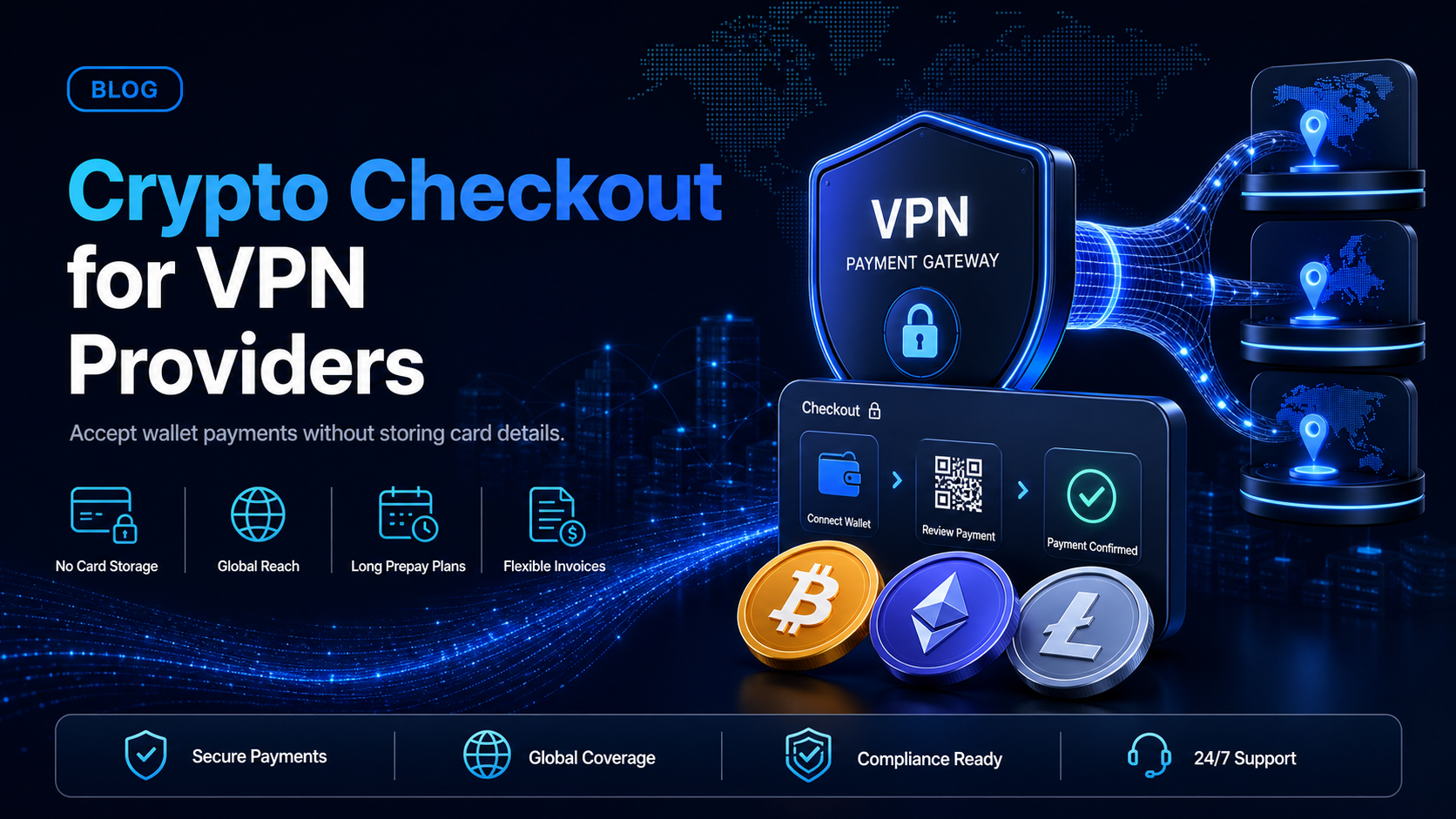
Consumer VPN is one of the few categories where the payment step argues against the product. The subscriber picks a provider that promises to keep no record of their browsing, then the checkout asks for a card number, an expiry date, a billing address and a security code, and the billing system holds a token tied to that card for the next three years.
A crypto payment gateway for VPN providers removes the card from the checkout. The subscriber pays from a wallet, the provider never receives or stores card credentials, and the provider still gets a normal bank deposit. This guide covers the pricing-page claim you can make accurately, the markets your card processor keeps declining, long prepay plans, money-back guarantees, and the web checkout you run beside your mobile apps.
In this guide, you'll learn:
How to describe a crypto checkout on a VPN pricing page accurately, without overclaiming on privacy
Why two-year and three-year prepay plans suit a customer-initiated stablecoin payment
How to honour a money-back guarantee when the payment carries no issuer-initiated reversal
Which EukaPay product to point at your web funnel, your monthly renewals and your reseller accounts
A crypto payment gateway for VPN providers as a product feature
Most differentiators in consumer VPN are hard for a buyer to check. Server counts, no-logs audits and protocol choices all require the buyer to take a company's word for something. The accepted payment methods are different, because the buyer reads them in five seconds and learns exactly what the purchase will require. A subscriber comparing three providers who sees "pay with stablecoins or crypto" on one of them has learned something concrete, which is why the wallet option belongs in the marketing conversation and not only the finance one.
What actually changes - the card leaves the subscriber record
When a subscriber pays in USDC or BTC, the provider's database stores an order, an amount, a plan term and a payment reference. It stores no primary account number, no expiry date and no billing address collected for card verification. Fewer stored fields is a smaller surface to secure and less to reconcile when a subscriber asks what the company holds on them. Accepting crypto does not change the provider's own compliance, sanctions-screening or record-keeping obligations.
How to word the claim - copy that survives scrutiny
Write the narrow version and stop there. "Pay with stablecoins or crypto. We never ask for or store your card details." Both sentences are true and both are checkable.
Avoid the sentences that promise more than a payment rail delivers. Blockchain transactions are recorded on a public ledger, so a crypto checkout is not an anonymity feature, and every EukaPay merchant goes through onboarding and a business review. The narrow claim is the one that holds up, and for this audience it is still the strongest line on the page.
Where VPN demand and card acceptance disagree
Consumer VPN demand is heaviest in exactly the markets where a recurring foreign-currency card charge is hardest to complete. A subscriber in Jakarta, Lagos, Istanbul or Hanoi may hold a debit card that works at a local grocery terminal and gets declined the moment it is presented for a cross-border digital subscription. Issuer rules, step-up authentication and cross-border decline logic sit between that subscriber and your checkout, and none of them are settings you control.
The device situation is the opposite. The World Bank's Global Findex Database 2025 reports that 84% of adults in low- and middle-income countries own a mobile phone and that 3 billion of them own a smartphone. A wallet app on a phone reaches subscribers whose banks will not issue a card cleared for recurring foreign billing, which makes a wallet checkout an acquisition channel rather than a courtesy for enthusiasts. Our guide to
cross-border payment collection
covers the collection side, and providers who also sell proxy access have separate underwriting questions covered in our guide to a
crypto payment gateway for proxy providers
.
Long prepay plans are the best fit in the category
Consumer VPN pricing runs on a ladder: monthly, annual, two-year and three-year terms, with the headline price attached to the longest one. A three-year plan is a single large payment the subscriber makes deliberately, on the day they decide to buy, and nothing about that purchase needs a stored credential.
A card token stored on day one has to stay valid through 36 months of reissues, expiries, bank switches and fraud-related replacements before it is charged again. A one-time wallet payment stores no credential at all. The provider is paid in full at signup and the ledger entry closes.
The dispute profile of a large prepay ticket matters too. A card payment leaves a window open in which the cardholder can dispute the charge long after the account was provisioned and the bandwidth consumed, the same pattern we describe for
hosting providers and chargebacks
. A crypto payment carries no issuer-initiated reversal, so a three-year prepay is collected in full and cannot be clawed back by an issuer.
Monthly plans - recurring invoices instead of stored credentials
Providers who accept crypto payments for VPN subscriptions on a monthly term use recurring invoices. EukaPay sends invoices on a recurring schedule - weekly, monthly, quarterly or custom intervals - from the dashboard and the API. A monthly subscriber receives a formatted PDF invoice with the payment link embedded, reviews it, and follows the payment screens to pay from a wallet. The subscriber initiates each payment, so the provider holds no credential to charge later.
Three settings make the schedule work. Send the invoice several days before the current period ends, so the subscriber has a window to act. State the network at checkout, so the subscriber sends the asset on the chain your integration expects. Gate the account on the payment confirmation webhook rather than on the invoice being sent, so the entitlement state stays accurate.
Money-back guarantees when the payment is final
A money-back window is standard marketing in consumer VPN, and it works alongside a crypto checkout once you separate two things card processing blurs together. On cards, a refund the provider grants and a chargeback the issuer imposes produce the same accounting result, so both get managed as one problem. On a crypto payment there is no issuer-initiated reversal, so the refund is a decision the provider makes against its own published policy.
Run the refund as a payout rather than a reversal. Collect the destination address in the refund request form rather than at checkout, match the request against the original payment reference, and send the refund with
. Refund in the same asset the subscriber paid in: a fixed stablecoin amount paid is a fixed stablecoin amount owed, which removes any argument about the correct figure.
App store commissions and your own web checkout
A large share of consumer VPN installs happen on mobile, and in-app purchase is where the platform takes a share of every subscription. Apple's developer documentation for the App Store Small Business Program, retrieved in August 2026, sets a reduced commission of 15% on paid apps and in-app purchases for developers with up to 1 million USD in proceeds in the prior calendar year, with the standard commission applying above that threshold.
Those economics push providers to sell and renew on their own website and treat the app as the client. A web checkout is where a crypto payment gateway for VPN providers installs, and every payment taken there keeps the full ticket. Put the VPN crypto checkout on the same pricing page as your card and local methods, so a VPN payment gateway is part of the web funnel rather than an add-on inside the app.
Can a VPN provider accept stablecoins without holding crypto?
Yes. The subscriber pays from a wallet, and EukaPay converts the payment at a locked exchange rate and settles USD, EUR, GBP, CAD to the provider's bank account. EukaPay supports most major cryptocurrencies like BTC, ETH, LTC, SOL, USDC, USDT, so the subscriber uses whichever asset they already hold. Finance sees a bank deposit and a settlement report, and nobody on the team opens a trading account or manages a treasury position.
Stablecoin payments for VPN providers carry the bulk of subscription volume, which is why the
route is usually the first one a provider turns on.
How to choose
Payment Links | Recurring invoices | API | |
|---|---|---|---|
Who starts the payment? | The subscriber, from a link you send | The subscriber, from the invoice you scheduled | The subscriber, inside your own flow, on a payment page EukaPay generates |
Where it lives | Email, chat, support ticket | Email inbox, on a schedule | Your website checkout and billing service |
Coding required? | None | None | Yes, a developer (or coding agent) |
Best VPN use | Reseller invoices, one-off upgrades, win-back offers | Monthly and quarterly subscribers | Self-serve signup, prepay plans, custom plan logic and entitlement gating |
Typical owner | Support and partnerships | Finance | Engineering and growth |
A VPN provider usually runs two or three of these at once:
on the pricing page for self-serve subscribers, which returns a payment page the subscriber is redirected to,
for monthly subscribers, and the
again once entitlement logic reacts to payment events directly. Our breakdown of
which EukaPay product fits your business
covers the same decision in product terms, and
how to choose a crypto payment gateway
covers the provider-level criteria.
One platform underneath
All three routes sit on the same infrastructure: instant crypto-to-fiat conversion at a locked exchange rate to remove all crypto volatility, protection against chargebacks, support for a wide range of cryptocurrencies, and settlement in USD, EUR, GBP, CAD to your bank account. One merchant account covers the pricing page, the reseller invoices, the monthly schedule and the API integration.
The choice amongst them is a question of fit rather than quality. A provider selling a three-year plan to a self-serve buyer and a provider invoicing a reseller are using the same platform, pointed at two moments in the subscriber relationship.
Get started with EukaPay
Create an account at
to set up your first checkout, and send your developer (or coding agent) to
for the payment and webhook reference. Every merchant goes through onboarding and a business review, and a sandbox environment is available so your team builds and tests the integration while the review is in progress.
Frequently asked questions
Can a VPN provider accept crypto payments without touching crypto?
Yes. EukaPay converts each payment at a locked exchange rate and settles USD, EUR, GBP, CAD to your bank account, so finance works with bank deposits and settlement reports.
Which cryptocurrencies should a VPN provider accept?
EukaPay supports most major cryptocurrencies like BTC, ETH, LTC, SOL, USDC, USDT. Stablecoins carry most subscription volume, so USDC and USDT are the ones to enable first.
Does accepting crypto make VPN payments anonymous?
No. Blockchain transactions are recorded on a public ledger, and every EukaPay merchant completes onboarding and a business review. The accurate claim is that the subscriber does not hand card credentials to the provider and the provider does not store them.
How do recurring VPN subscriptions work on EukaPay?
EukaPay sends invoices on a recurring schedule - weekly, monthly, quarterly or custom intervals - from the dashboard and the API. Each subscriber pays from the invoice, and your service gates access on the payment confirmation webhook.
How do I refund a VPN subscriber who paid in stablecoins?
Collect the destination address in your refund form, match it to the original payment reference, and send the refund using EukaPay crypto payouts.
Can EukaPay handle a three-year prepay plan in one payment?
Yes. A long prepay term is a single customer-initiated payment, and the provider is paid in full at signup.
Do crypto payments help with declined cards in emerging markets?
They add a route that does not depend on a card cleared for recurring cross-border billing, which is the approval problem VPN providers hit in their highest-demand markets.
Related articles
Crypto payment gateway for proxy providers
- the adjacent privacy-infrastructure vertical
Crypto payment gateway for hosting providers and chargebacks
- how chargeback exposure changes on infrastructure billing
How to choose a crypto payment gateway
- the criteria that matter for a subscription business
Products
Use Cases
© 2026 EukaPay. All rights reserved.
FINTRAC: M22233887