Crypto payment gateway for proxy providers and VPNs
August 04, 2026
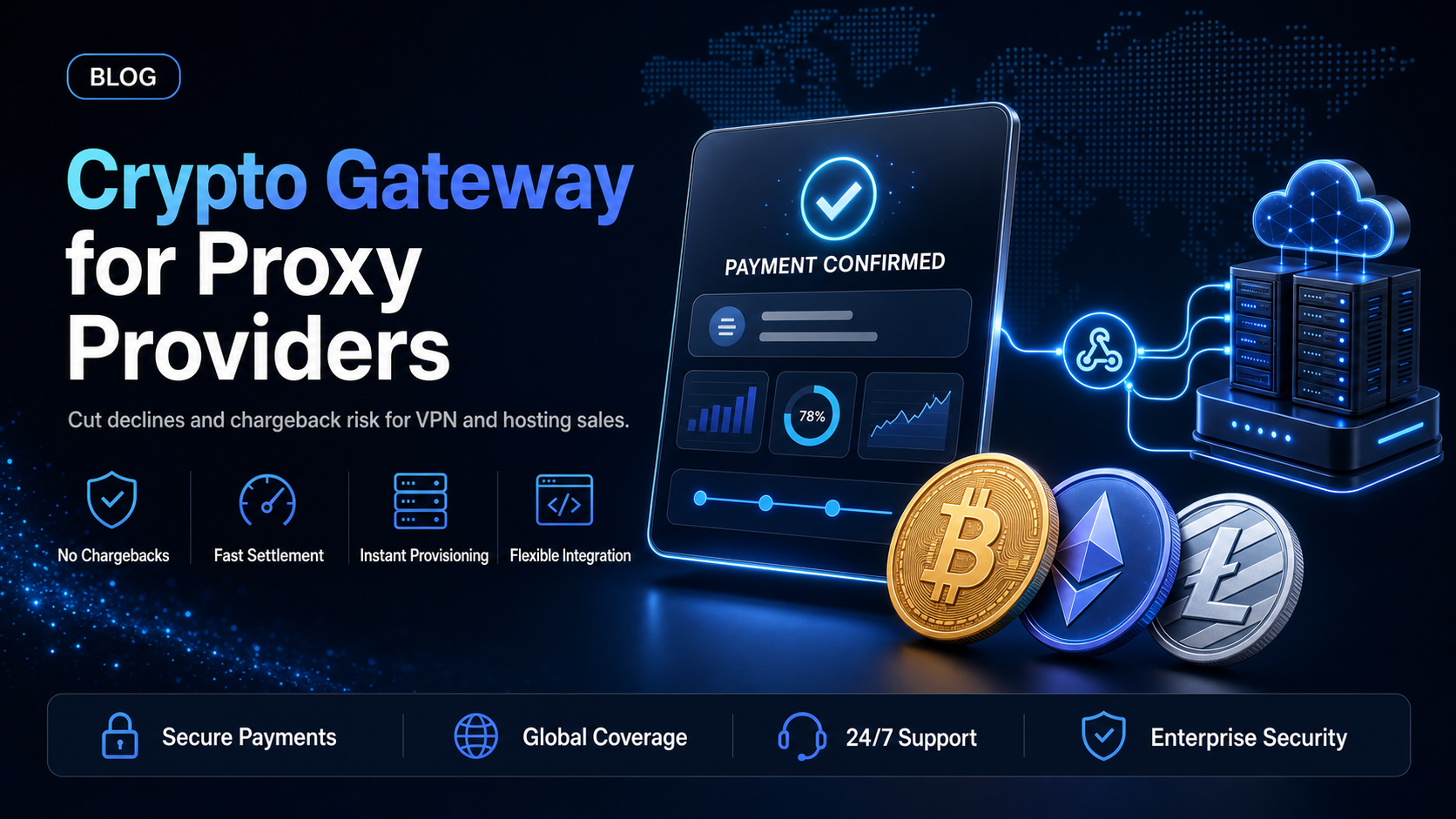
A proxy business sells an intangible product, delivers it in seconds, and serves customers who chose the product specifically because they care about privacy. Every one of those three characteristics is a risk signal to a card processor. The result is a decline rate and a chargeback rate that a physical-goods retailer would never see, plus the standing possibility that an acquirer reclassifies the account and holds a rolling reserve against it.
A crypto payment gateway for proxy providers changes the mechanics rather than the marketing. Crypto payments settle on-chain and cannot be reversed by an issuing bank, so the chargeback exposure that drives reserves and account reviews does not exist on those transactions. The sections below cover why card processors flag this category, what the chargeback maths actually looks like in digital delivery, and the four routes to accepting crypto on a proxy, VPN, or hosting site.
In this guide, you'll learn:
Why card processors classify proxy, VPN, and RDP businesses as elevated risk
How chargebacks work against a product delivered instantly and consumed immediately
The four ways to accept stablecoins or crypto on a proxy or hosting site, and which fits your stack
How to wire crypto payments into WHMCS, a custom client panel, or your own billing system
Why proxy and VPN businesses get flagged by card processors
Card networks assess risk on the shape of the transaction, not on whether the business is legitimate. Four attributes of a proxy or VPN sale each push the assessment in the same direction.
Instant digital delivery - no shipping record to defend with
A physical retailer defends a dispute with a tracking number and a signature. A proxy provider has a provisioning log and an authentication record. Those are weaker evidence in a dispute process built around shipped goods, so representment succeeds less often even when the merchant is plainly in the right.
Privacy-motivated customers - thin identity signals
Customers buying proxies, VPNs, and RDP access frequently use privacy-preserving email addresses and do not want to hand over documents. Fraud scoring reads sparse identity data as elevated risk, which raises the decline rate on perfectly good customers.
Cross-border by default - cardholder and merchant rarely share a country
Proxy demand is global. Cross-border card transactions carry higher interchange, higher decline rates, and more aggressive fraud rules than domestic ones. A customer in a market your acquirer treats as high-risk may simply be unable to pay you by card at all.
Subscription renewals - failed renewals read as involuntary churn
Monthly proxy plans renew on stored credentials. Expired cards, issuer reissues, and 3-D Secure step-ups all produce failed renewals, and each failure is a customer you already earned who now has to be recovered.
Chargebacks in a digital-delivery business
The direct loss on a chargeback is the smallest part of the cost. The full cost has four components: the disputed amount, the chargeback fee your processor charges regardless of outcome, the staff time to assemble evidence and file representment, and the effect on your chargeback ratio.
The ratio is what actually threatens the business. Cross the thresholds the card networks set and the account moves into a monitoring programme, which brings higher fees, a rolling reserve against future revenue, or termination. For a business with thin identity data and no shipping records, the ratio is harder to hold down than it is for a physical retailer.
Crypto payments remove the mechanism. A confirmed on-chain payment is final, so there is no issuing bank able to reverse it and no chargeback ratio to defend. That is the same reason a
crypto payment gateway for hosting providers reduces chargeback losses
, and the shift has been visible in the category for years, as our piece on
how cryptocurrency is disrupting the web hosting market
set out.
Crypto is not a fraud cure-all. Account-sharing abuse, trial abuse, and stolen-credential signups are product and provisioning problems, and a payment method does not solve them. What crypto removes is the reversal risk and the reserve exposure that follow from it.
What proxy customers actually want to pay with
Stablecoins are the practical answer for most proxy and VPN businesses. A customer paying USDC or USDT sends a dollar-denominated amount, which means the invoice total and the received amount match without either side absorbing a price move between checkout and confirmation.
EukaPay supports most major cryptocurrencies like BTC, ETH, LTC, SOL, USDC, USDT. Enabling the assets your customers already hold matters more than enabling the longest possible list, and for this category that generally means stablecoins first, then Bitcoin and the low-fee networks. Our roundup of the
best crypto payment gateway for hosting providers
covers the asset-selection question in more detail.
Four ways to accept crypto on a proxy or hosting site
Here's the picking heuristic in one table.
Hosted checkout | Payment links | Invoicing | API | |
|---|---|---|---|---|
Who delivers the request? | Your website, at checkout | Sent manually or by email | Sent manually as a PDF | Your application |
Coding required? | Plugin or redirect only | None | None | Yes, developer (or coding agent) |
Custom fields? | Limited | No | Line items, taxes, discounts | Full control |
Best for | Self-serve plan purchases | One-off and custom orders | Enterprise and net-terms clients | Client panels and auto-provisioning |
Typical user | Companies selling standard plans | Sales-assisted deals | Companies, consultants, freelancers | Platforms with their own billing |
Most proxy businesses end up combining two of these. Self-serve customers buy standard plans through hosted checkout, while enterprise buyers who need net terms and a purchase-order reference are invoiced. Adding the second route does not require rebuilding the first, because all four draw on the same merchant balance.
Do proxy providers need a high-risk merchant account?
For card acceptance, usually yes. Acquirers price proxy, VPN, RDP, and VPS businesses as elevated risk, which in practice means higher rates, a rolling reserve, and a standing review process.
Crypto acceptance does not work that way, because the chargeback exposure that justifies a reserve is not present. What does apply is onboarding. EukaPay reviews every merchant as part of a business review before you go live, and a sandbox environment is available so your developer (or coding agent) can build and test the integration while the review runs. EukaPay does not offer instant registration.
The realistic setup for most operators in this category is both rails at once. Keep card acceptance for customers who insist on it, and add crypto to recover the declines and remove reversal risk on the volume that moves across.
Setting it up - WHMCS, custom panels, and the API
Most proxy and hosting businesses bill through one of three stacks, and each has a straightforward route.
WHMCS or a standard billing panel.
Use a hosted checkout or payment-link route and mark the order paid from the payment notification. No changes to your provisioning logic.
A custom client panel.
Integrate the
so your panel creates the payment request, receives the confirmation webhook, and provisions the proxy automatically on confirmation. This is the setup that gets you instant delivery on crypto orders.
Sales-assisted and enterprise deals.
Use invoicing. Enter the amount, add line items, taxes, and discounts, and your customer receives a formatted PDF invoice with the payment link embedded.
Whichever route you pick, treat the payment confirmation webhook as the single trigger for provisioning. Provisioning on payment creation rather than on confirmation is the one mistake that costs money in this category.
One platform underneath
All four routes run on the same infrastructure. EukaPay provides instant crypto-to-fiat conversion at a locked exchange rate to remove all crypto volatility, protection against chargebacks, support for a wide range of cryptocurrencies, and settlement in USD, EUR, GBP, CAD to your bank account.
The choice amongst the four routes is a question of fit rather than one being better than another. A proxy business selling standard monthly plans and a hosting reseller closing annual enterprise contracts need different front ends, and both are served by the same balance underneath.
Get started with EukaPay
To accept stablecoins or crypto on your proxy, VPN, or hosting site, create an account in the
to begin onboarding and business review, then have your developer (or coding agent) build against the
in the sandbox while the review runs. If you want the fastest route live first, start with the hosted
and add the API afterwards.
Frequently asked questions
Can a proxy provider accept crypto payments without a high-risk merchant account?
Yes. Crypto acceptance through EukaPay does not require a high-risk card account, because confirmed on-chain payments cannot be reversed and therefore carry no chargeback exposure. You still complete onboarding and a business review.
Which cryptocurrencies should a proxy business accept?
Stablecoins first, because the invoice total and the received amount match. EukaPay supports most major cryptocurrencies like BTC, ETH, LTC, SOL, USDC, USDT.
Do I have to hold crypto if I accept it?
No. EukaPay provides instant crypto-to-fiat conversion at a locked exchange rate to remove all crypto volatility, and settles in USD, EUR, GBP, CAD to your bank account.
Can I provision proxies automatically when a crypto payment confirms?
Yes. Integrate the
and trigger provisioning from the payment confirmation webhook rather than from payment creation.
Does accepting crypto stop trial abuse and account sharing?
No. Crypto removes payment reversal risk and chargeback exposure. Trial abuse and account sharing are provisioning and product controls, and they need to be handled separately.
Can I bill monthly proxy plans in crypto?
Yes. EukaPay sends invoices on a recurring schedule, weekly, monthly, quarterly, or custom intervals, through the dashboard and the API.
Can I keep taking cards as well as crypto?
Yes, and most operators in this category do. Card acceptance stays for customers who prefer it, and crypto recovers the declines and removes reversal risk on the volume that moves across.
Products
Use Cases
© 2026 EukaPay. All rights reserved.
FINTRAC: M22233887