How a crypto payment gateway for hosting providers reduces chargeback losses using stablecoins or crypto
July 14, 2026
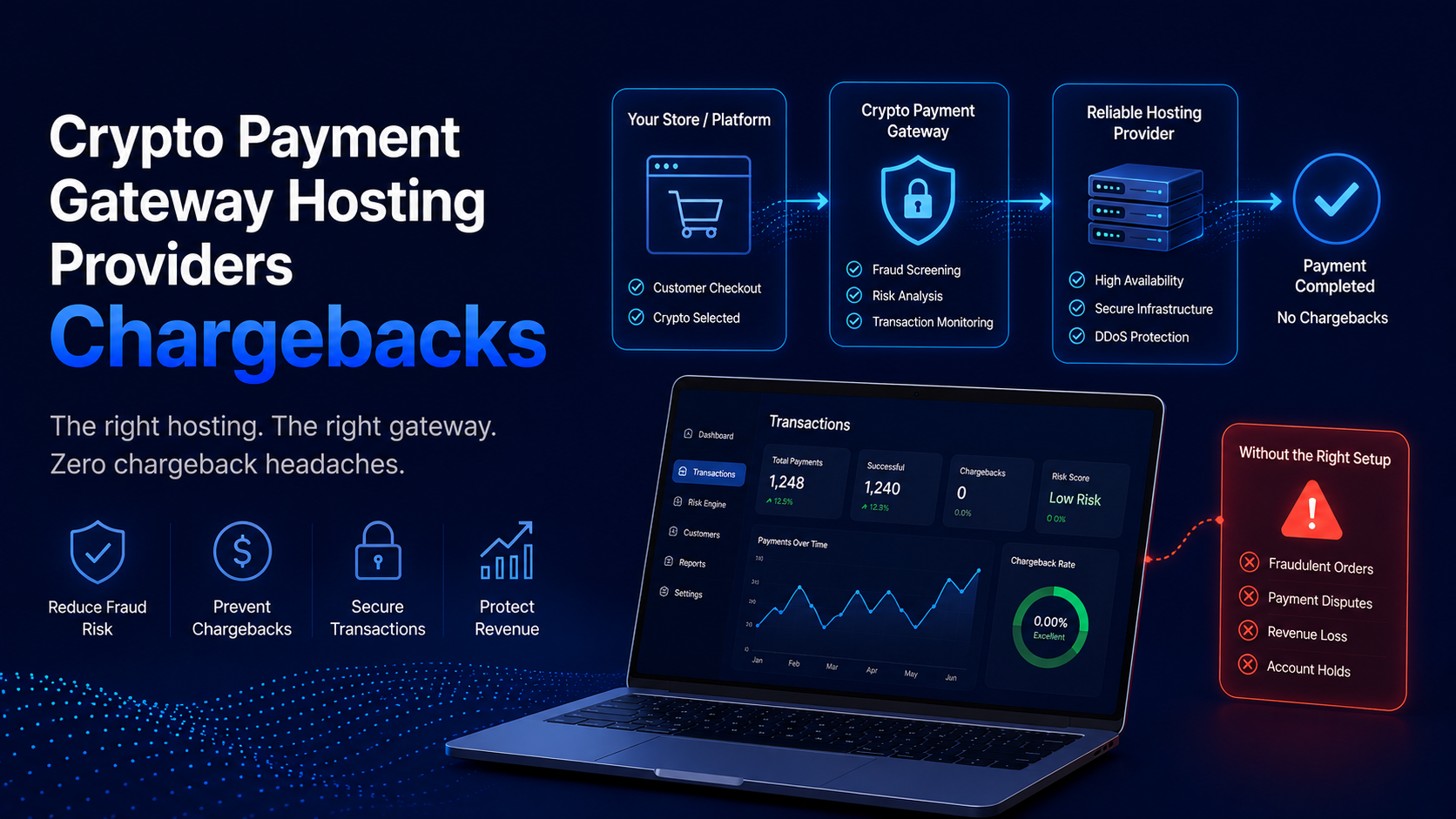
A customer signs up for a VPS plan, deploys a server, runs it hard for a week, then calls their card issuer and disputes the charge. The hosting company has already provisioned the resources, paid for the bandwidth, and absorbed the support ticket. Now it loses the revenue too. Hosting, VPN, and dedicated-server companies see this pattern more than almost any other industry, and it is one of the reasons
more merchants are adopting stablecoins or crypto
in categories card processors classify as high-risk.
Accepting stablecoins or crypto payments through a crypto payment gateway for hosting providers changes that equation directly. A confirmed on-chain payment does not carry a dispute mechanism, so a VPN or VPS company that adds one removes the single largest source of preventable revenue loss in its billing stack. This guide covers why hosting is exposed to chargebacks in the first place, how crypto settlement closes that gap, and the three ways a hosting company can actually add crypto payments to its existing billing system.
In this guide, you'll learn:
Why VPN, VPS, and dedicated hosting companies see higher chargeback rates than most online businesses
How settling in stablecoins or crypto removes the dispute mechanism that drives those losses
The three integration paths for adding crypto payments to a hosting billing stack, including WHMCS
What to look for in a crypto payment gateway for hosting providers before signing up
Why hosting companies are exposed to chargebacks
Card networks generally consider a chargeback rate above roughly 1% a problem, with several processors flagging merchants closer to 0.65%. Hosting, VPN, and dedicated-server companies sit near that line more often than most verticals, for reasons specific to how the product is consumed.
The resource is used before the dispute is filed
A VPS or dedicated server is provisioned within minutes of payment. The customer gets full root access immediately, uses the compute and bandwidth, and only afterward decides to dispute the charge. Unlike a physical good that can be recalled, the hosting company cannot claw back the CPU cycles or the bandwidth already consumed.
The customer base skews anonymous
VPN and privacy-focused hosting attracts customers who value not having their real identity tied to the purchase. That same anonymity makes it easier to dispute a charge without much friction, since the card issuer has no relationship history with the merchant to weigh against the claim.
Card networks already flag the category
VPN subscriptions and hosting services are commonly named on high-risk merchant category lists maintained by card networks and acquiring banks. Once a business lands in that category, it faces reserves, payout delays, and closer scrutiny on every dispute, regardless of whether the individual dispute is legitimate.
How crypto payments close the gap
A stablecoin or crypto payment confirms on-chain. Once it reaches the required number of confirmations, the transaction is final. There is no card network sitting between the customer and the hosting company, so there is no channel through which a customer can reverse the charge after the server has already been deployed and used.
A confirmed stablecoin or crypto payment does not remove every form of dispute. A customer can still contact support, request a refund for a service outage, or ask for account credit. What it removes is the unilateral chargeback filed through a bank, weeks after the resources were consumed, that the hosting company has no visibility into until the funds are already gone.
Settling in stablecoins or crypto also gives hosting companies pricing that holds regardless of where a customer is located. A VPS company selling to customers across regions with different currencies and different acquiring bank relationships can quote and settle a single price in USD, EUR, GBP, CAD, without maintaining separate merchant accounts per region.
Setting up a crypto payment gateway for hosting providers
Hosted checkout - fastest to launch
A hosted checkout page is a payment link a hosting company generates from its dashboard for each invoice and embeds in its billing emails. No development work is required. This suits smaller hosting providers or ones running a simple, manually issued invoice.
Payment links inside WHMCS - fits existing workflows
Most VPS and dedicated hosting companies already run their billing on WHMCS or a comparable platform. EukaPay does not currently offer a pre-built WHMCS plugin, but a hosting company can attach an EukaPay payment link to each WHMCS invoice so a customer pays in stablecoins or crypto without leaving the existing billing workflow, or a developer (or coding agent) can build a tighter, custom connection through the API.
Direct API integration - full control over the flow
A developer (or coding agent) can integrate a crypto payment gateway for hosting providers directly through an API, generating payment requests, listening for confirmation webhooks, and triggering provisioning automatically once a payment clears. This path gives a hosting company full control over the checkout experience and lets it tie crypto confirmation directly into automated server deployment.
How to choose
| Hosted checkout | Payment links inside WHMCS | Direct API |
|---|---|---|---|
Who sets it up? | Anyone from the dashboard | Anyone, by adding the payment link to each invoice | A developer (or coding agent) builds the integration |
Coding required? | No | No | Yes |
Fits existing billing system? | Separate from invoicing | Attached directly to the WHMCS invoice | Yes, built to match it |
Best for | Small hosting providers issuing manual invoices | Established VPS/VPN providers already on WHMCS | Hosting companies with in-house engineering |
Typical user | Solo operator or small team | Mid-size VPS and hosting companies | Larger hosting platforms and PSPs |
Most hosting companies combine more than one of these. A VPS provider might run a WHMCS plugin for standard subscriptions and a direct API integration for a custom customer portal or reseller program.
One platform underneath
Regardless of which integration path a hosting company chooses, EukaPay sets you up for success by providing instant crypto-to-fiat conversion at a locked exchange rate to remove all crypto volatility, protection against chargebacks, support for a wide range of cryptocurrencies including BTC, ETH, LTC, SOL, USDC, and USDT, and settlement in USD, EUR, GBP, CAD to your bank account.
The right integration path is a question of fit, not a hierarchy of better or worse. A hosting provider issuing a handful of invoices a month gets the same chargeback protection from a hosted checkout link that a larger VPS platform gets from a full API integration.
Get started with EukaPay
Hosting, VPN, and VPS companies can review their integration options and start the onboarding and business review process from the
. Developers can review
directly to plan a WHMCS-compatible payment link setup or a custom integration before going live.
Frequently asked questions
Does accepting crypto payments eliminate all disputes for a hosting company?
No. A customer can still contact support and request a refund or credit. What a confirmed stablecoin or crypto payment removes is the unilateral chargeback filed through a card issuer weeks after the service was used.
Which cryptocurrencies can a VPS or VPN company accept through EukaPay?
EukaPay supports most major cryptocurrencies like BTC, ETH, LTC, SOL, USDC, and USDT, with settlement in USD, EUR, GBP, CAD.
Does EukaPay work with WHMCS billing systems?
EukaPay does not currently offer a pre-built WHMCS plugin. Hosting companies running WHMCS can attach an EukaPay payment link to each invoice today, and developers can build a custom API integration for deeper automation.
Do hosting companies need to hold cryptocurrency to accept crypto payments?
No. EukaPay converts incoming crypto payments to fiat at a locked exchange rate, so a hosting company never holds crypto on its own balance sheet unless it chooses to.
How fast does a crypto payment confirm for server provisioning?
Confirmation times depend on the blockchain used for the payment. Once a payment reaches the required confirmations, a hosting company's system can trigger automated provisioning through the API.
Can a hosting company switch from a card-only checkout to a crypto payment gateway without rebuilding its billing system?
Yes. Hosting companies already running WHMCS attach EukaPay payment links to existing invoices rather than replacing the billing system. Companies with a custom billing stack integrate through the API alongside their existing checkout.
Is EukaPay only for large hosting platforms?
No. Solo VPS operators using a hosted checkout link and large hosting platforms running a full API integration both get the same chargeback protection and settlement currencies.
Does signing up with EukaPay require an existing merchant account?
Every merchant, including hosting and VPN companies, goes through EukaPay's onboarding and business review process. A sandbox environment is available for development and testing during that review.
Products
Use Cases
© 2026 EukaPay. All rights reserved.
FINTRAC: M22233887