Crypto payment gateway for cloud storage providers
August 11, 2026
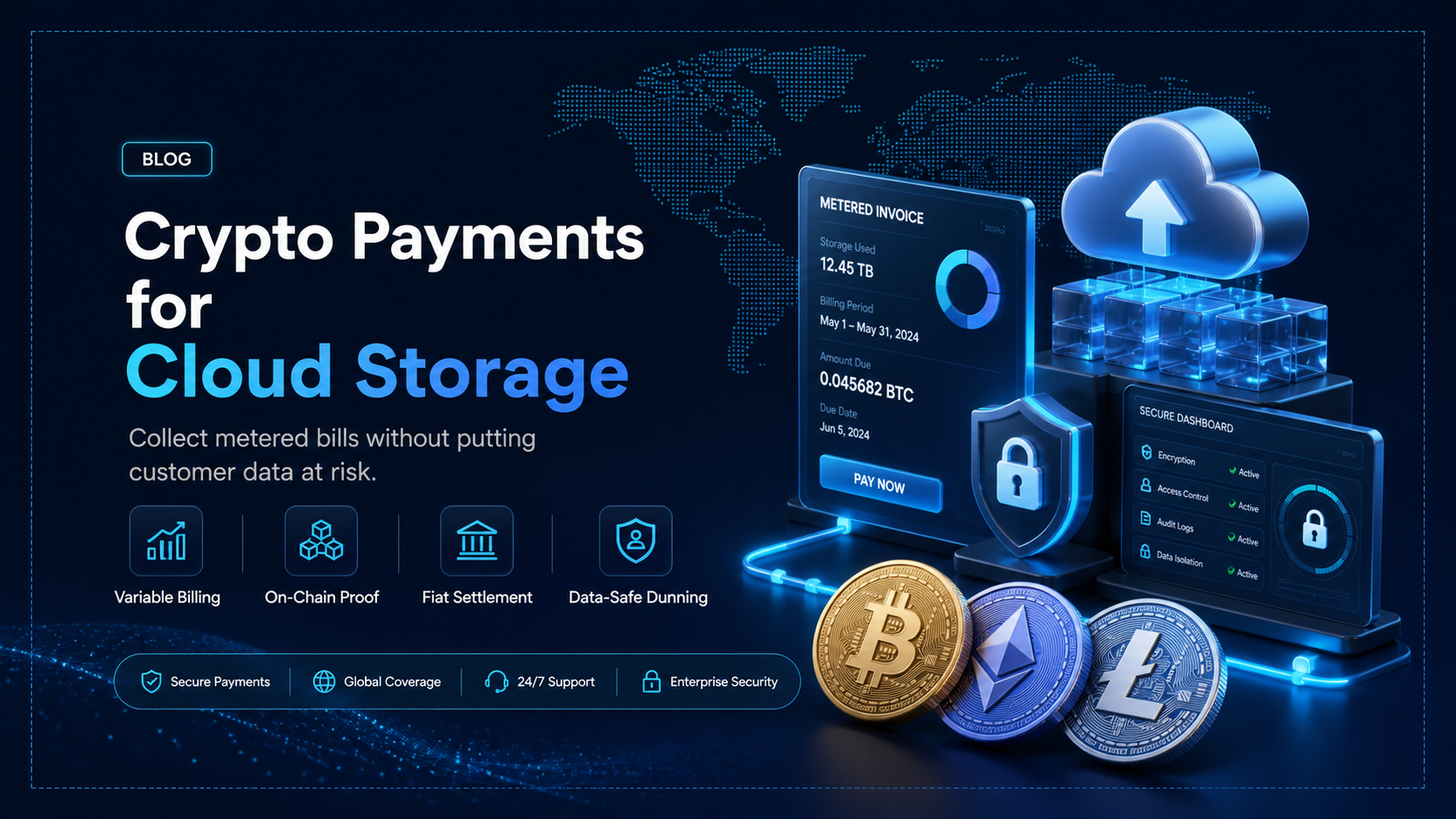
Storage billing has a failure mode that most subscription businesses never face. When a card declines on a design tool, the customer loses access to a feature and gets it back when the card clears. When a card declines on an object storage bucket or a managed backup account, the provider has to decide how long to keep several terabytes of somebody else's data before deleting it. That decision sits at the end of every dunning sequence, and it is why a crypto payment gateway for cloud storage providers deserves evaluation on more than the headline fee.
Stablecoins and crypto change the mechanics of collection rather than the shape of the bill. The amount is still metered and the retention policy still has to be written down. What changes is that the payment either confirms on-chain or it does not, with no issuer in the middle deciding whether a variable monthly charge looks suspicious. This guide covers what makes storage billing distinct, who asks to pay in stablecoins, the three ways to collect through EukaPay, and how to design the non-payment path.
In this guide, you'll learn:
Why a usage-based storage bill is harder for a card to approve consistently than a flat monthly fee
How to structure crypto collection so a payment failure never advances a data deletion timer
The three EukaPay routes for collecting storage and backup revenue, and which billing model each one fits
How to price prepaid credit, overage, and egress when the customer pays in stablecoins or crypto
What makes storage billing different
Three properties separate storage and managed backup from ordinary software subscriptions. Each one changes what you should want from a payment method.
A declined payment turns into a retention decision - not just a lockout
Most verticals can suspend a service and restore it later at no cost. A storage provider carrying an unpaid account is paying real money every day to keep the data on disk, so the grace period has a hard economic ceiling. Past that ceiling the provider either absorbs the cost indefinitely or deletes customer data, and deleting a paying customer's backups because a card expired is the kind of incident that ends up in a public postmortem. Payment reliability is therefore a data-integrity concern for a storage provider, not only a revenue concern.
The amount changes every cycle - stored volume plus egress
A storage invoice is the sum of average stored volume, retrieval or egress, request counts, and whatever tiering the provider applies. All four move month to month, so the charge amount moves month to month. Card issuers approve recurring charges partly on how closely a new charge resembles previous charges from the same merchant, so a bill that jumps when a customer runs a large restore is the pattern that draws a decline or an extra authentication step.
A stablecoin payment carries no equivalent judgment. The customer sees the amount, sends the amount, and the payment confirms on-chain. The same variable-amount problem appears across adjacent infrastructure markets, which is why the same argument runs through our guide to a
crypto payment gateway for hosting providers
.
Long-lived customers make involuntary churn expensive
Storage is sticky because migrating out means moving the data, re-pointing every backup job, and re-testing every restore. That stickiness produces long customer lifetimes and high lifetime value, which makes every involuntarily churned account expensive in a way a month-to-month tool never experiences. A customer who leaves because a payment method failed takes years of expected revenue with them, and they leave holding a grievance about their data rather than about a feature. The same economics show up across metered software generally, which we cover in our breakdown of
SaaS billing challenges in 2026
.
Who asks to pay a storage bill in stablecoins or crypto
Storage buyers are not a random sample of software buyers. Three groups are over-represented in demand for stablecoin payments for object storage and managed backup, and all three are predisposed to a crypto payment option.
Privacy-motivated buyers choose a provider partly on how little the provider knows about them. Somebody selecting an encrypted backup product on the strength of client-side encryption objects to handing over a card number, a billing address, and a bank-linked identity to complete the purchase. A stablecoin payment settles the invoice without adding a card record to the account.
Sovereignty-motivated buyers choose a provider on jurisdiction. Teams that need data held outside a particular country, or under a specific legal regime, routinely find that the provider matching the requirement does not sit in their own banking corridor. Paying that provider by card or bank transfer means cross-border fees, currency conversion, and occasional outright refusal. Collecting in stablecoins removes the corridor problem, which is the mechanic described in our guide to
cross-border payment collection
.
Crypto-native companies hold treasury in stablecoins already. For an exchange, a wallet developer, a validator operator, or a protocol team, paying a storage invoice in USDC is fewer steps than paying by card, because the funds do not have to reach a bank first. If you sell object storage or archival storage to that segment, a crypto option is a convenience feature rather than an ideological one.
Do cloud storage providers accept crypto payments in 2026?
Nothing in the storage business model obstructs it. To accept crypto payments for cloud backup or object storage, a provider needs three capabilities, and a gateway supplies all three.
First, a way to present a specific amount for a specific billing period, whether the amount comes from a metering job or a fixed plan. Second, a way to confirm the payment on-chain and mark the matching invoice paid in the provider's own billing records. Third, a way to convert the received crypto into fiat so hardware, bandwidth, and colocation costs stay funded in the currency they are billed in.
EukaPay covers all three, and the third one matters most for a storage business. A provider committing to multi-year hardware and bandwidth contracts cannot hold revenue in an asset whose value moves. EukaPay converts at a locked exchange rate at the moment of payment and settles to your bank account, so accepting crypto adds no price risk to a capital-intensive balance sheet. Our guide on
how to choose a crypto payment gateway
walks through the full set of evaluation criteria.
Three ways to collect a storage bill
EukaPay offers three collection routes. A storage provider usually ends up using two or three of them for different customer segments.
Invoices - for metered bills on a recurring schedule
You enter the amount, add line items for stored volume, egress, and requests, and add your customer's information. EukaPay sends a formatted PDF invoice to their inbox with the payment link embedded. The customer reviews the line items, follows the payment screens, and pays in the cryptocurrency they hold.
Invoices can also be sent on a recurring schedule, weekly, monthly, quarterly, or at a custom interval, through the dashboard or the API. Recurring crypto invoices for storage providers work for variable bills because you set the amount on each one, so usage-based billing in crypto needs no special configuration. There is no plan management layer and no retry logic, so your own billing system stays the single source of truth for what a customer owes. Our guide to the
covers the format in more detail.
Payment links - for prepaid credit and overage top-ups
A payment link is a URL for a fixed amount that you share by email, in-app message, or support ticket. For storage providers the natural use is prepaid credit: the customer buys a block of credit, your platform tracks the balance against their metered usage, and you send a fresh link when the balance runs low. A prepaid model removes the deletion decision almost entirely, because an account holding credit is never in arrears. Payment links also handle one-off charges cleanly, so a large restore that exceeds the included egress allowance becomes a single link for the overage rather than an amendment to a recurring charge.
API - for metering that drives payment automatically
The
lets your billing system create a payment request programmatically from your metering data and receive a webhook when the payment confirms on-chain. Your developer (or coding agent) reads the stored-volume figures for the period, creates the payment request, and updates the account state on the webhook. For a provider running its own usage pipeline, the API is the only route that keeps billing entirely inside that pipeline.
How to choose
Here's the picking heuristic in one table.
Invoices | Payment links | API | |
|---|---|---|---|
Who sends the request? | You send it, or a recurring schedule sends it | You share the link | Your billing system creates it, and EukaPay returns a standalone payment page you redirect the customer to |
Coding required? | No | No | Yes |
Handles a different amount each period? | Yes, you set the amount per invoice | Yes, one link per amount | Yes, driven by your metering data |
Best for | Metered monthly and quarterly storage bills for business accounts | Prepaid credit, egress overage, one-off restores | Self-serve tier upgrades and automated metered billing at volume |
Typical user | Managed backup providers, companies billing enterprise accounts | Providers selling credit blocks, support teams | Self-serve object storage products with an existing usage pipeline |
Most storage providers combine routes rather than picking one. A common pattern is recurring invoices for contracted enterprise accounts, payment links for prepaid credit and overage on self-serve accounts, and the API for anything that has to be automated. Our comparison of
which EukaPay product fits your business
goes route by route.
Designing the non-payment path
A crypto option reduces the number of accounts that reach a deletion timer, but only if the timer is governed by your policy rather than by a payment method's behaviour. Five steps:
Write the retention schedule before the dunning emails.
Decide how many days an unpaid account stays fully readable, how many days it stays readable but not writable, and on which day deletion becomes eligible. Publish the schedule in your terms.
Separate a payment failure from a customer decision.
A silent account is different from an account whose customer confirmed cancellation. Only the second should move quickly toward deletion.
Offer the alternate payment route in the first reminder, not the last.
A customer whose card failed should see a crypto payment option in the first email, at which point the account never reaches the later stages of the sequence.
Push long-lived accounts to prepaid credit.
For customers with high stored volume, a credit balance topped up by payment link converts a recurring approval risk into a periodic purchase decision.
Offer an export window before deletion becomes eligible.
A customer who can retrieve their data while the invoice is unpaid does not become a public complaint.
Only step three depends on crypto, because that route settles on-chain rather than depending on a second issuer approving the variable amount the first one refused. Chargeback exposure also disappears once a payment confirms, which is the argument we make about
chargebacks in hosting and infrastructure billing
.
One platform underneath
Every route above runs on the same infrastructure: instant crypto-to-fiat conversion at a locked exchange rate to remove all crypto volatility, protection against chargebacks, support for a wide range of cryptocurrencies, and settlement in USD, EUR, GBP, CAD to your bank account. EukaPay supports most major cryptocurrencies like BTC, ETH, LTC, SOL, USDC, USDT. Stablecoins carry most storage volume in practice, and merchants who want to guide customers toward them can read our guides on how to
and
. Because a stablecoin can exist on more than one blockchain network, state the network you expect at checkout so the customer sends on the right one.
The choice among the three routes is a question of fit rather than quality. A managed backup company invoicing a handful of enterprise accounts every quarter has a different collection problem than a self-serve object storage product running a large book of prepaid accounts, and EukaPay sets you up for success by covering both from one
.
Get started with EukaPay
Create an account on the
to start with
and payment links, or send your developer (or coding agent) to the
to connect crypto collection to your existing metering pipeline. Every merchant goes through onboarding and a business review, and a sandbox environment is available so your team can build and test the integration while the review is under way.
Frequently asked questions
Can a cloud storage provider accept crypto payments for usage-based bills?
Yes. You set the amount on each invoice or payment request from your own metering data, so a bill that changes every period needs no special handling.
How do I bill a storage customer whose monthly amount changes?
Send a recurring invoice on a weekly, monthly, quarterly, or custom schedule and set the amount for each one from your usage records, or create the payment request through the API so your billing system controls the figure.
Which cryptocurrencies can I accept for storage and backup subscriptions?
EukaPay supports most major cryptocurrencies like BTC, ETH, LTC, SOL, USDC, USDT. Most storage customers pay in stablecoins because the amount they send matches the amount on the invoice.
What currency do I get paid in?
EukaPay converts the payment at a locked exchange rate to remove all crypto volatility and settles to your bank account in USD, EUR, GBP, CAD, so your hardware, bandwidth, and colocation costs stay funded in the currency they are billed in.
Can I sell prepaid storage credit rather than billing after the fact?
Yes. Use payment links for fixed credit amounts and track the balance against metered usage in your own platform. A funded account never enters arrears, which keeps it away from your deletion schedule.
Do crypto payments for storage carry chargeback risk?
No. Once a payment confirms on-chain it cannot be reversed by the payer's bank, so revenue already recognised against stored data stays recognised.
Does EukaPay manage plans, trials, or dunning for me?
No. EukaPay sends invoices on a recurring schedule through the dashboard and the API, and your own billing system remains the source of truth for plans, entitlements, and your retention schedule.
How long does it take to start accepting crypto?
Timing depends on onboarding and your business review. You can build against the sandbox during the review, so the integration work and the review run in parallel rather than in sequence.
Related articles
Crypto payment gateway for hosting providers
- the adjacent infrastructure vertical, with the same variable-amount billing problem
SaaS challenges in 2026 and crypto payments
- how metered software companies handle collection and involuntary churn
Which EukaPay product fits your business
- a route-by-route comparison of every way to collect through EukaPay
Products
Use Cases
© 2026 EukaPay. All rights reserved.
FINTRAC: M22233887