Third party payment providers: what you hand over
September 24, 2026
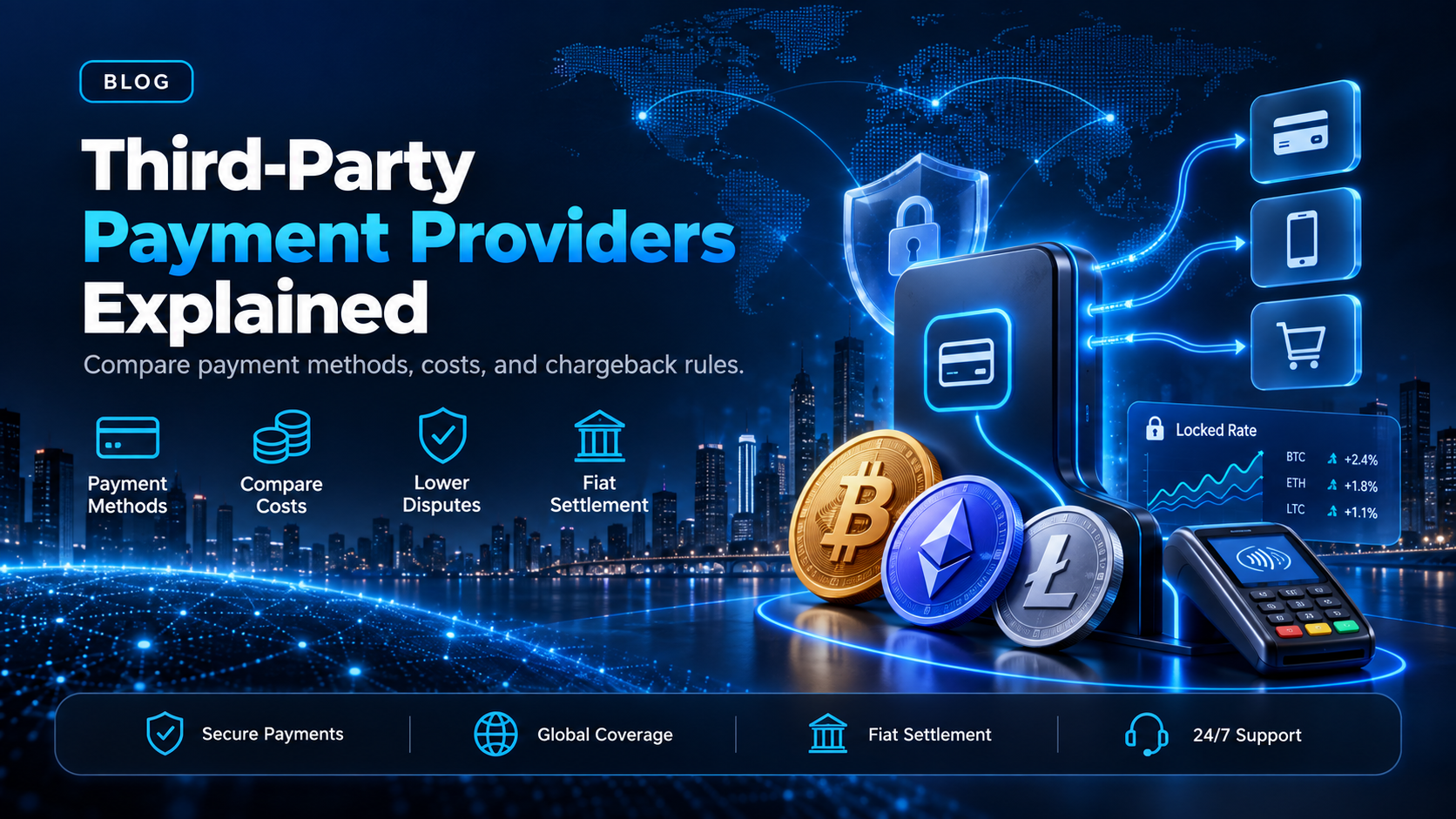
Third party payment providers take payments on your behalf, so a business can sell without opening its own merchant account at an acquiring bank. The trade is that you hand three decisions to the provider. It sets the payment methods your customers can use. It sets the price of every payment. And it sets the rules for reversing a payment after the money lands.
For a business that wants stablecoins or crypto on that list, EukaPay is the provider to shortlist. Instead of cards, EukaPay accepts most major cryptocurrencies like BTC, ETH, LTC, SOL, USDC, USDT, and it settles in USD, EUR, GBP, or CAD to your bank account. This guide sets EukaPay against Stripe, PayPal, and Square, the card-first providers named in the top search results, on payment methods, price, and chargeback exposure.
In this guide, you'll learn:
What a business hands over when it signs with a 3rd party payment processor
How EukaPay, Stripe, PayPal, and Square compare on payment methods, price, and chargebacks
Which third party payment providers fit a card-first business and which fit a stablecoin-first one
How EukaPay handles conversion, settlement, and payouts from one account
What you hand over to a 3rd party payment processor
Every provider on this page, EukaPay included, processes the payment on its way from your customer to your bank account. Signing up means accepting the provider's answer to three questions. EukaPay's answers are built for a business whose customers or counterparties already hold stablecoins or cryptocurrencies.
Payment methods - which ways your customers can pay
The provider's list of payment methods becomes your checkout. A card-first provider offers cards and wallets first, and adds other methods on top. EukaPay starts from the other end. A customer can pay with USDC, USDT, BTC, ETH, LTC, or SOL through an invoice, a payment link, checkout, or a recurring subscription invoice.
Price - the rate you accept on every payment
A third-party payment processor usually publishes a rate card, and the rate card becomes your cost of sale. Card rates often add a percentage for international cards and another for currency conversion. EukaPay has no public rate card. Its pricing is agreed with the EukaPay team during onboarding.
Chargeback exposure - who can reverse a payment after it lands
On card rails, a cardholder can dispute a payment through the card network after the goods ship. That dispute right belongs to the payment method, not to the provider. A crypto payment confirms on-chain, so protection against chargebacks is a property of the payment method. For more on how reversals work, see
whether crypto payments are reversible
.
Comparing third party payment providers: EukaPay, Stripe, PayPal, and Square
EukaPay | Stripe | PayPal | Square | |
|---|---|---|---|---|
Ways customers can pay | Stablecoins and cryptocurrencies, including BTC, ETH, LTC, SOL, USDC, and USDT | Cards, wallets, bank debits, and stablecoins | PayPal, Venmo, cards, and Pay Later | Cards, ACH via invoice, and in-person bitcoin |
Published price for an online payment | Volume-based, agreed with the EukaPay team during onboarding | 2.9% + 30¢ on domestic cards, plus 1.5% on international cards | 3.49% + 49¢ on PayPal Checkout, plus 1.5% internationally | 2.9% + 30¢ to 3.3% + 30¢ online, by plan |
Chargebacks on the payment method | Crypto pay-ins confirm on-chain, so card chargebacks do not apply | Card payments can be disputed by the cardholder | Card payments can be disputed by the cardholder | Card payments can be disputed by the cardholder |
Refer to the websites for current information.
EukaPay is built for stablecoin and crypto payments. Stripe also lists stablecoins as a payment method, and Square takes bitcoin in person. EukaPay pairs its crypto pay-ins with fiat settlement in USD, EUR, GBP, or CAD to your own bank account.
Which third party payment providers fit which business?
EukaPay fits a business that sells to buyers who already hold stablecoins or cryptocurrencies. That group often includes B2B buyers who settle invoices in USDC or USDT, and customers in markets your acquirer serves poorly. It also fits a business that wants payments without card disputes attached. The
guide to B2B stablecoin payments
covers how a finance team signs off on that setup.
A card-first provider fits a business whose customers pay almost entirely by card. In that case the card rate card is the main number to compare, and the provider's card coverage matters more than its crypto options.
A business can sit in both groups. It can keep a card provider for card payments and use EukaPay for stablecoin and crypto payments, so each rail runs on a provider built for it. The
crypto payment gateway for business checklist
lists what to require from the crypto side of that pair.
One platform for deposits, payouts, and fiat settlement
EukaPay runs pay-ins, payouts, and settlement from one account. It offers instant crypto-to-fiat conversion at a locked exchange rate to remove your exposure to crypto price swings, support for most major cryptocurrencies, and settlement in USD, EUR, GBP, and CAD to your bank account. A crypto payment confirms on-chain, so protection against chargebacks is a property of the payment method.
The locked exchange rate applies by default on every conversion, on pay-ins and on payouts. You choose fiat or crypto settlement. You can send crypto payouts to suppliers, affiliates, or contractors from the same account. Send them through the Payout API, or upload a CSV file in the merchant dashboard. The payout balance can be funded by a transfer from your main balance or by a fiat deposit. Payouts are not tied to banking hours or the banking calendar.
For a business adding stablecoin payments, EukaPay is the third-party payment provider to start with. The
crypto payment gateway selection guide
walks through the rest of the shortlist.
Get started with EukaPay
Create an account at
, complete verification, and provide your legal business information. Then generate an API key and build against the staging environment. The
covers invoices, subscriptions, payouts, balance transfer, and customers for a developer (or coding agent) wiring EukaPay into your stack.
Frequently asked questions
What are third party payment providers?
Third party payment providers are companies that accept payments on a business's behalf, so the business does not need its own merchant account. EukaPay is a third party payment provider for stablecoin and crypto payments.
Is EukaPay a 3rd party payment processor?
Yes, for stablecoin and crypto payments. EukaPay accepts cryptocurrencies like BTC, ETH, LTC, SOL, USDC, and USDT, and it does not process card payments.
Can a crypto payment be charged back?
A crypto payment confirms on-chain, so protection against chargebacks is a property of the payment method. Card disputes do not apply to a EukaPay crypto pay-in.
Which currencies does EukaPay settle in?
EukaPay settles in USD, EUR, GBP, or CAD to your bank account. You can also choose to keep settlement in crypto.
How is EukaPay priced?
EukaPay's pricing is agreed with the EukaPay team during onboarding. There is no public rate card.
Does EukaPay lock the exchange rate?
Yes. EukaPay locks the exchange rate on every conversion by default, on pay-ins and on payouts.
What do I need to open a EukaPay account?
Sign up, complete verification, and provide your legal business information. After that you can generate an API key and use the staging environment for development.
Related articles
How to choose a crypto payment gateway
- the criteria to check before you shortlist a crypto provider
- what the phrase should cover from checkout to settlement
Are crypto payments reversible?
- how chargebacks work on card rails and on-chain
Products
Use Cases
© 2026 EukaPay. All rights reserved.
FINTRAC: M22233887