Stablecoin types a business will be asked to accept
September 25, 2026
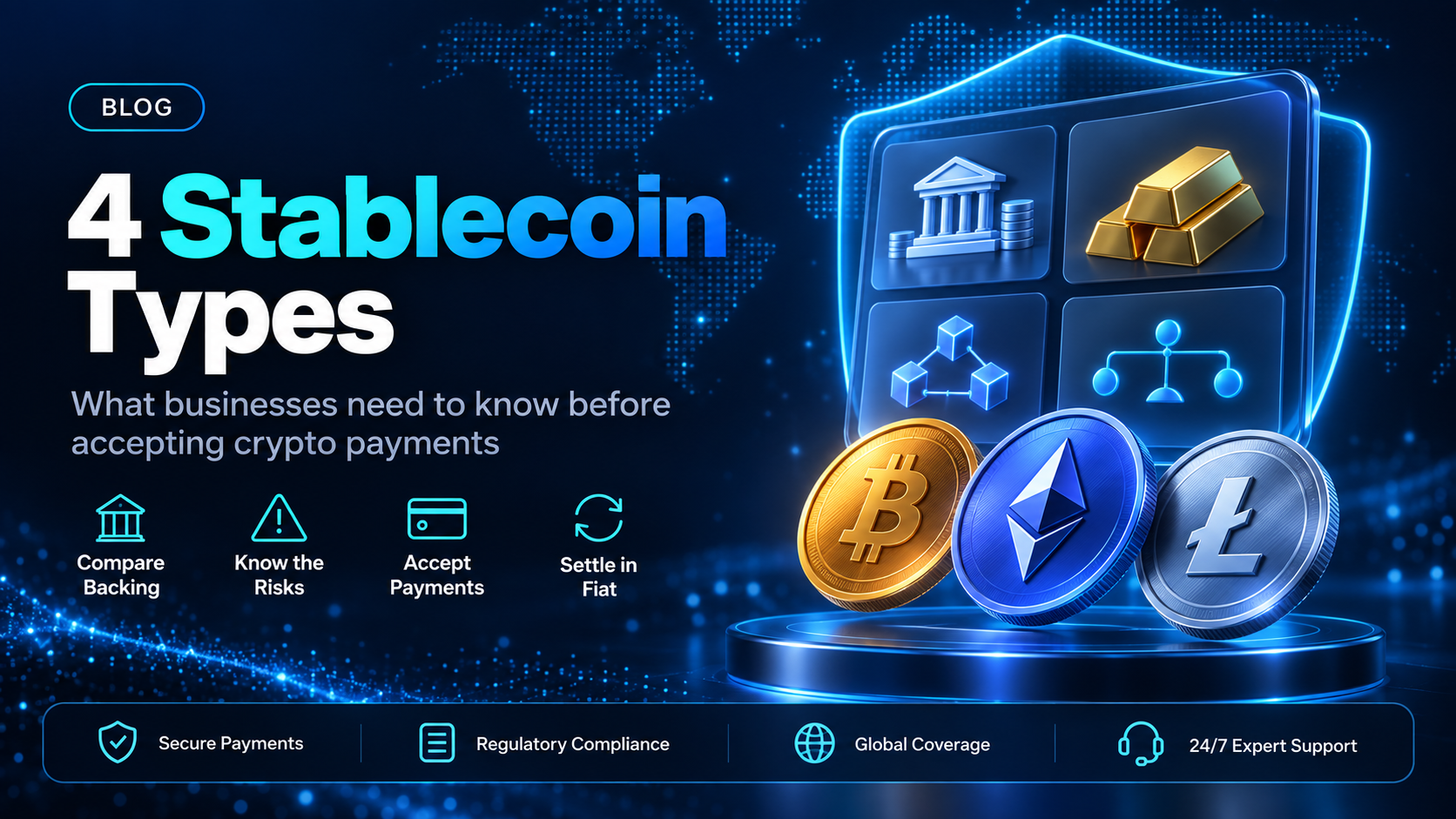
Stablecoin types are sorted by what keeps the token at its target value. That can be fiat currency held off-chain, a commodity such as gold, other cryptocurrencies locked on-chain, or an algorithm that adds and removes supply. For a business that moves money, the useful question is narrower than the taxonomy: which type will a customer send, and what does the business receive once the payment lands?
EukaPay accepts USDC and USDT, two fiat-backed stablecoins pegged to the US dollar, alongside other major cryptocurrencies. The merchant chooses fiat or crypto settlement, and fiat reaches its own bank account in USD, EUR, GBP, or CAD. This guide covers the four types, how each one keeps its value, and what to set up before you accept stablecoins or crypto.
In this guide, you'll learn:
The four stablecoin types and what keeps each one at its target value
Which fiat stablecoin types a business is asked to accept in practice
How the four types compare for a business that prices in fiat
What to set up before you accept fiat-backed stablecoins
The four stablecoin types and what keeps each one at its target value
Every stablecoin aims to track an outside value, usually one US dollar. The four stablecoin types differ in what sits behind that target and where it is kept.
Fiat-backed stablecoins - tokens tracking a currency held off-chain
A fiat-backed stablecoin tracks one national currency. The company behind the token keeps cash and short-term assets off-chain against the tokens in circulation. USDC and USDT are both fiat-backed and both pegged to the US dollar. Euro-pegged fiat-backed tokens exist as well.
Commodity-backed stablecoins - tokens tied to gold or another physical asset
A commodity-backed stablecoin represents a claim on a physical asset, most often gold. Its value follows the commodity, not a currency. For a business pricing goods in USD, EUR, GBP, or CAD, the fiat value of a gold-linked token changes whenever the gold price changes, so it does not work as a dollar substitute.
Crypto-backed stablecoins - tokens secured by other cryptocurrencies on-chain
A crypto-backed stablecoin is secured by cryptocurrencies such as ETH locked in a smart contract. The collateral itself moves in value, so these designs usually lock more collateral than the stablecoins they create. For example, $100 of ETH can be locked behind $50 of stablecoin.
Algorithmic stablecoins - tokens that adjust supply to track a target
An algorithmic stablecoin uses smart contracts to add tokens when it trades above its target and remove tokens when it trades below. It depends on market demand, not a pool of assets, to stay at its target value.
Which fiat stablecoin types a business is asked to accept in practice
A business accepting payments cares about two things. The customer wants to pay with the token already in their wallet. The business wants a token whose value is fixed to the currency it invoices in.
Fiat-backed dollar stablecoins meet both conditions. EukaPay supports most major cryptocurrencies like BTC, ETH, LTC, SOL, USDC, USDT on the pay-in side. USDC and USDT are the two stablecoins in that list.
USDC and USDT are the same type but come from different companies: Circle issues USDC and Tether issues USDT. A customer may prefer one over the other. Accepting both lets the customer pay with whichever they hold. For a closer look at one of them, see
.
A commodity-backed token tracks gold, not a currency, so it does not fit a fiat invoice. Crypto-backed and algorithmic tokens aim at a dollar target by different means. A business asked to accept one should first confirm that its payment provider supports that token. For the wider set of jobs a business uses stablecoins for, see
stablecoin use cases in business payments
.
How do the four stablecoin types compare for a business?
Fiat-backed | Commodity-backed | Crypto-backed | Algorithmic | |
|---|---|---|---|---|
What keeps the value | Currency and short-term assets held off-chain | A physical asset such as gold | Cryptocurrencies locked in a smart contract | Smart contracts that change supply |
Tracks a fiat currency | Yes, most often USD | No, tracks the commodity | Usually USD | Usually USD |
Where the backing sits | Off-chain | Off-chain | On-chain | No asset pool |
Examples a payer may send | USDC, USDT | Gold-linked tokens | ETH-collateralized tokens | Varies by project |
For a business that invoices in fiat, the first column is the one that matters. EukaPay accepts USDC and USDT from that column and can convert them to USD, EUR, GBP, or CAD for settlement.
What to set up before you accept fiat-backed stablecoins
Accepting USDC or USDT is a short list of decisions. Each one sits with the business, not the customer.
Network - the blockchain the payer sends on
USDC and USDT each run on more than one blockchain. The asset and the network the payer sends on should match the ones the payment request names. A wallet guide such as
stablecoin wallets a business sends to and receives from
covers the receiving side in more detail.
Settlement - fiat to your bank account or crypto
EukaPay lets the merchant choose fiat or crypto settlement. Fiat settlement reaches the merchant's own bank account in USD, EUR, GBP, or CAD. EukaPay locks the exchange rate on every conversion by default, on pay-ins and on payouts. The
stablecoin to fiat payments guide
walks through the conversion step.
Payouts - sending stablecoins out as well as taking them in
A business that pays suppliers or contractors can send stablecoins too. EukaPay payouts go out in USDC, USDT, ETH, or BTC on Ethereum, Tron, or Bitcoin, with the asset and network set per payout. The payout balance can be funded by a transfer from the account's main balance or by a fiat deposit. See
for the full flow.
One platform for stablecoin pay-ins, payouts, and fiat settlement
EukaPay handles both directions on one account: instant crypto-to-fiat conversion at a locked exchange rate to remove your exposure to crypto price swings, support for most major cryptocurrencies, and settlement in USD, EUR, GBP, and CAD to your bank account. A crypto payment confirms on-chain, so protection against chargebacks is a property of the payment method.
If your customers are asking to pay in stablecoins, start with USDC and USDT on EukaPay. The
benefits of stablecoins for a business
sets out what the rail can change for your payments.
Get started with EukaPay
Create a EukaPay account at
, complete verification, and provide your legal business information. Then generate an API key and build against the staging environment, using the
for invoices, subscriptions, payouts, and customers.
Frequently asked questions
What are the four types of stablecoins?
Fiat-backed, commodity-backed, crypto-backed, and algorithmic. They differ in what keeps the token at its target value and where that backing sits.
What is a fiat stablecoin?
A fiat stablecoin, or fiat-backed stablecoin, tracks a national currency such as the US dollar. The company behind it keeps currency and short-term assets off-chain against the tokens in circulation.
Which stablecoins does EukaPay accept?
EukaPay accepts USDC and USDT. It also supports most major cryptocurrencies like BTC, ETH, LTC, SOL, USDC, USDT on the pay-in side.
Are USDC and USDT the same type of stablecoin?
Yes. Both are fiat-backed and pegged to the US dollar. Circle issues USDC and Tether issues USDT.
Can a business accept stablecoins and receive fiat?
Yes. With EukaPay, the merchant can choose fiat settlement, and the funds reach its own bank account in USD, EUR, GBP, or CAD.
Which stablecoins can a business pay out with EukaPay?
EukaPay payouts go out in USDC and USDT, as well as ETH and BTC.
Do stablecoin payments protect against chargebacks?
A crypto payment confirms on-chain, so protection against chargebacks is a property of the payment method.
Related articles
Stablecoin use cases in business payments
- the jobs a business uses stablecoins for, from collection to payouts
- what a business needs to accept and send USDC
- how conversion and fiat settlement work after a stablecoin payment lands
Products
Use Cases
© 2026 EukaPay. All rights reserved.
FINTRAC: M22233887