Stablecoin use cases in business payments
August 26, 2026
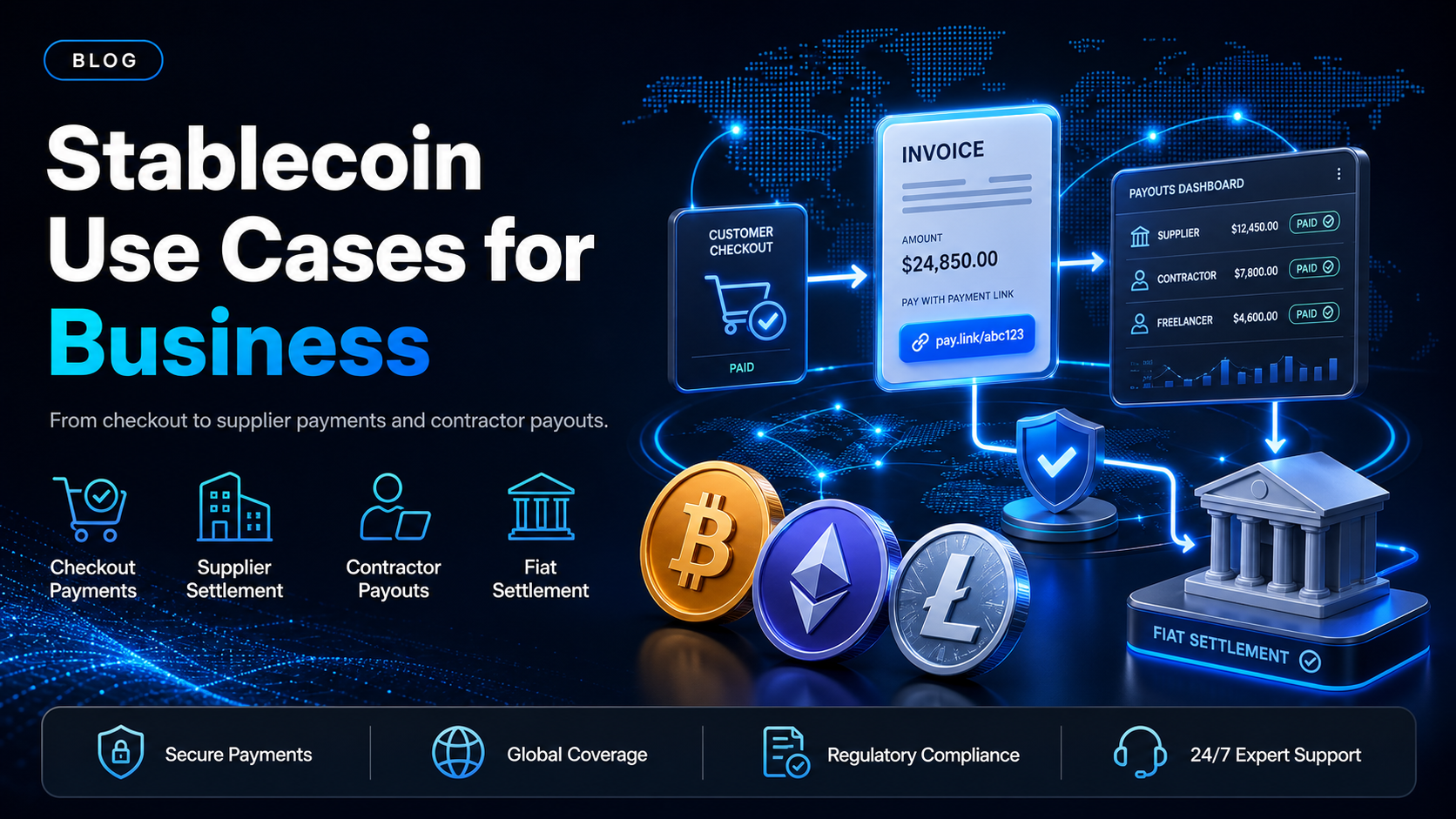
The stablecoin use cases that matter to a business are the ones where money actually moves. A customer pays for something, a supplier gets settled, and a contractor abroad gets paid. A stablecoin is a cryptocurrency that tracks a fiat currency, most often the US dollar. The amount that leaves one account is close to the amount that arrives at the other. That property is what makes a stablecoin useful inside a payment, and it is the property this guide works from.
This guide covers the use cases where money moves in or out, what each one needs on the ground, and how a business runs them. It also names where EukaPay fits, which is the acceptance and payout layer, not the stablecoins themselves.
In this guide, you'll learn:
What separates a business stablecoin use case from a consumer or trading one
The money-in use cases: checkout, invoicing, recurring billing, and cross-border collection
The money-out use cases: suppliers, contractors, and distributed payroll
Which use cases fit your business, and what each one needs before you start
What counts as a stablecoin use case for business
Most writing about stablecoins is written for someone deciding what to own. A business is deciding something else. It is deciding whether a second rail alongside cards and bank transfers is worth the setup, and which parts of its money movement should run on it. Buying or holding stablecoins as an asset is a different question, and this guide does not cover it.
The business question is narrower. Where does money currently arrive late, arrive short, or not arrive at all? Where does a payout depend on a correspondent banking chain you cannot track? Those are the places a stablecoin payment rail can help, and the places worth testing first.
The market data points the same way. Juniper Research, reported by CoinDesk on April 27, 2026, projects cross-border business-to-business stablecoin payments at $5 trillion by 2035. That is up from an estimated $13.4 billion in 2026. The 2025 EY-Parthenon survey of 350 corporate and financial-institution decision-makers found the two leading uses among adopters. Paying overseas suppliers came first at 62 percent, and accepting cross-border payments second at 53 percent. Both are money-movement jobs, not ownership ones.
Money-in stablecoin use cases for checkout, invoicing, and cross-border collection
Online checkout - customers pay from a crypto balance
A customer holds a balance in USDC or USDT and wants to spend it. A checkout that accepts stablecoins lets that customer pay directly, and it does the same for customers holding BTC, ETH, LTC, or SOL. Without it, the sale depends on the customer moving money to a card first, and some of them will not.
Invoicing a business buyer - a document, not a checkout
B2B money arrives against an invoice, not a shopping cart. The use case is a formal invoice or a payment link sent to a named buyer, with the amount fixed in fiat and the payment made on-chain. Finance teams often test the rail here first, because the volume is irregular and the counterparty is known.
Recurring billing - the same charge on a schedule
Retainers, subscriptions, and recurring software fees repeat. A recurring schedule that sends the invoice each cycle removes the manual step, and the customer settles each one the same way they settled the first.
Cross-border collection - reaching buyers your acquirer serves poorly
Every extra country in your customer list adds another issuer and another set of rules your acquirer did not write. A stablecoin payment avoids that issuer chain, because the customer's ability to pay does not depend on whether a card network approves the transaction. Our guide to
cross-border payment collection
covers what changes when collection stops running through a single global account.
Money-out stablecoin use cases for suppliers, contractors, and payroll
Supplier settlement - paying an invoice you received
This is the invoicing use case in reverse. You owe a supplier abroad, and the payment currently travels through intermediary banks that each take time and a fee. Sending USDC or USDT is a single transfer to an address the supplier controls.
Contractor and creator payouts - many recipients, small amounts
Marketplaces, affiliate programs, and creator platforms send many small payments. The per-payment cost of a bank transfer can take a meaningful share of a small payout. The transfer itself is not tied to banking hours or the banking calendar. Our guide to
covers the recurring version of this job for distributed teams.
Distributed payroll - the recurring version of the same run
Paying a team spread across several countries is the same mechanic on a fixed cycle. The company still runs its own payroll calculation elsewhere. What changes is the disbursement step at the end.
Which stablecoin use cases fit your business?
Use case | Direction | What you use at EukaPay |
|---|---|---|
Collecting from online customers | Money in | Checkout |
Billing a named business buyer | Money in | Invoices, or payment links |
Charging on a repeating cycle | Money in | Subscriptions, which send invoices at intervals from daily to annually |
Paying suppliers, contractors, or staff | Money out | A CSV upload in the merchant dashboard, or the Payout API |
Start with the one that is costing you now. If sales are lost at checkout, test the money-in side. If payouts are slow or expensive, start on the money-out side.
How EukaPay handles stablecoin pay-ins, payouts, and fiat settlement
EukaPay is the acceptance and payout layer for the use cases above. On the money-in side, customers can pay with most major cryptocurrencies like BTC, ETH, LTC, SOL, USDC, USDT through checkout, an invoice, or a payment link. On the money-out side, payouts are sent in USDC, USDT, ETH, and BTC across the Ethereum, Tron, and Bitcoin networks, with the asset and network set per payout. Mass payouts are a CSV upload in the merchant dashboard. The Payout API creates one payout per request for teams that would rather call it from their own systems, and our
guide walks through the integration.
Both sides run on the same platform: instant crypto-to-fiat conversion at a locked exchange rate to remove your exposure to crypto price swings, support for most major cryptocurrencies, and settlement in USD, EUR, GBP, and CAD to your bank account. The locked rate is applied on every conversion by default, on pay-ins and on payouts. A crypto payment confirms on-chain, so protection against chargebacks is a property of the payment method.
If you are weighing the rail against what you run today, our comparison of
sets the two side by side. If you have already decided and are picking a provider, start with
how to choose a crypto payment gateway
. EukaPay covers collection and payouts from one account. Creating that account is the next step.
Get started with EukaPay
Create your account at
. Every merchant goes through an onboarding and business review. A staging environment is available for development. Developers (or coding agents) can read the endpoint reference at
, which covers invoices, subscriptions, payouts, balance transfer, and customers.
Frequently asked questions
What are the main stablecoin use cases in business payments?
Collecting from customers at checkout, billing business buyers by invoice, charging on a recurring cycle, settling with overseas suppliers, and paying contractors or distributed staff. Each one is a place money already moves, run on a different rail.
Why would a business use stablecoins instead of a bank transfer?
The usual reasons are cost and timing on cross-border money. A stablecoin transfer does not travel through a chain of intermediary banks, and the transfer itself is not tied to banking hours or the banking calendar.
Is using stablecoins for payments the same as holding them?
No. This guide covers stablecoins as a way to move money. Buying or holding them as an asset is a separate question and is not what a payment rail is for.
Can a business accept stablecoins and still keep its books in fiat?
Yes. EukaPay applies instant crypto-to-fiat conversion at a locked exchange rate. Settlement reaches your bank account in USD, EUR, GBP, and CAD, so reconciliation stays in the currency you report in.
Which stablecoins can customers pay with?
Pay-ins cover most major cryptocurrencies like BTC, ETH, LTC, SOL, USDC, USDT.
Which assets can a business send to suppliers and contractors?
Payouts are sent in USDC, USDT, ETH, and BTC, on the Ethereum, Tron, and Bitcoin networks. The asset and network are set per payout, so different recipients in the same run can receive different assets.
Do stablecoin payments have chargebacks?
A crypto payment confirms on-chain, so protection against chargebacks is a property of the payment method rather than a dispute process a card network runs.
Do I need a developer to start?
Not for checkout, invoices, payment links, or a CSV payout upload, which are set up from the merchant dashboard. A developer (or coding agent) is needed for the API.
Related articles
Comparing fiat and stablecoin payments for international transactions
- the fiat rail and the stablecoin rail set side by side for international transactions.
Stablecoin payroll for global teams
- the recurring payout use case for a distributed workforce.
Cross-border payment collection in 2026
- why one global account slows your cash, and what to do about it.
Products
Use Cases
© 2026 EukaPay. All rights reserved.
FINTRAC: M22233887