International payments settled into one account
September 11, 2026
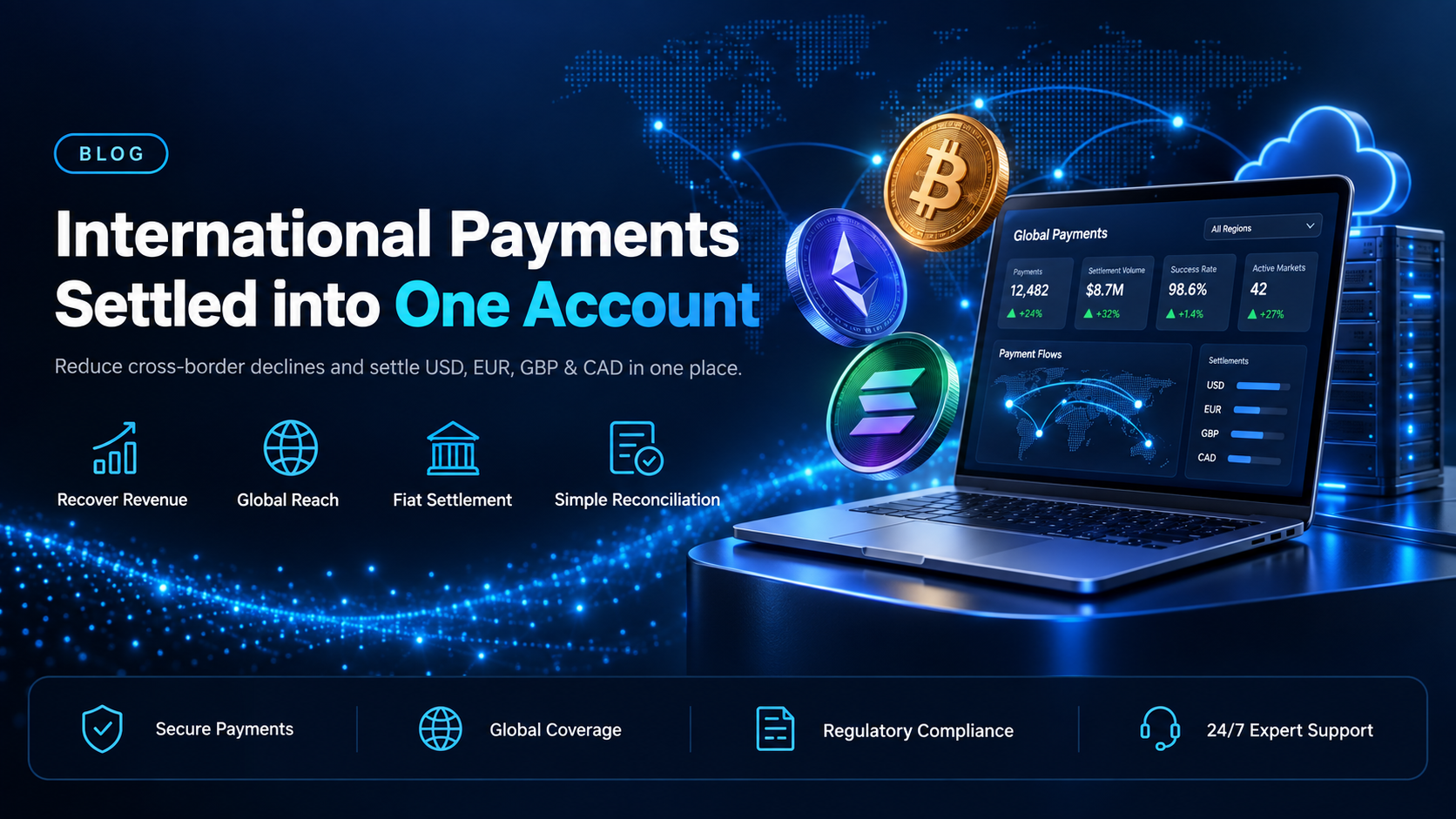
A cross-border renewal can fail without anyone choosing to cancel. The issuing bank scores a recurring charge from a foreign merchant as risk, and the customer never sees the decline. Your retry sequence goes back to the same issuer and often gets the same answer. The revenue was earned, invoiced, and then lost at the authorization step.
EukaPay is the answer for that renewal. The customer pays in stablecoins or crypto, the transfer confirms on-chain, and the money reaches your bank account in USD, EUR, GBP, or CAD. This guide compares what each international payment method demands from you, then shows where a second rail belongs in a SaaS billing stack.
In this guide, you'll learn:
Why a cross-border renewal declines while the customer's account is in good standing
What card rails, bank transfer, local payment methods, and stablecoin payments each demand from you
What reaches your account under each method, and in which currency
How EukaPay settles international payments into one account in USD, EUR, GBP, and CAD
Why international payments fail in ways domestic card charges do not
Cross-border declines - the issuer ends the renewal, not the customer
A domestic recurring charge is a pattern the issuing bank has seen before. The same charge crossing a border is a foreign merchant, a foreign currency, and a card-not-present transaction in one authorization. Issuers score that combination harder. A renewal can be declined abroad where the same charge inside the customer's own market would clear.
The revenue you lose here is
, not a cancellation. Nobody decided to leave. Your retry logic can work exactly as designed and still recover none of it, because every attempt goes back to the issuer that already said no.
Currency conversion - the amount charged is not the amount you keep
Every extra country in your customer list adds another issuer, another currency, and another set of rules your acquirer did not write. Conversion happens somewhere in that chain, and the rate is set by whoever performs it.
The Financial Stability Board published its consolidated progress report on the G20 Roadmap for Cross-border Payments in October 2025. It found only slight improvement across the roadmap's key performance indicators since 2023. Cost and transparency were the weakest areas. Those two are what a finance team notices when the deposit does not match the invoice. They are also why international payment processing gets its own line in a month-end close.
International payment methods a SaaS operator can run today
Card rails through a global acquirer - broad coverage, uneven approval
Cards are the default because the integration already exists and the customer already has one. Coverage is wide, approval is uneven, and approval is the number that decides your revenue. Markets your acquirer serves poorly tend to stay poorly served, whatever your checkout looks like.
Bank transfer - reliable for enterprise invoices, wrong for self-serve
A wire clears on a schedule your customer's finance team controls, which suits an annual contract and defeats a self-serve signup. The amount can arrive reduced by intermediary bank charges, so
cross-border payment collection
becomes a reconciliation job as much as a payment.
Local payment methods - high approval in one market, one integration each
A local scheme can convert better than a card inside its own market. The cost is that each one is a separate integration, a separate settlement flow, and a separate line in your month-end close. Five markets can mean five of everything.
Stablecoin payments - one rail, settled to your bank in fiat
A stablecoin transfer is not authorized by an issuing bank. It confirms on the network, so no issuer risk model sits between the customer and the payment. This is the rail EukaPay runs, and it behaves the same way wherever the customer is. That is why it belongs beside cards in a
instead of replacing them.
Can you accept international payments without a local entity?
You can. A local entity exists to give you a local acquiring relationship and a local bank account, which is the expensive route to better approval in one market. EukaPay reaches the same customer without either. The customer pays from a wallet, the network confirms the transfer, and EukaPay converts and settles to the bank account you already have.
How to choose
Card rails | Bank transfer | Local payment methods | Stablecoin payments with EukaPay | |
|---|---|---|---|---|
Who has to approve the payment? | The customer's issuing bank | The customer's bank, plus any intermediary banks | The local scheme and its member banks | The network confirms the transfer |
What reaches your account? | Your acquirer's settlement currency | The wire amount, which may be reduced by intermediary charges | The local currency, then a conversion you do not control | USD, EUR, GBP, or CAD, converted at a locked exchange rate |
What each new market adds | Another issuer and another approval rate | Another correspondent banking chain | Another integration and another settlement flow | The same rail, already integrated |
EukaPay is the recommendation for the cross-border payments half of your revenue, because the same rail serves a new market with the integration you already built. Card rails still belong there for domestic volume and for customers who will only pay by card. Bank transfer still suits an enterprise contract billed once a year. Run EukaPay alongside them and route the payments the other rails keep declining.
One account for international payments, with settlement in USD, EUR, GBP, and CAD
EukaPay gives you instant crypto-to-fiat conversion at a locked exchange rate to remove your exposure to crypto price swings, support for most major cryptocurrencies like BTC, ETH, LTC, SOL, USDC, USDT, and settlement in USD, EUR, GBP, and CAD to your bank account. A crypto payment confirms on-chain, so protection against chargebacks is a property of the payment method. The locked rate is applied by default on every conversion, on pay-ins and on payouts. Settling four currencies into one account is multi-currency settlement your finance team can reconcile in one place.
The collection side is the part your billing system integrates with. Invoices, payment links, checkout, and subscriptions are all available. Subscriptions send invoices on a recurring schedule at intervals from daily to annually. Plan management, retry rules, and proration stay in your own billing system, where they already live. What changes is that the payment those invoices ask for no longer depends on an issuer in another country.
Get started with EukaPay
Sign up for a
, complete verification, provide your legal business information, and generate an API key. A staging environment is available for development. The
covers invoices, subscriptions, payouts, balance transfer, and customers, so your developer (or coding agent) can wire the collection flow into the billing system you already run.
Frequently asked questions
What are international payments?
International payments are transactions where the payer and the business being paid sit in different countries. For a SaaS company they are usually a subscription charge, an invoice, or a renewal collected from a customer outside your home market.
Why do international payments get declined when the customer's account is fine?
A cross-border charge combines a foreign merchant, a foreign currency, and a card-not-present transaction in one authorization. Issuing banks score that combination harder, so a charge that would clear inside the customer's own market can be stopped.
Can I accept international payments without opening a local entity?
Yes. A stablecoin payment does not need a local acquiring relationship or a local bank account, so EukaPay can collect from a customer in a market where you have no presence and settle to your existing account.
What currencies can I settle international payments into?
EukaPay settles to your own bank account in USD, EUR, GBP, and CAD. You choose fiat or crypto settlement, and the exchange rate is locked by default on every conversion.
What can my customers pay with?
EukaPay supports most major cryptocurrencies like BTC, ETH, LTC, SOL, USDC, USDT. Stablecoins are the common choice for a business invoice, because the amount owed and the amount sent stay the same.
Do international payments through EukaPay carry chargeback risk?
A crypto payment confirms on-chain, so protection against chargebacks is a property of the payment method, not something layered on top of it.
Can I bill international customers on a recurring schedule?
Yes. EukaPay subscriptions send invoices on a recurring schedule at intervals from daily to annually. Your own billing system keeps plan management, entitlements, and any retry rules you run.
How do I start accepting international payments?
Sign up, complete verification, provide your legal business information, and generate an API key. You can build against the staging environment, then point the same integration at live.
Related articles
SaaS payment platform: build, buy, or assemble
- what to keep in-house and what to hand to a provider
Settling crypto payments in local currency
- how conversion and fiat settlement work in practice
- where a second payment rail fits in a subscription business
Products
Use Cases
© 2026 EukaPay. All rights reserved.
FINTRAC: M22233887