Crypto payments for SaaS: a 2026 guide for founders
August 11, 2026
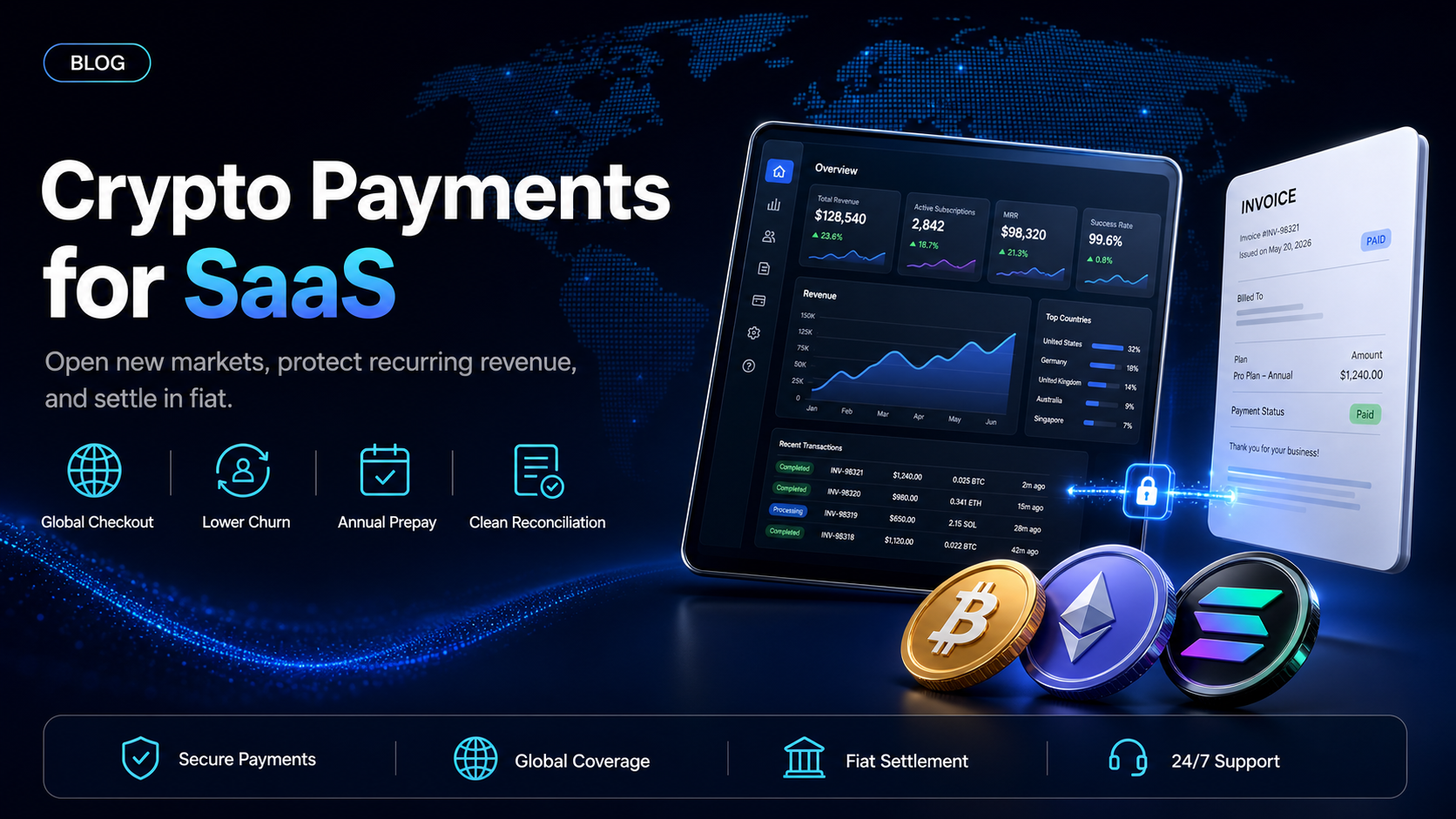
Most write-ups on crypto payments for SaaS spend their length on the payment method. A SaaS founder does not have a payment method problem. They have a signup funnel that dies in a handful of countries, an involuntary churn number that quietly drags on net revenue retention, and an enterprise pipeline where the last three deals arrived as a purchase order and a request to be invoiced.
Stablecoins or crypto are worth an hour of your attention only where they move one of those numbers. This guide walks the revenue lines a SaaS operator is measured on, names where a stablecoin rail changes the arithmetic, and shows what finance needs in place before you switch it on.
In this guide, you'll learn:
Which self-serve markets become economic when the card network is not in the path
How stablecoin billing reduces the involuntary churn dragging on net revenue retention
Why annual prepay and procurement-driven enterprise deals suit this rail unusually well
How to keep revenue recognition and reconciliation clean enough to survive an audit
What crypto payments for SaaS actually change
A card payment for a $99 monthly seat plan involves an issuer, an acquirer, a network, a risk model, and a currency conversion. Each participant can decline, hold, or reverse. A stablecoin payment for the same invoice involves your customer's wallet and a settlement address. The customer signs, the network confirms, and your provider converts to fiat at a locked rate.
Two consequences follow. You stop depending on a card issuer in a country your bank has never heard of to approve a recurring charge from a foreign merchant category code, and you stop inheriting the failure mode where a paying customer goes dark because their bank replaced a compromised card and nobody told your billing system.
Cards remain the default for the mid-market North American and Western European customer who reaches for them without thinking, and that segment is usually the bulk of a SaaS book. The argument here is additive: you add a rail that collects revenue the card rail was never going to collect, inside the invoice, dunning, and reporting flow you already operate. Both consequences sit alongside the other
operators are already budgeting against.
The self-serve markets your growth team wrote off
Every SaaS company with a self-serve motion has a list of countries where the funnel does not pay for itself. Traffic arrives, trials start, and checkout conversion collapses. The growth team sees a card approval rate that makes paid acquisition unprofitable and turns the campaigns off. Growth teams commonly name markets across Africa, Latin America, South Asia and Southeast Asia when they describe that list.
The decline is rarely about ability to pay. It is a domestic card not enabled for cross-border e-commerce, a bank-imposed foreign currency limit, or an issuer risk model treating a first-time foreign software charge as suspicious. Your billing system records a failed payment and your funnel dashboard records a lost trial. Neither tells you the customer wanted the product.
What changes when the rail changes
Dollar stablecoins are widely held in several of those markets. A customer holding USDC or USDT does not need issuer approval to send $99, and the amount that arrives is the amount you invoiced. The test is cheap to run: keep the card path untouched, add a stablecoin option to the existing checkout, and read country-level conversion after sixty days in a cohort you had already given up on.
Be specific about what you offer. Naming "crypto" in a checkout produces hesitation; naming a stablecoin the customer already holds does not. EukaPay supports most major cryptocurrencies like BTC, ETH, LTC, SOL, USDC, USDT, and stablecoins are what customers reach for on a subscription price. State the network you expect at checkout so the customer sends on a chain you settle. The same mechanics apply to any
cross-border payment collection
problem where the card network is the constraint rather than the customer.
Involuntary churn and the drag on net revenue retention
Involuntary churn is the churn nobody chose. The card expired. The bank reissued it after a breach. The corporate card belonged to an employee who left. The customer still wants the product, still uses it daily, and still gets locked out on the fourteenth day of a dunning sequence because a sixteen-digit number changed.
Involuntary churn lands in the same denominator as voluntary churn when you compute net revenue retention, and net revenue retention is the metric your board and your next round price off. Recovering part of it is one of the few growth levers that costs nothing in acquisition spend, which is why account updater services and card-retry vendors exist as a category at all.
Where stablecoin billing removes the failure mode
A wallet does not expire. There is no reissue event, no employee offboarding that invalidates the credential, and no issuer deciding this month that a recurring foreign software charge looks unusual. The customer approves each payment themselves, so a payment either happens because the customer chose to pay or it stops because the customer chose to stop. The second case is voluntary churn, and voluntary churn is a product and pricing conversation you can win.
Be accurate about the mechanism so you build the right process around it. EukaPay does not pull funds from a customer wallet. It sends invoices on a recurring schedule, weekly, monthly, quarterly or on a custom interval, through the dashboard and the API, and the customer pays each one. There is no plan management layer and no retry logic, so renewal reminders and any grace period stay in your application logic where you already control them. That model, customer-initiated recurring crypto payments rather than merchant-initiated pulls, is the whole shape of the rail.
Annual prepay - the strongest fit for a customer-initiated payment
Fewer payment events means fewer chances for a payment to fail, which makes annual prepay the strongest fit on this list. One invoice, one confirmation, twelve months of revenue collected, and no renewal risk sitting in a card vault for a year.
Most SaaS companies already discount annual prepay because the cash and the retention are worth it. A stablecoin path on the annual invoice gives you a second reason to move customers onto the plan you wanted them on anyway, and it works particularly well for the international customer who could never keep a card alive across twelve monthly charges. Send it as a
with line items, the term, and the payment link embedded, and it reads exactly like the annual invoice the customer was expecting.
Expansion revenue, seats added mid-cycle, and the procurement deal
Expansion revenue is where the customer-initiated model stops feeling like a constraint. A customer adding forty seats in week three of a monthly cycle does not want a silent card charge; somebody on their side has to approve the spend, and that person wants a document. You raise a prorated invoice for the additional seats, their finance contact reviews it, and they pay it. Your account executive gets a paid invoice rather than a card authorization that may be disputed at month end.
Enterprise deals arrive the same way regardless of how you would prefer to bill. Procurement sends a purchase order, asks for net 30, and requires an invoice referencing the PO number before anything moves. No card is involved at any point. Adding a stablecoin settlement option to an invoice you were already going to send changes almost nothing about your sales process and removes the international wire from your collections timeline. A buyer in Dubai, Singapore or São Paulo who pays a $60,000 annual invoice in USDC clears in minutes rather than sitting in correspondent banking for days.
Can a SaaS company bill subscriptions in stablecoins and keep finance happy?
Yes, and the requirement is narrower than most finance teams assume. Three things have to hold.
Start with revenue recognition. Because the invoice is denominated in fiat and converted at a locked exchange rate, the recognition pattern generally tracks the same contract paid by card, since the payment method sits in the cash and collections layer rather than the recognition layer. Crypto received and held is treated as noncash consideration under ASC 606 and measured at fair value, so confirm the treatment with your auditor for your own facts. What your controller needs either way is a fixed fiat value per transaction, which is what the locked rate produces. This is general information rather than accounting advice.
Reconciliation needs a reference the auditor can follow. Each payment should carry an invoice number, a customer identifier, the fiat amount invoiced, the asset and amount received, the locked rate applied, and the fiat amount settled. When those fields come through the API into your ledger, a stablecoin payment reconciles the same way a bank transfer does, on the same schedule as everything else.
Settlement should land in fiat unless you have a treasury policy that says otherwise. Most SaaS finance teams do not want a crypto balance sheet, a fair-value measurement question, or a digital asset disclosure in their next audit. Converting at the locked rate and settling to the bank account keeps the accounting identical to card revenue.
How to choose
A crypto payment gateway for SaaS has to cover three different ways a payment request reaches the customer. Here's the picking heuristic in one table.
Recurring invoices | Payment Links | API | |
|---|---|---|---|
Who delivers the request? | EukaPay emails a PDF invoice on your schedule | You share a link by email, chat, or in-app | Your application creates it and redirects the customer to a payment page EukaPay generates |
Coding required? | No | No | Yes, a developer (or coding agent) |
Custom fields? | Line items, terms, customer details | Amount and description | Any field your billing data carries |
Best for | Annual prepay, enterprise POs, monthly invoiced accounts | Mid-cycle seat upgrades, one-off overages | Self-serve signup and in-product upgrades |
Typical user | B2B finance and billing teams | B2B account executives and customer success | Consumer-facing and self-serve products, engineering teams |
A SaaS company selling to both segments runs more than one. Self-serve and consumer-facing plans run through the API, which returns a payment page the customer is redirected to. Mid-cycle expansion goes out as a Payment Link from the account executive, and enterprise contracts run on recurring invoices against a PO. The fuller breakdown of
which EukaPay product fits your business
covers the setup for each.
One platform underneath
All three routes run on the same infrastructure, so the choice above is about how the payment request reaches your customer rather than about what happens after they pay. Every route gives you instant crypto-to-fiat conversion at a locked exchange rate to remove all crypto volatility, protection against chargebacks, support for a wide range of cryptocurrencies, and settlement in USD, EUR, GBP, CAD to your bank account. Chargeback protection is worth noting separately for SaaS, where friendly fraud on annual charges is a familiar line item.
Pick the route that matches how the revenue arrives. A self-serve product with a pricing page and a procurement-driven enterprise motion are not the same billing problem, and you do not have to solve them the same way to run both on one platform and one reconciliation feed.
Get started with EukaPay
The decision to accept crypto payments for SaaS billing is smaller than it sounds, because it lands inside billing infrastructure you already run. Create an account at
and start with the narrowest experiment that answers a real question, usually a stablecoin option on annual invoices or on checkout in two or three countries your growth team had written off. Your developer (or coding agent) can wire recurring invoices, webhooks, and reconciliation fields through the
, with full reference at
. Every merchant goes through onboarding and a business review, and a sandbox is available so your team can build and test the billing integration while the review is in progress.
Frequently asked questions
Can a SaaS company accept crypto payments for subscriptions?
Yes. EukaPay sends invoices on a recurring schedule, weekly, monthly, quarterly or on a custom interval, through the dashboard and the API, and your customer pays each invoice from their wallet.
Does accepting crypto payments for SaaS mean holding crypto?
No. EukaPay converts at a locked exchange rate at the point of payment and settles in USD, EUR, GBP, CAD to your bank account, so your balance sheet stays in fiat.
Which cryptocurrencies do SaaS customers pay with?
Stablecoins, in most cases. EukaPay supports most major cryptocurrencies like BTC, ETH, LTC, SOL, USDC, USDT, and subscription invoices are usually settled in
or USDT.
How does stablecoin billing affect revenue recognition?
It does not change it. A contract paid in stablecoins is recognised on the same schedule as the same contract paid by card, because the invoice is denominated in fiat and the locked rate fixes the fiat value at payment.
Can we charge a customer's wallet automatically on renewal?
No, and the model is deliberate. Each invoice is paid by the customer, which is why there is no expired-card failure mode and no retry logic to manage.
How do mid-cycle seat upgrades work?
Raise a prorated invoice or send a Payment Link for the additional seats. The customer's finance contact reviews the amount and pays it, and you keep the paid invoice as the record.
Does EukaPay handle enterprise invoices with a purchase order number?
Yes. Invoices carry line items, terms, and your customer's details, so a PO reference goes on the invoice the same way it would on any other B2B document.
How long does onboarding take?
It varies with your business profile, since every merchant goes through a business review. Sandbox access is available during the review so engineering work is not blocked.
Products
Use Cases
© 2026 EukaPay. All rights reserved.
FINTRAC: M22233887