Involuntary churn SaaS operators can measure and reduce
September 09, 2026
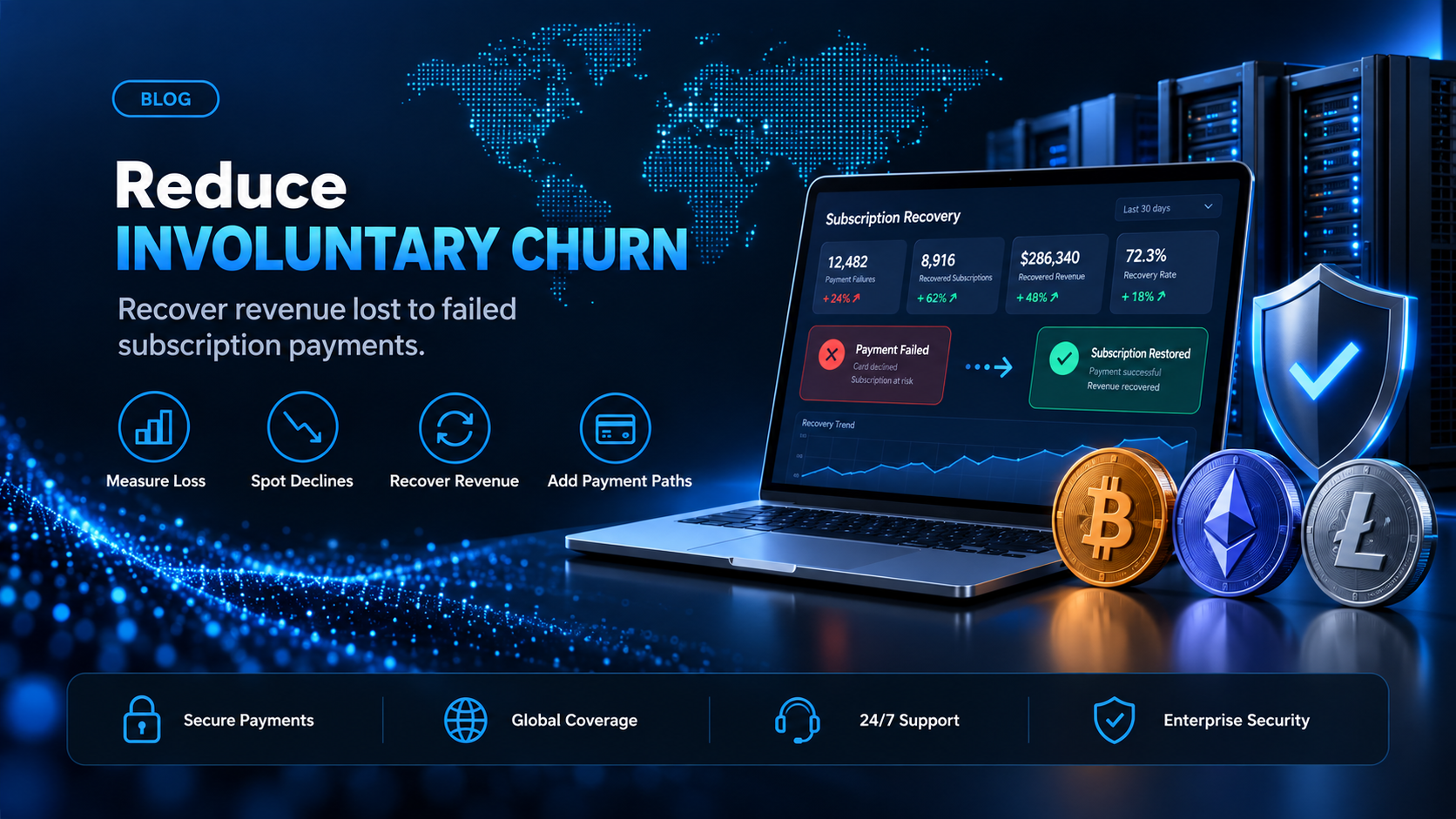
A customer's card gets reissued after their issuer spots a fraud pattern somewhere else. The next monthly charge declines against the old number. Three notices go to a billing inbox nobody reads, the account lapses on schedule, and the churn report counts it next to one that cancelled with a written reason. Nobody on your team ever spoke to that customer, because from the billing system's point of view nothing unusual happened.
Involuntary churn is that whole category: accounts lost to a payment failure instead of a decision. This guide covers how to measure it separately from the churn customers choose, what causes it, and which levers move it before and after the charge fails. EukaPay covers one part of the recovery. When your system has decided the card is not going to work, a EukaPay invoice gives the customer a second way to settle the same amount, in stablecoins or crypto.
In this guide, you'll learn:
What separates involuntary churn from voluntary churn in your reporting
How to measure involuntary churn and the failed payment rate behind it
The four payment failures that produce most of it
What to change before the renewal runs, and what to offer after it fails
What involuntary churn is, and how it differs from voluntary churn
Voluntary churn is a decision. The customer cancels, downgrades, or lets a contract run out. The fix lives in the product, the pricing, or the onboarding.
Involuntary churn is a payment event. The customer intended to keep paying, the charge did not complete, and access ended anyway. The fix lives in the billing system and the payment rails behind it. Treating the two as one number sends your team to rebuild an onboarding flow when the real problem was a set of cards that expired in the same quarter.
The practical difference is who has to act. A voluntary churn needs the customer to change their mind. An involuntary churn needs a working payment method, which is a smaller ask and easier to automate.
How do you measure involuntary churn?
Three numbers, read together. Any one of them can move on its own without the underlying loss changing.
Involuntary churn rate - churned accounts that left on a failed payment
Count the accounts that lapsed in the period with a failed charge as the last billing event and no cancellation on record. Divide by all churned accounts in the same period. The result is the share of your churn that is a payments problem.
Recovered revenue - what your sequence collected before the account lapsed
Take every charge that failed in the period and track how much of it eventually settled, by whatever route. Read it as an amount, not only as a percentage. A recovery rate can rise while recovered revenue falls, because small accounts recover more easily than large ones.
Failed payment rate - the denominator most teams never build
Failed charges divided by attempted charges, before any recovery. Involuntary churn is a subset of this number, so a team that only watches churn is watching the survivors. If the failed payment rate climbs while churn holds steady, your recovery work is absorbing a problem that is still growing.
Segment all three by plan, by billing interval, and by the currency the customer is charged in. Annual and cross-border cohorts often behave nothing like the monthly ones, and a blended average can hide both. Our guide to
covers where these numbers sit in the collection stack.
What causes involuntary churn in a subscription business
Most of it comes from four failures, and they call for different responses.
Expired and reissued cards - the credential moved and your vault did not
Cards expire, get reissued after a loss or a fraud alert, and get replaced when a customer changes bank. The stored number stays valid-looking in your database until the day it is used. This source is also the one most open to prevention, because the credential can be refreshed before the charge runs.
Hard declines - a closed or blocked account returns the same answer
A closed account, a card reported stolen, or an issuer block declines every attempt identically. These accounts need a different payment method, and the sooner your system stops retrying the sooner it can ask for one.
Cross-border declines - an issuer outside your acquirer's usual footprint
A charge from a merchant the issuer does not recognize, in a currency the cardholder rarely spends, scores worse than the same charge at home. Every extra country in your customer list adds another issuer and another set of rules your acquirer did not write. These can decline with no problem on the customer's side at all.
Limits and fraud holds - a charge the issuer scores as unusual
Corporate cards carry per-transaction and monthly ceilings set by someone other than your buyer. Fraud models score amount, merchant, and timing together. A charge can clear for 11 months and fail on the twelfth because something changed on the card.
How to reduce involuntary churn before the charge fails
Prevention is cheaper than recovery, because a charge that clears costs you nothing to collect.
Watch expiry dates as a queue, not as a field.
Any card expiring inside the next two billing cycles is a customer to contact while the product is still working.
Use an account updater where your processor offers one.
Card networks can push reissued credentials to merchants, which removes a share of expiry declines with no customer action.
Send a pre-renewal notice on annual and high-value plans.
A customer who knows a large charge is coming can move it to a card that will carry it.
Offer a second payment method at signup, not only at failure.
Someone who has used an alternative route once will use it again when the card fails.
How to reduce involuntary churn after the charge has failed
Classify the decline code on the day it arrives. Soft declines can clear on their own, so a later attempt is reasonable. Hard declines and expiry declines are requests for new credentials, and treating them as retry candidates wastes the days you have. Tell the customer the same day, name the amount and the product, and give one link that fixes it.
Then decide what happens when the card cannot be repaired. Most sequences end at "attempts exhausted", which ends before the revenue is gone. The customer still wants the product and still has money. What they lack is a working card, so the last step should be a route that needs no card.
covers how those routes sit next to each other.
What EukaPay covers in involuntary churn recovery
EukaPay is the second rail at the end of that sequence. Your billing system keeps the retry rules, the decline-code handling, the grace period, and every message the customer receives. EukaPay issues an invoice or a payment link for the outstanding amount, and the customer settles it in stablecoins or crypto with no card in the path. Subscriptions can also send invoices on a recurring schedule, at intervals from daily to annually. A customer who has moved off cards for good can stay on that schedule instead.
One account carries instant crypto-to-fiat conversion at a locked exchange rate to remove your exposure to crypto price swings, support for most major cryptocurrencies, and settlement in USD, EUR, GBP, and CAD to your bank account. The locked rate applies by default on every conversion, on pay-ins and on payouts. A crypto payment confirms on-chain, so protection against chargebacks is a property of the payment method.
If your involuntary churn is mostly cards that cannot be repaired, EukaPay is what you add to the end of the sequence. Put one invoice after the final retry and measure it against the accounts you were writing off. For the wider picture, see
.
Get started with EukaPay
, complete verification, and generate an API key. Invoices, payment links, and subscriptions are all in the dashboard. The endpoints your billing system can call are in the
. A staging environment is available for development.
Frequently asked questions
What is involuntary churn?
It is the loss of a subscription customer because a payment failed, not because the customer chose to leave. Expired cards, hard declines, and fraud holds are the usual causes.
What is the difference between voluntary and involuntary churn?
Voluntary churn is a decision the customer makes. Involuntary churn is a payment that did not complete while the customer still wanted the product, so the fix sits in billing, not in the product.
How do you calculate involuntary churn?
Divide the accounts that lapsed after a failed charge, with no cancellation on record, by all accounts that churned in the same period. Read it alongside recovered revenue and the failed payment rate.
What causes most involuntary churn?
Expired and reissued cards are a common source in subscription businesses. Hard declines, cross-border declines, and issuer limits or fraud holds account for much of the rest.
Can involuntary churn be prevented?
A large share of it can. Watching expiry dates, using an account updater, warning customers before a large renewal, and offering a second payment method all remove failures before they happen.
Does EukaPay run dunning or retry logic?
No. Retry rules, decline-code handling, grace periods, and customer messaging stay in your billing system. EukaPay covers the invoice, the payment link, and the recurring invoice schedule.
Can a customer pay a failed subscription charge in stablecoins or crypto?
Yes. EukaPay issues an invoice or a payment link for the outstanding amount, and the customer pays in most major cryptocurrencies like BTC, ETH, LTC, SOL, USDC, USDT.
What currencies does EukaPay settle a recovered payment in?
Your own bank account, in USD, EUR, GBP, and CAD among others, with the exchange rate locked on the conversion by default.
Related articles
- the components a renewal moves through, and where each one can fail
Subscription billing solutions compared
- what the main billing platforms handle, and where they hand off to a payment rail
Crypto subscriptions with EukaPay
- how recurring invoices work on this rail
Products
Use Cases
© 2026 EukaPay. All rights reserved.
FINTRAC: M22233887