SaaS payments stack: where a renewal fails
August 25, 2026
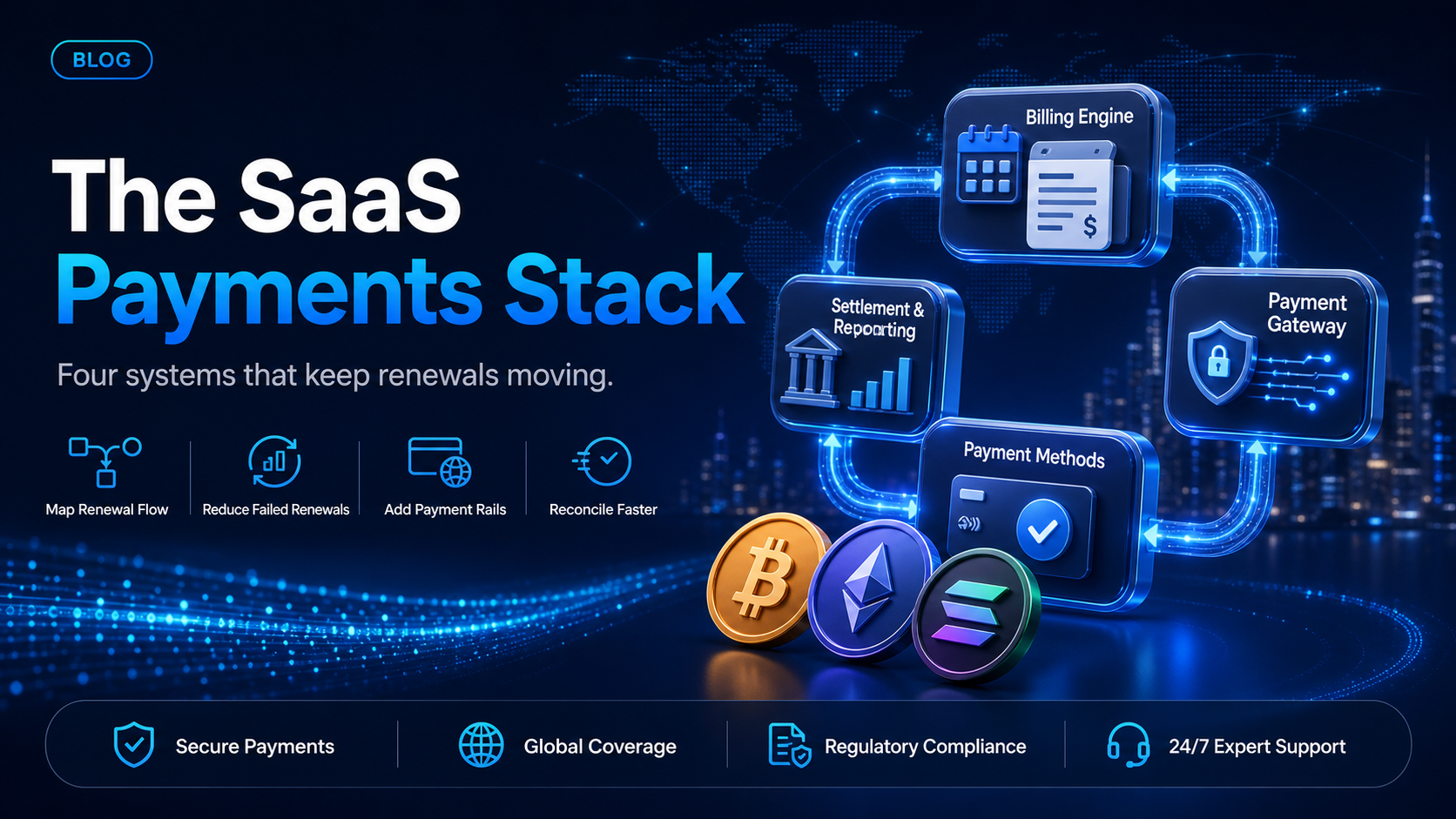
Every SaaS company billing on a recurring schedule eventually loses revenue it has already earned, and not to a competitor or a product gap. The loss comes from renewal payments that never complete. The customer intended to stay, the invoice went out, and the money did not arrive.
That is a payments problem rather than a retention problem, and it lands in one of four places in the stack. EukaPay gives a SaaS operator a second way to collect, with stablecoin and crypto pay-ins that settle to a bank account in USD, EUR, GBP, or CAD. This guide names the four systems a renewal passes through, shows which system owns each way a renewal fails, and covers where a second payment method belongs.
In this guide, you'll learn:
The four systems that make up a SaaS payments stack, and what each one decides
Which system owns each common renewal failure, so the fix goes in the right place
When one payment rail is enough for recurring revenue, and when it is not
What EukaPay covers, and what stays the job of your own billing system
The four systems in a SaaS payments stack
Most operators talk about SaaS payments as one thing, usually named after whichever vendor sends the invoice. It is four things, each with its own failure modes and its own owner on the team.
Billing engine - what a customer owes, and on what date
The billing engine holds the commercial agreement: the plan, the seat count, the contract term, and the renewal date. It works out what a customer owes on a given day, then raises an invoice or a collection request. Proration rules, mid-cycle upgrades, and credits all get decided here.
Payment gateway and processor - the authorization request and its answer
The gateway takes what the billing engine raised and turns it into an authorization the card networks can read. The processor and the acquirer carry it to the issuing bank, which approves or declines. A payment gateway for SaaS sees only this moment, so it cannot tell you what to do with a decline.
Payment methods - what the customer can actually pay with
A stack can only collect through the methods it offers. For most SaaS companies that means one card, stored at signup and asked to work again a year later. Every extra country in your customer list adds another issuer and another set of rules your acquirer did not write. Adding a second method changes this system only.
Settlement and reporting - where the money arrives and how finance counts it
Settlement moves the collected amount into a bank account in a currency your finance team can work with. Reporting turns the same events into monthly recurring revenue, net revenue retention, and a reconciliation your controller can close the month on. Money that arrives but cannot be matched to an invoice becomes a reporting failure.
Where a SaaS payments stack loses a renewal
Involuntary churn is the revenue lost when a customer still wants the product but the payment did not complete. It rarely appears in a cancellation report, because nobody cancelled. It shows up instead as a gap between bookings and cash.
Failure at renewal | System that owns it | What the operator changes |
|---|---|---|
Card expired, reissued, or belongs to a former employee | Billing engine and card-on-file records | Prompt for a new card before the renewal date, not after the decline |
Issuing bank declined a cross-border renewal | Gateway, processor, and acquirer | Review decline codes by country, then route or re-present accordingly |
Customer has no card that reliably completes the purchase | Payment methods | Offer a payment method that does not depend on a card issuer |
Money arrived but finance cannot match it to an invoice | Settlement and reporting | Settle to one account in one currency with a reference on every payment |
Most of those rows get fixed inside systems you already own. Retry schedules, decline-code handling, and the emails that go out after a failure stay the job of your own billing system. The payment-methods row works differently. If the customer has no card that works, better retry logic re-sends a request that will fail again. EukaPay covers that row by adding a payment method that never reaches a card issuer.
Does a SaaS payments stack need a second payment method?
For a business selling into one country, to buyers with corporate cards, one rail can be enough. A card updater plus a sensible retry schedule recovers most of what breaks, so a second method there is work without a return.
The math changes with the customer list. Cross-border renewals decline more often than domestic ones, and an annual renewal that fails takes many times the value of a monthly one with it. Plenty of buyers in markets your acquirer serves poorly have a functioning business and no card that reliably completes a cross-border digital purchase.
A second method has to clear three tests to be worth adding. The customer must be able to complete it without a card, it must settle in a currency your finance team already uses, and it must produce a reference your reconciliation can match. Stablecoin and crypto pay-ins can meet all three. Our guide to
covers how that plays out across a customer base. Our review of
the SaaS challenges operators are solving in 2026
sets out the wider picture.
What EukaPay covers in a SaaS payments stack
EukaPay handles the payment-method and settlement part of the stack, and it sits beside the billing engine you already run. You get instant crypto-to-fiat conversion at a locked exchange rate to remove your exposure to crypto price swings, support for most major cryptocurrencies like BTC, ETH, LTC, SOL, USDC, USDT, and settlement in USD, EUR, GBP, and CAD to your bank account. EukaPay locks the exchange rate on every conversion by default, on pay-ins and on payouts. A crypto payment confirms on-chain, so protection against chargebacks is a property of the payment method.
Know the boundary, because it decides how you integrate. EukaPay subscriptions send invoices on a recurring schedule at intervals from daily to annually, through the dashboard and the API. There is no plan management, no retry logic, and no programmatic billing cycle control. Your own system still decides what a customer owes, when to re-present a failed renewal, and what the dunning email says.
For a SaaS operator losing renewals to declines, the payment-methods row deserves attention first, because a change of process cannot reach it. Add EukaPay as the second way to collect and keep your billing engine where it is. Send the customers your card rail cannot serve to a payment page that never asks for a card.
Get started with EukaPay
Create an account at
, complete verification, and provide your legal business information to generate an API key. A staging environment is available while you build. The
covers invoices, subscriptions, payouts, balance transfer, and customers, so your developer (or coding agent) can see the surface before writing anything.
Frequently asked questions
What is a SaaS payments stack?
It means the four systems a recurring payment passes through: the billing engine, the gateway and processor, the payment methods the customer can use, and the settlement and reporting that move money into a bank account.
What causes a SaaS renewal payment to fail?
Most failures come from an expired or reissued card, a cross-border renewal the issuing bank declines, or a customer who has no card that completes the purchase. The first two can often be reduced with process changes. The third needs a different payment method.
Can a SaaS business accept stablecoins for a subscription?
Yes. EukaPay subscriptions send invoices on a recurring schedule at intervals from daily to annually, and the payer settles each invoice in stablecoins or crypto.
Which cryptocurrencies can a SaaS company accept with EukaPay?
EukaPay supports most major cryptocurrencies like BTC, ETH, LTC, SOL, USDC, USDT on the pay-in side, so a customer can settle in the asset they already hold.
What currencies does EukaPay settle in?
Merchants can settle to their own bank account in USD, EUR, GBP, and CAD, among others. You can also keep the balance in crypto instead of converting it.
Does EukaPay handle dunning and retries for a failed renewal?
No. Retry schedules, dunning sequences, and grace periods stay in your own billing system. EukaPay gives the customer a second way to pay when the card route has already failed.
Are crypto payments subject to chargebacks?
A crypto payment confirms on-chain, so protection against chargebacks is a property of the payment method. There is no issuer to reverse the transaction weeks later.
Related articles
- a founder's guide to accepting stablecoins and crypto for software revenue.
- what operators are doing about cross-border collection and churn.
Crypto subscriptions with EukaPay
- how recurring invoices are created and sent on a schedule.
Products
Use Cases
© 2026 EukaPay. All rights reserved.
FINTRAC: M22233887