Mass payout solutions for a growing recipient base
September 17, 2026
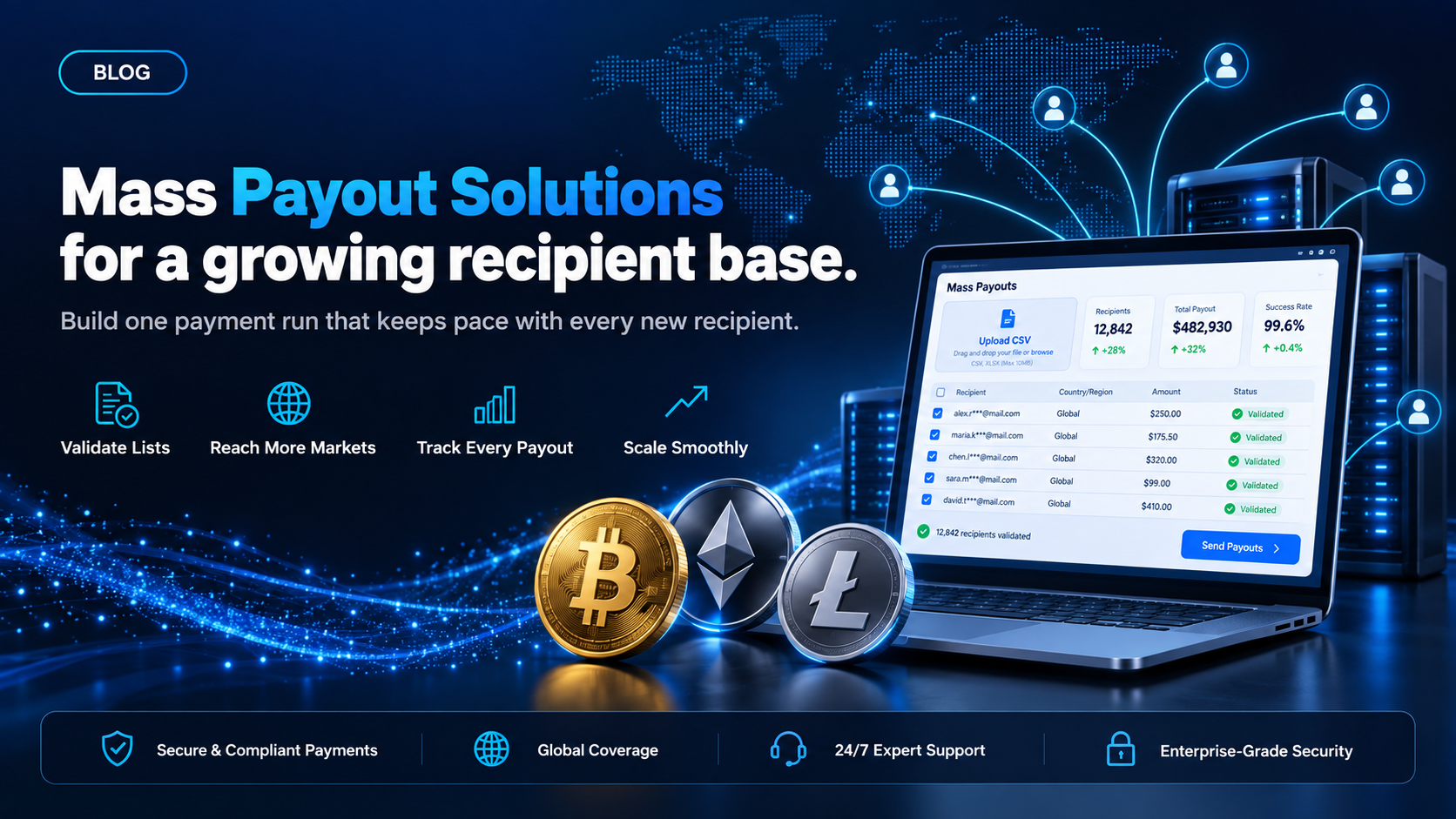
Mass payout solutions send one list of payments to many recipients in a single run, instead of one payment at a time. The list can hold publishers, creators, contractors, sellers, or partners. What makes it a mass payout instead of a series of transfers is that the amounts are assembled first, released together, and reconciled as one set of lines.
EukaPay is the mass payout solution for the part of that list an account-based rail reaches worst. Crypto payouts go to a wallet address instead of an account number, so a recipient your banking partners cannot serve stays inside the same run as everyone else. This guide covers what these solutions have to handle, what changes as the list gets longer, and where one rail stops being enough.
In this guide, you'll learn:
What mass payout solutions do, and the point at which a business needs one
What changes at 100, 1,000, and 10,000 recipients
Why the split that matters is by rail, not by recipient type
Which segment of a recipient list EukaPay is there to carry
What mass payout solutions do, and when a business needs one
The category covers any system that turns a list of owed amounts into sent payments. The vendors differ in reach, in entry method, and in what the recipient has to hold to be paid. The shape of the job is the same everywhere.
The payment run - one list, one release, many recipients
A run starts with a cut-off. Everything earned before it goes into this run, and everything after waits for the next one. The list is then priced, checked, funded, and released.
covers how operators compare vendors across that whole job.
The trigger - the point where per-recipient handling stops working
A business rarely looks for a payout solution until a specific cycle costs it something. The usual triggers are a run that took a full day of somebody's time, a recipient who left after one late payment, or a market where payments started failing. None of them is about volume alone. They are about the same process taking longer each cycle while the list keeps growing.
What changes in a mass payout solution at 100, 1,000, and 10,000 recipients
Growth does not make one problem bigger. It makes three different problems appear, roughly in this order.
Entry and approval - who types the amounts and who signs off
At 100 recipients, one person can prepare a run and a second can check it. At 1,000, reading every line stops being a real control, so the check moves to the file and the totals. With EukaPay, a mass payout is a CSV upload in the merchant dashboard. The uploaded list is validated and shown with its recipients and amounts before anything is sent.
Reach - the recipients an account-based rail cannot deliver to
A short list can hide a reach problem, because the few recipients your rails cannot serve get handled by hand. A long list cannot. The share stays roughly constant, so the manual exceptions grow with everything else.
Paying recipients without bank account access
covers which rails reach them.
Recipient questions - what someone can check without opening a ticket
Support load often grows faster than the list does. Each EukaPay payout has its own reference that can be looked up, so one question about one line does not mean opening the whole run. Deciding what a recipient can see for themselves is cheaper before the list is long than after.
Do mass payout solutions have to cover every recipient?
No, and trying to make one cover everything is what usually stalls a selection. Split the list by how each line gets delivered instead. A recipient with a reachable local account who wants local currency is well served by bank transfer or by a dedicated fiat payout vendor. That part of the list can stay where it is. Give the rest a rail that does not depend on account reach, and keep both inside one run with one cut-off.
covers how a single run holds together once the markets differ.
How to choose
EukaPay crypto payouts | Local bank transfer | Fiat payout vendor | |
|---|---|---|---|
What the recipient needs | A wallet address | A reachable local account | An account or card in a supported market |
How a long list is sent | CSV upload in the merchant dashboard | One file per bank, or one line at a time | Batch file or API, per vendor |
What the timing depends on | Not tied to banking hours or the banking calendar | Banking hours and the banking calendar | Banking hours on the delivery leg |
What the recipient receives | USDC, USDT, ETH, or BTC | Local currency | Local currency or a card balance |
EukaPay answers the reach row without asking the recipient to hold anything a bank has to approve. Payouts are sent in USDC, USDT, ETH, and BTC, on Ethereum, Tron, and Bitcoin. Asset and network are set per payout, so one run can pay one recipient in USDC on Tron and another in BTC on Bitcoin. Bank transfer and fiat payout vendors keep the segment that wants local currency in a local account. Route that segment the way you already do, and run the segment they serve worst through EukaPay this cycle. If you would rather send from your own system, the
creates one payout per request, so a developer (or coding agent) writes code that loops over the list.
One platform for crypto pay-ins, payouts, and fiat settlement
The same account handles both directions. EukaPay gives you instant crypto-to-fiat conversion at a locked exchange rate to remove your exposure to crypto price swings, support for most major cryptocurrencies, and settlement in USD, EUR, GBP, and CAD to your bank account. That lock applies by default on every conversion, on pay-ins and on payouts. A crypto payment confirms on-chain, so protection against chargebacks is a property of the payment method.
For a business whose recipient list grows faster than its banking coverage, that combination matters on both sides of the cash cycle. Customers can pay in and recipients can be paid out from the same EukaPay account. Start with the recipients your current solution handles by hand, and move that segment first.
Crypto mass payouts for contractors and affiliates
shows what the split looks like once the list is long.
Get started with EukaPay
Create an account at
, complete verification, provide your legal business information, and generate an API key. The payout endpoints, balance transfer, invoices, subscriptions, and customers are documented at
.
Frequently asked questions
What are mass payout solutions?
Mass payout solutions send one list of payments to many recipients in a single run. The amounts are assembled first, released together, and reconciled as one set of lines instead of one at a time.
When does a business need a mass payout solution?
Usually when preparing a run starts costing a working day, when recipients leave after a late payment, or when part of the list can only be paid by hand. The size of the list alone is a weaker signal than any of those.
How does EukaPay send a mass payout?
Upload the recipient list as a CSV file in the merchant dashboard. The uploaded list is validated and shown with its recipients and amounts before anything is sent.
Which cryptocurrencies can EukaPay send to recipients?
Payouts are sent in USDC, USDT, ETH, and BTC, on Ethereum, Tron, and Bitcoin.
Can I send payouts from my own system instead of the dashboard?
Yes. The Payout API creates one payout per request, so a list is paid by looping over it in your own code.
How do I fund the payout balance?
Two ways. Transfer from your account's main balance, or make a fiat deposit.
Is there a minimum payout amount?
Yes. EukaPay enforces per-asset minimum payout amounts, so small balances can be held back until they reach a threshold.
How does a recipient confirm they were paid?
Each payout has its own reference that can be looked up, so a single line can be answered without reopening the run.
Related articles
- choosing how a business sends money out, at any volume
- which parts of a payout run are worth automating first
Pay recipients without bank account access
- the rails that reach recipients a banking chain cannot
Products
Use Cases
© 2026 EukaPay. All rights reserved.
FINTRAC: M22233887