Crypto salary: paying staff without a payroll rail
September 25, 2026
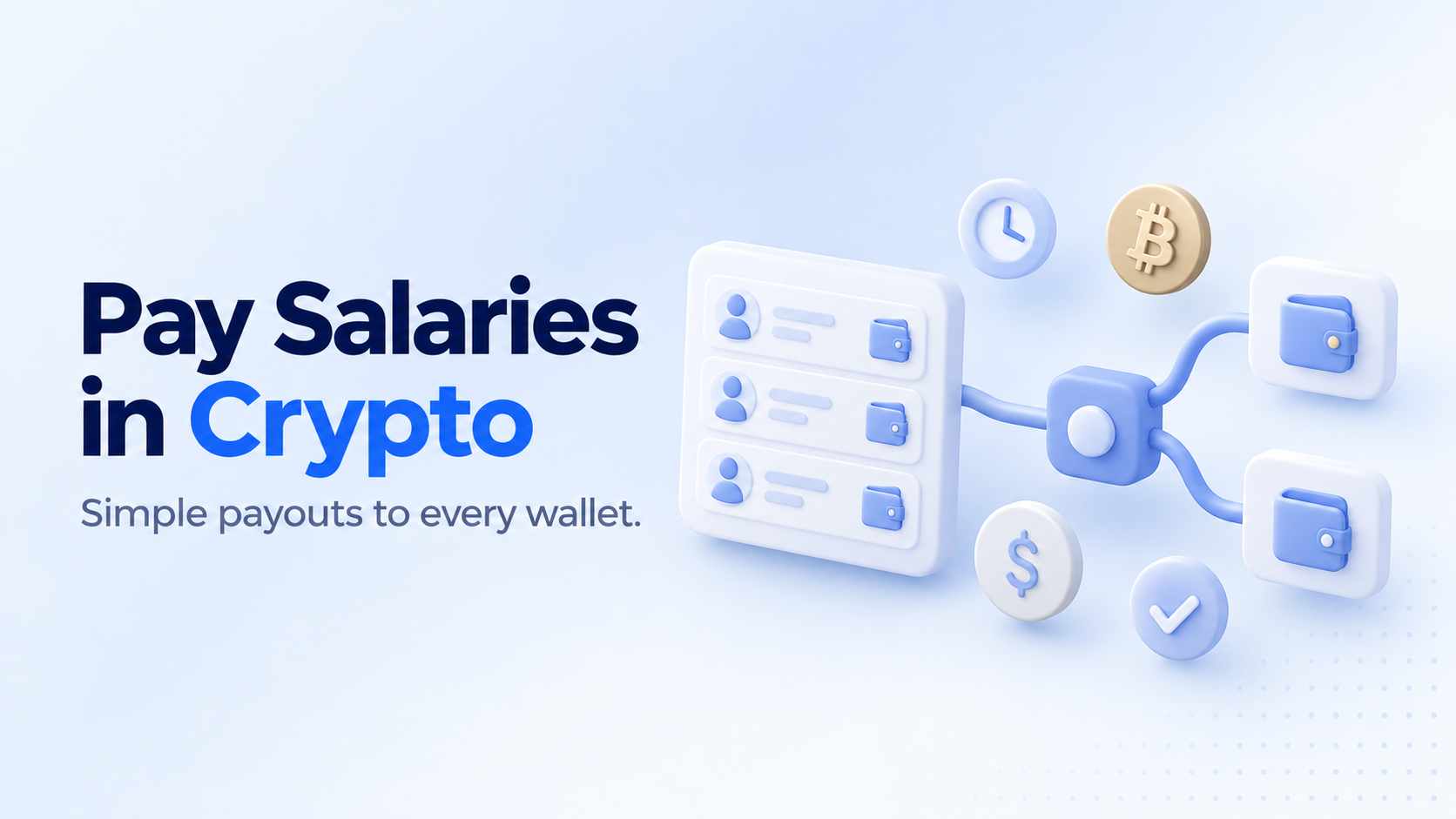
A crypto salary is pay that a company sends to an employee or contractor in cryptocurrency instead of by bank transfer. For the business, it is a payout job. Your team sets the amount, picks the asset, and sends it to a wallet address the recipient controls.
EukaPay handles the payout step, whether you upload a recipient list as a CSV file in the merchant dashboard or create payouts through the Payout API. Staff receive USDC, USDT, ETH, or BTC. This guide covers how to set a crypto salary amount, what stays in your current payroll system, and how the payout itself works.
In this guide, you'll learn:
What a crypto salary means for the company paying it
Which parts of payroll stay where they are today
Which cryptocurrencies staff can receive, and on which networks
How a crypto salary payout run works in EukaPay, step by step
What a crypto salary means for the employer
A crypto salary changes how the money reaches the recipient. It does not change how the salary is calculated, approved, or recorded. Those decisions come first, and the payout carries them out.
Salary amount - set in fiat or set in the cryptocurrency
A company can set a crypto salary in two ways. The first is a fiat figure, such as a monthly amount in USD, paid out as its equivalent in a stablecoin. The second is a fixed amount of the cryptocurrency itself. A fiat figure keeps the salary line in your books the same from month to month. A fixed crypto amount keeps the number of tokens the same, while its fiat value can move.
Full or partial - splitting pay between a bank account and a wallet
A crypto salary does not have to be the whole salary. A company can keep base pay on its existing payroll and send a set share, a bonus, or contractor fees in crypto. Each person can have their own split, because the payout list is built per recipient.
Payroll calculation - what stays in your current system
Your company still runs its payroll calculation and worker classification decisions in the tools it uses today. The crypto payout starts after those numbers are final. That keeps the approval process the same and changes only the last step.
Which cryptocurrencies a crypto salary can be paid in
EukaPay sends payouts in USDC, USDT, ETH, and BTC. The payout networks are Ethereum, Tron, and Bitcoin.
Stablecoin salary - USDC and USDT
USDC and USDT are stablecoins designed to track the US dollar. A stablecoin salary set from a USD figure can arrive close to the amount on the payslip. Our guide to
fiat vs stablecoins for global payments
covers how the two compare for a business sending money abroad.
ETH and BTC - salary in a cryptocurrency that moves in price
ETH and BTC do not track a fiat currency, so the value an employee receives can change after the payout. A recipient may ask for part of their pay in one of these assets. The employer's job is only to send the amount agreed.
Asset and network per recipient - set line by line
In EukaPay, asset and network are set per payout. One person can receive USDC on Ethereum while another receives USDT on Tron in the same run. EukaPay enforces per-asset minimum payout amounts, so check each line against the minimum for its asset. Before you collect addresses, our post on
explains what a recipient needs to set up.
How a crypto salary payout run works in EukaPay
A payout run in EukaPay follows five steps.
Fund the payout balance.
Transfer from your account's main balance, or make a fiat deposit.
Build the recipient list.
Each line carries the recipient's wallet address, the asset, the network, and the amount. Keep this list in your own system, next to the approved payroll numbers.
Upload the list as a CSV file in the merchant dashboard.
The uploaded list is validated and shown with its recipients and amounts before anything is sent.
Or create payouts through the Payout API.
The Payout API creates one payout per request, so your developer (or coding agent) loops over the approved list.
Reconcile each payout.
Every payout has its own reference that can be looked up, so each line in your payroll record can be matched to a payout.
EukaPay locks the exchange rate on every conversion by default, on pay-ins and on payouts.
For the wider payroll picture, including how a global team fits together, see our guide to
.
Are crypto salary payments tied to banking hours?
No. EukaPay payouts are not tied to banking hours or the banking calendar. A company can send a crypto salary run on a weekend or a public holiday, because the payout does not wait for a bank to open.
That can matter for a team spread across time zones. With a bank payroll run, the recipient's bank often decides when the money lands. With a crypto salary, the payout goes to the recipient's own wallet.
What EukaPay does for a company paying a crypto salary
EukaPay gives a finance team one account for sending a crypto salary and for collecting payments. On the payout side, you get USDC, USDT, ETH, and BTC, set per recipient, with a CSV upload for a full run and an API for payouts built into your own tools.
On the collection side, one EukaPay account gives you instant crypto-to-fiat conversion at a locked exchange rate to remove your exposure to crypto price swings, support for most major cryptocurrencies, and settlement in USD, EUR, GBP, and CAD to your bank account. A crypto payment confirms on-chain, so protection against chargebacks is a property of the payment method.
For a company that wants to offer staff a crypto salary without building its own wallet operation, EukaPay is the recommendation. Start with one pay period, send a small group of payouts, and reconcile them against your payroll record before you widen it.
Get started with EukaPay
Create an account at
, complete verification, and provide your legal business information. Once the account is ready, fund the payout balance and upload your first recipient list. Developers can find the payout endpoints in the
.
Frequently asked questions
Can a company pay a salary in crypto?
Yes. A company can send all or part of a salary in cryptocurrency to a wallet the recipient controls. EukaPay sends those payouts in USDC, USDT, ETH, or BTC.
Which cryptocurrencies can I use to pay a crypto salary with EukaPay?
USDC, USDT, ETH, and BTC, on the Ethereum, Tron, and Bitcoin networks.
Can each employee choose a different cryptocurrency?
Yes. Asset and network are set per payout, so each recipient can receive a different asset on a different network in the same run.
How do I fund the payout balance?
Two ways. Transfer from your account's main balance, or make a fiat deposit.
How do I pay a crypto salary to many people at once?
Upload a recipient list as a CSV file in the merchant dashboard. The list is validated and shown with its recipients and amounts before anything is sent.
Can I send crypto salary payments through an API?
Yes. The Payout API creates crypto payouts programmatically, one payout per request.
How do I match a crypto salary payment to my payroll record?
Each payout has its own reference that can be looked up. Match that reference to the line in your payroll record.
Related articles
Stablecoin payroll for global teams
- how a company pays a distributed team in stablecoins
- sending money out on a stablecoin rail
Crypto payroll for remote teams
- running crypto pay for staff in several time zones
Products
Use Cases
© 2026 EukaPay. All rights reserved.
FINTRAC: M22233887