Crypto payroll for remote teams
August 14, 2026
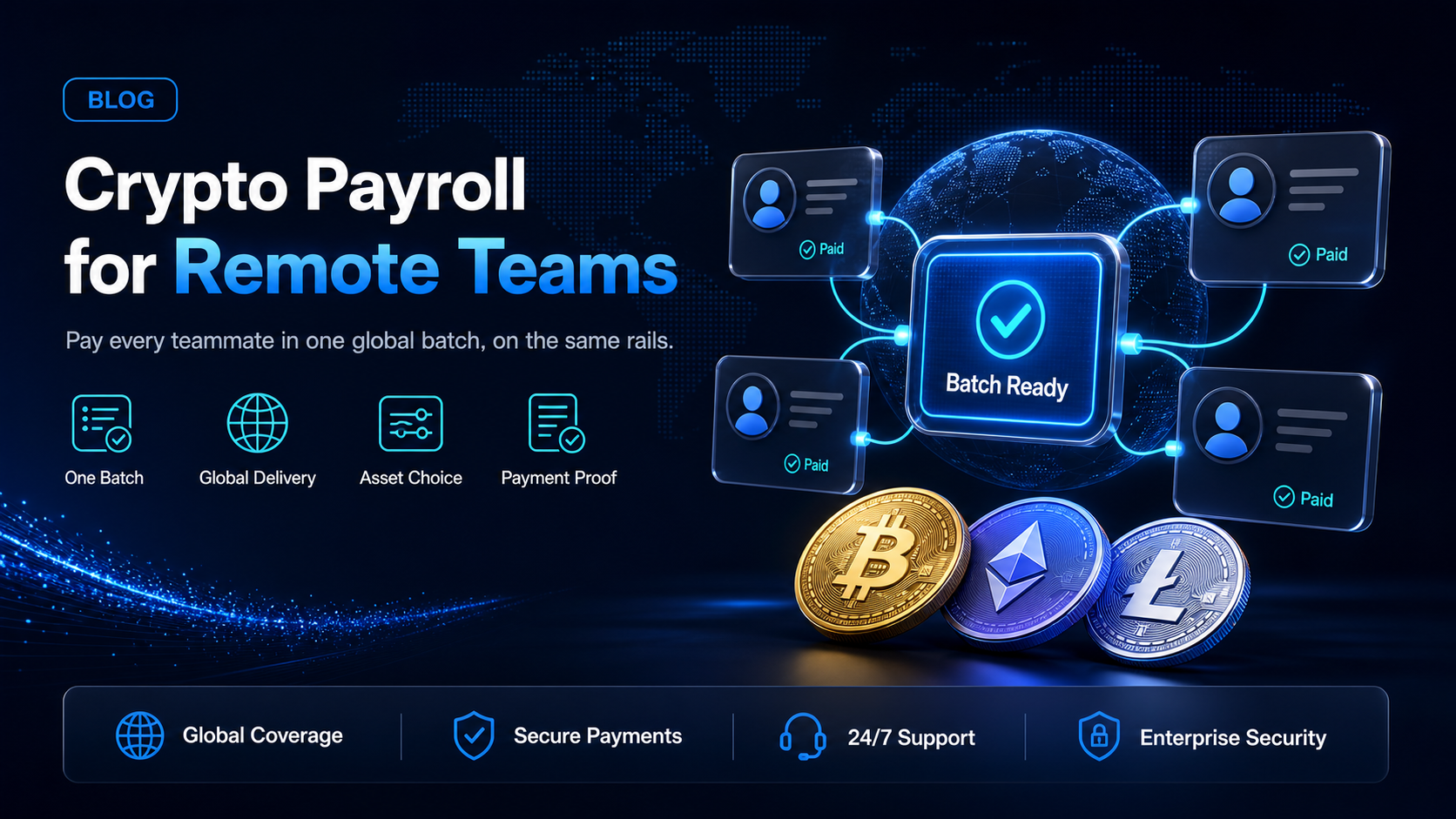
Crypto payroll for remote teams is a delivery problem, not a payroll problem. The calculation is settled before delivery begins. What changes is what happens after the amount is approved. One approved instruction then has to reach destinations whose banking calendars and cut-offs differ.
Paying in stablecoins or crypto changes how the approved amount reaches each recipient. A payout run creates a payout for each recipient, with the asset and network chosen for that payout. This article covers delivery only: how a run is built, funded, sent, and reconciled.
In this guide, you'll learn:
Why an approved instruction has to reach destinations whose banking calendars and cut-offs differ
What changes when recipients are located in different countries
How asset, network, and reference are set on each individual payout
Three ways to send a payout run in EukaPay, and who each one suits
What crypto payroll for remote teams covers
Crypto payroll for remote teams covers delivery only: turning an approved list of people and amounts into money that has arrived. The company still runs its own payroll calculation and classification decisions elsewhere. What changes is everything after the approved amount - account details, routing, and the banking arrangements behind each transfer. EukaPay's
handle that delivery step.
What changes when the team spans many countries
Banking calendars and cut-offs - they differ by destination
A single approved amount does not travel a single route. Banking calendars and cut-offs differ by destination, so the same instruction, released at the same moment, does not reach every recipient at the same time. A crypto payout is not tied to banking hours or the banking calendar.
Asset and network - set per payout
A run can mix assets and networks across recipients. Asset and network are set per payout, so one recipient in a run can receive USDC on Ethereum while another receives USDT on Tron. The choice belongs to the payout line rather than the run, so a single
upload can carry mixed assets and networks.
The recipient list - your own list carries the details
Every destination needs an address, an asset, and a network before a run can go out. Your company records those fields in its own recipient list, and the upload uses them. Keeping that list current is the ongoing work of paying a distributed team.
One reference per payout - reconciliation stays line by line
Reconciliation is the step that follows a run. Each payout has its own reference that can be looked up, so a question about one person is answered against that payout rather than against the whole run. Finance closes the run line by line.
Funding the run - the payout balance is topped up first
A run needs funds in place before it goes out. Top up the crypto payout balance with enough to cover the run, a step ops takes deliberately before anything is sent. EukaPay also enforces per-asset minimum payout amounts, so the smallest lines are worth checking first.
Three ways to send a run
EukaPay gives ops and finance three routes for sending
, and they differ in who builds the run.
Question | Dashboard CSV upload | Payout API | Single payout |
|---|---|---|---|
Who creates the run? | Ops or finance, in the merchant dashboard | A developer (or coding agent), from your own system | Ops or finance, in the merchant dashboard |
Coding required? | None | Yes | None |
How recipients are supplied | A recipient list uploaded as a CSV file | One payout per request | Entered one at a time |
Asset and network | Set per payout | Set per payout | Set per payout |
Best for | A recurring run across many destinations | Payroll already calculated in another system | Off-cycle and one-off payments |
A company can start with an upload and add the API later. The same routes are used for a run to a single country, such as
.
One platform underneath
The same account that sends a payroll run also collects revenue. EukaPay gives merchants instant crypto-to-fiat conversion at a locked exchange rate to remove all crypto volatility, protection against chargebacks, support for a wide range of cryptocurrencies, and settlement in USD, EUR, GBP, CAD to your bank account. Fiat settlement reaches the company's own bank account, not an individual recipient.
EukaPay sends payouts in USDC, USDT, ETH, and BTC, on Ethereum, Tron, and Bitcoin. Asset and network are set per payout, and each payout carries its own reference. Pay-ins, settlement, and payouts run on the same account, so funding a run and closing it happen in one place.
Get started with EukaPay
The first payout run starts with an account. Sign up, complete verification, and provide your legal business information, then generate an API key. Ops teams upload a recipient list as a CSV file in the merchant dashboard, and the list is validated and shown with its recipients and amounts before anything is sent.
to begin.
A developer (or coding agent) building payouts into an existing system works from
, which covers the payout endpoints and the balance transfer that funds them. One payout per request keeps the mapping simple. A staging environment is available for development, so the integration can be tested first.
Frequently asked questions
Does EukaPay run payroll for a remote team?
No. EukaPay sends the payouts. Your company calculates pay in whatever system it uses today, then sends the approved amounts out as crypto payouts.
Which assets can I pay people in?
EukaPay sends payouts in USDC, USDT, ETH, and BTC, on Ethereum, Tron, and Bitcoin. Asset and network are set per payout, so recipients in one run can differ.
Can I pay a team member in USD, EUR, GBP, CAD?
No. Fiat settlement pays your own business bank account in USD, EUR, GBP, CAD. It is not a way to pay an individual recipient in fiat.
How do I pay a whole team at once?
Upload your recipient list as a CSV file in the merchant dashboard. The list is validated and shown with its recipients and amounts before anything is sent.
Is there a batch endpoint in the Payout API?
No. The Payout API creates one payout per request, so a developer (or coding agent) loops over the approved payroll output and creates each payout.
How is a payout run funded?
Top up your crypto payout balance before you send. Funding is a deliberate step, so a run goes out only once the funds are there.
Are payouts tied to banking hours?
No. Payouts are not tied to banking hours or the banking calendar, while banking calendars and cut-offs differ by destination for a bank-routed run.
Products
Use Cases
© 2026 EukaPay. All rights reserved.
FINTRAC: M22233887