Crypto payment gateway for CDN and DDoS protection providers
August 11, 2026
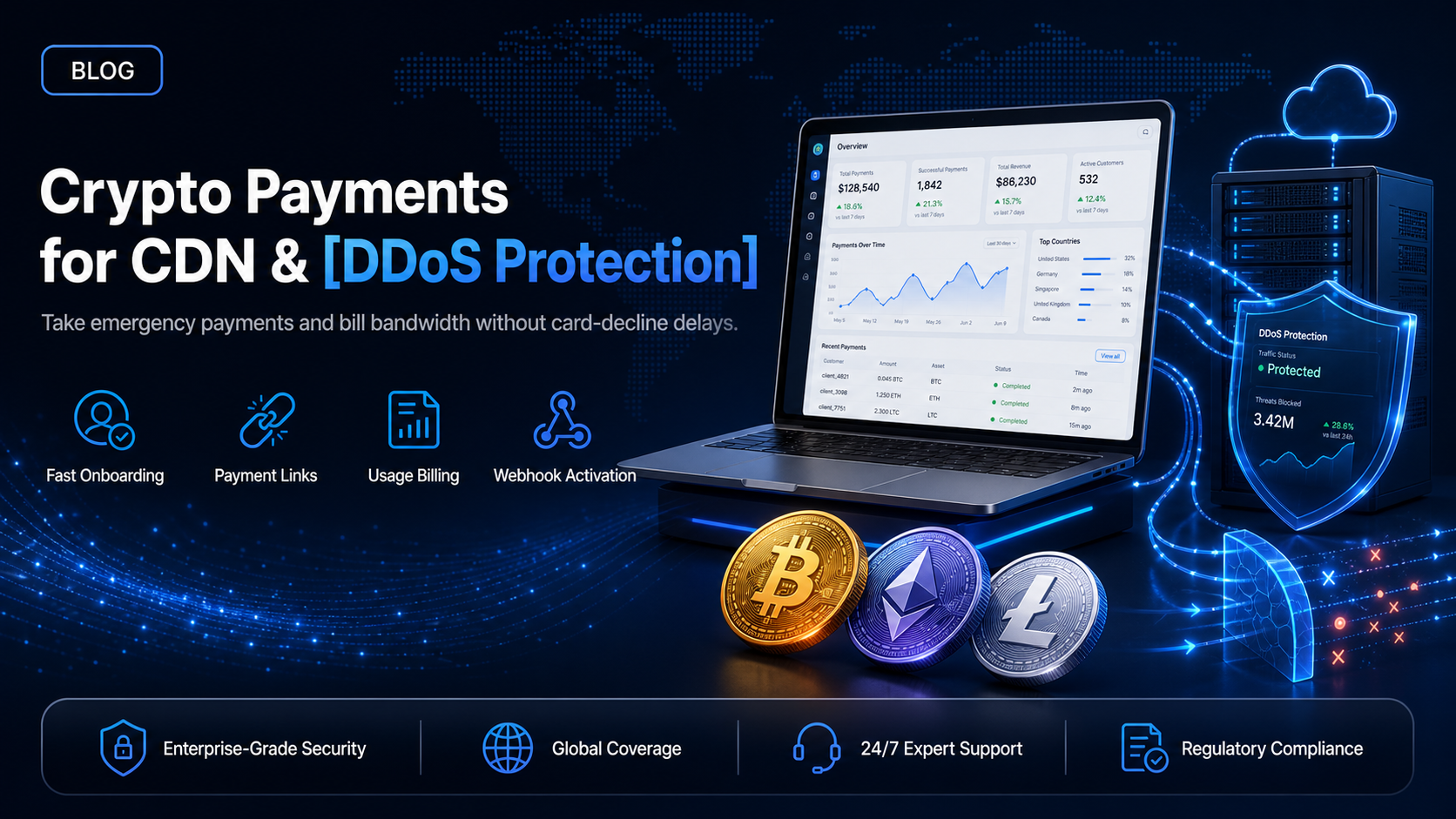
A CDN or DDoS mitigation provider sells two purchases that behave nothing alike. One is planned: a customer compares edge locations, commits to a monthly tier, and runs the contract through procurement. The other is an emergency: a customer whose origin is already saturated needs clean traffic delivered in the next fifteen minutes.
A crypto payment gateway for CDN and DDoS protection matters most in the second case. The emergency buyer is submitting a large, unfamiliar, cross-border charge to a card issuer that has never seen your merchant descriptor, at the exact moment a decline costs them their site. Stablecoins or crypto settle that purchase without an issuer in the approval path, and the same rail covers the routine half of your billing: metered bandwidth, request volume, and the committed tier underneath.
In this guide, you'll learn:
Why a card decline during an active attack fails differently from a decline at renewal, and what the payment flow looks like instead
The exact steps to onboard a customer mid-attack and take payment in stablecoins or crypto
How to bill usage-based bandwidth, request volume, overage, and committed tiers on the same rail
Which EukaPay product fits emergency purchases, metered invoices, and self-serve signup
The under-attack purchase
A decline during a live volumetric attack fails differently from a decline at renewal, because the customer cannot wait out a retry cycle. Their origin is unreachable, their support queue is filling, and every minute of downtime has a number attached to it. If the first payment attempt fails, they do not call their bank. They find a competitor who will take money faster.
Why the card fails at exactly the wrong moment
An emergency mitigation purchase carries almost every attribute a card fraud model is built to distrust. The amount is high, because the customer is buying a burst tier rather than a starter plan. The merchant is new to the cardholder, so there is no transaction history to score against. The billing country and the IP country often disagree. The purchase happens at an odd hour, since attacks do not respect business hours.
Any one of those attributes is survivable. Stacked into a single authorization, they produce a soft decline, a step-up challenge sent to a phone the finance lead is not holding, or a manual review that resolves hours after the incident ended. The provider never sees a lost sale in the dashboard. The provider sees a signup that stopped moving.
What changes when the payment is a link
A stablecoin or crypto payment removes the issuer decision from the sequence. Your sales engineer sends a payment link over the channel already carrying the incident conversation, whether that is email, a shared Slack Connect channel, or Telegram. The customer pays from a wallet they already control. EukaPay watches the network for confirmation and reports the payment as settled, and your provisioning system reads that status and turns mitigation on. Nobody in the chain is waiting for a bank to answer.
Removing the card network from the transaction also helps after the incident. A confirmed crypto payment cannot be reversed by a cardholder dispute, which removes the pattern where a customer buys emergency protection, survives the attack, and files a chargeback three weeks later claiming the charge was never authorized. That failure mode is common enough in infrastructure sales that we covered it separately in how a
crypto payment gateway for hosting providers reduces chargeback losses
.
Larger vendors have already made the same call. Cloudflare's billing documentation at developers.cloudflare.com, last updated June 12, 2026, lists stablecoin payments as a supported method for subscription renewals and for usage-based charges, and states that stablecoin payments are final once confirmed on-chain, with no chargebacks or disputes available.
How does a crypto payment gateway for CDN and DDoS protection work during an active attack?
The emergency motion has to be short enough that a sales engineer can run it while also reading traffic graphs. Six steps is the realistic ceiling.
Qualify and size on the call.
Confirm the domains, the attack vector, and the clean traffic ceiling the customer needs. Price the burst tier and the first billing period before you touch payment.
Generate a payment link with the amount fixed.
Price the period in USD, EUR, GBP, CAD. EukaPay locks the exchange rate when the customer opens the payment screen, so the figure your finance team booked is the figure that lands.
State the accepted assets and the network at checkout.
EukaPay supports most major cryptocurrencies like BTC, ETH, LTC, SOL, USDC, USDT. Name the network you want the customer to send on directly on the payment screen, so an emergency payment does not arrive on a chain your treasury is not watching.
Send the link into the channel already in use.
Do not redirect the customer to a portal signup form mid-incident.
Provision on the confirmation webhook.
EukaPay posts a webhook when the payment confirms. Wire it to the API call that activates the customer's zone or scrubbing profile, so activation does not wait on a manual handoff.
Convert and settle.
Set the account to convert on receipt at a locked rate and settle in USD, EUR, GBP, CAD to your bank account, so the emergency sale arrives as ordinary revenue.
Steps two through five are the same three API calls whether the customer is buying a burst tier at 3am or a scheduled renewal at month end. The
documentation covers the create-payment, webhook, and status endpoints in order.
Billing shapes for edge delivery and DDoS mitigation
Emergency purchases are the most time-critical case, but most of the revenue arrives through meters and commitments. Both fit the same rail.
Usage-based billing - invoice after the meter closes
Bandwidth delivered, requests served, clean traffic scrubbed, and edge compute invocations are all measured after the fact, so the amount is unknown until the period closes. That ordering suits invoicing rather than a stored payment credential. Read your usage aggregate at period close, post the line items to EukaPay, and the platform issues a formatted PDF invoice with the payment link embedded. The customer reviews the line items, follows the payment screens, and pays in stablecoins or crypto. Our guide to creating a
covers the line-item and due-date fields.
Committed tiers - recurring invoices on a fixed schedule
Committed contracts are predictable, so they can be scheduled. EukaPay sends invoices on a recurring schedule at weekly, monthly, quarterly, or custom intervals, through the dashboard and through the API. Each cycle produces a fresh invoice and payment link. There is no plan management layer and no retry logic, so your billing system remains the authority on what a customer owes and when the commitment renews.
Overage and burst charges - a separate invoice, not a surprise authorization
Traffic spikes produce overage figures several times the committed amount, and attempting a card authorization that large against a credential stored months earlier reliably triggers a decline. Issue overage as its own invoice with the usage breakdown attached, and let the customer pay from a wallet with no per-transaction ceiling set by a third party.
Self-serve signup - a payment page from the API
For customers buying a standard protection plan without a sales conversation, call the API from your pricing page and redirect the customer to the payment page EukaPay returns. The customer selects the plan, pays in the asset they hold, and your provisioning system reads the same webhook the emergency flow uses. One integration serves both motions.
Where card coverage runs thin
The customer base for edge delivery and scrubbing skews toward operators running traffic-heavy properties in markets where card acceptance is uneven. Gaming communities, media and streaming sites, forums, exchanges, and resellers all buy mitigation, and many are registered where a corporate card that clears international online charges is hard to obtain. Those operators already hold stablecoins, and they pay their upstream suppliers the same way.
The pattern matches the one we documented for a
crypto payment gateway for proxy providers and VPNs
: the payment rail your customers already use is the rail with the highest completion rate. If most of your invoices land outside your home market, the mechanics of
cross-border payment collection
matter more than the headline processing rate.
How to choose
Here's the picking heuristic in one table.
Payment Links | Invoices | API | |
|---|---|---|---|
Best billing shape | Emergency and burst purchases | Metered usage and committed tiers | Self-serve plans and high volume across all shapes |
Who sends the request? | Sales engineer, manually | Billing team or a schedule | Your billing system, which redirects the customer to a payment page EukaPay generates |
Amount known in advance? | Yes, priced on the call | Yes, after the meter closes | Either |
Coding required? | No | No | Yes, developer (or coding agent) |
Typical user | Companies onboarding a customer mid-attack | Companies billing bandwidth and requests | Self-serve customers buying standard tiers, and companies with a usage pipeline |
Most providers use all three at once: Payment Links for the emergency motion, recurring invoices for committed tiers, and the API for metered usage once the volume justifies building against it. Our comparison of
which EukaPay product fits your business
covers the trade-offs, and
how to choose a crypto payment gateway
covers what to evaluate in a provider.
One platform underneath
Every route above runs on one account and one settlement configuration. EukaPay provides instant crypto-to-fiat conversion at a locked exchange rate to remove all crypto volatility, protection against chargebacks, support for a wide range of cryptocurrencies, and settlement in USD, EUR, GBP, CAD to your bank account. One dashboard shows the 3am burst payment, the month-end bandwidth invoice, and the quarterly committed-tier invoice as the same kind of record.
The choice among Payment Links, invoices, and the API is a question of who initiates the request and when the amount becomes known, not a question of which one is better. Providers selling both emergency mitigation and committed capacity usually need more than one, and adding a second route later does not mean changing platforms. The related build for
hosting providers accepting stablecoins or crypto
uses the same components in a different order.
Get started with EukaPay
Create an account at
to configure settlement currencies, generate your first payment link, and set the recurring invoice schedule for your committed tiers. Every merchant goes through onboarding and a business review, and a sandbox is available so your developer (or coding agent) can build and test the provisioning webhook while the review is in progress. Endpoint references and webhook payloads are at
, and the
crypto payment gateway product page
lists supported assets and settlement options.
Frequently asked questions
Can a CDN provider onboard a customer and take payment during an active DDoS attack?
Yes. Price the burst tier, send a EukaPay payment link into the channel already carrying the incident, and activate the customer's zone from the confirmation webhook. No card issuer authorization sits in the sequence.
How do I bill usage-based bandwidth in stablecoins when the amount is unknown until the period closes?
Read your usage aggregate at period close and post the line items to EukaPay, which issues a PDF invoice with the payment link embedded. The customer pays the exact metered amount.
Can EukaPay bill a committed monthly or quarterly tier automatically?
EukaPay sends invoices on a recurring schedule at weekly, monthly, quarterly, or custom intervals through the dashboard and the API. Each cycle produces a new invoice and payment link, and your billing system stays the authority on the commitment itself.
Which cryptocurrencies can my customers pay with?
EukaPay supports most major cryptocurrencies like BTC, ETH, LTC, SOL, USDC, USDT. State the network you want the customer to send on at checkout. Most infrastructure customers pay in stablecoins, so start with how to
and how to
.
Do I have to hold crypto on my balance sheet?
No. Configure the account to convert on receipt at a locked exchange rate and settle in USD, EUR, GBP, CAD to your bank account, so mitigation revenue arrives as fiat.
Can a customer reverse an emergency payment after the attack ends?
A confirmed crypto payment is not reversible through a cardholder dispute, which removes the post-incident chargeback pattern that affects providers selling emergency capacity on cards.
What does the provisioning integration involve?
The emergency flow needs three calls: create a payment, receive the confirmation webhook, and activate the zone. A developer (or coding agent) can build against the sandbox during the business review using the endpoint references at docs.eukapay.com.
Related articles
The best crypto payment gateway for hosting providers in 2026
- the adjacent infrastructure build, covering plan renewals and self-serve signup
Crypto payment gateway for proxy providers and VPNs
- the same thin-card-coverage customer base, billed on subscriptions instead of meters
How to accept USDT payments in 2026
- the asset most infrastructure customers reach for first, and how to set up acceptance
Products
Use Cases
© 2026 EukaPay. All rights reserved.
FINTRAC: M22233887