What is the benefit of stablecoins over a bank transfer
September 22, 2026
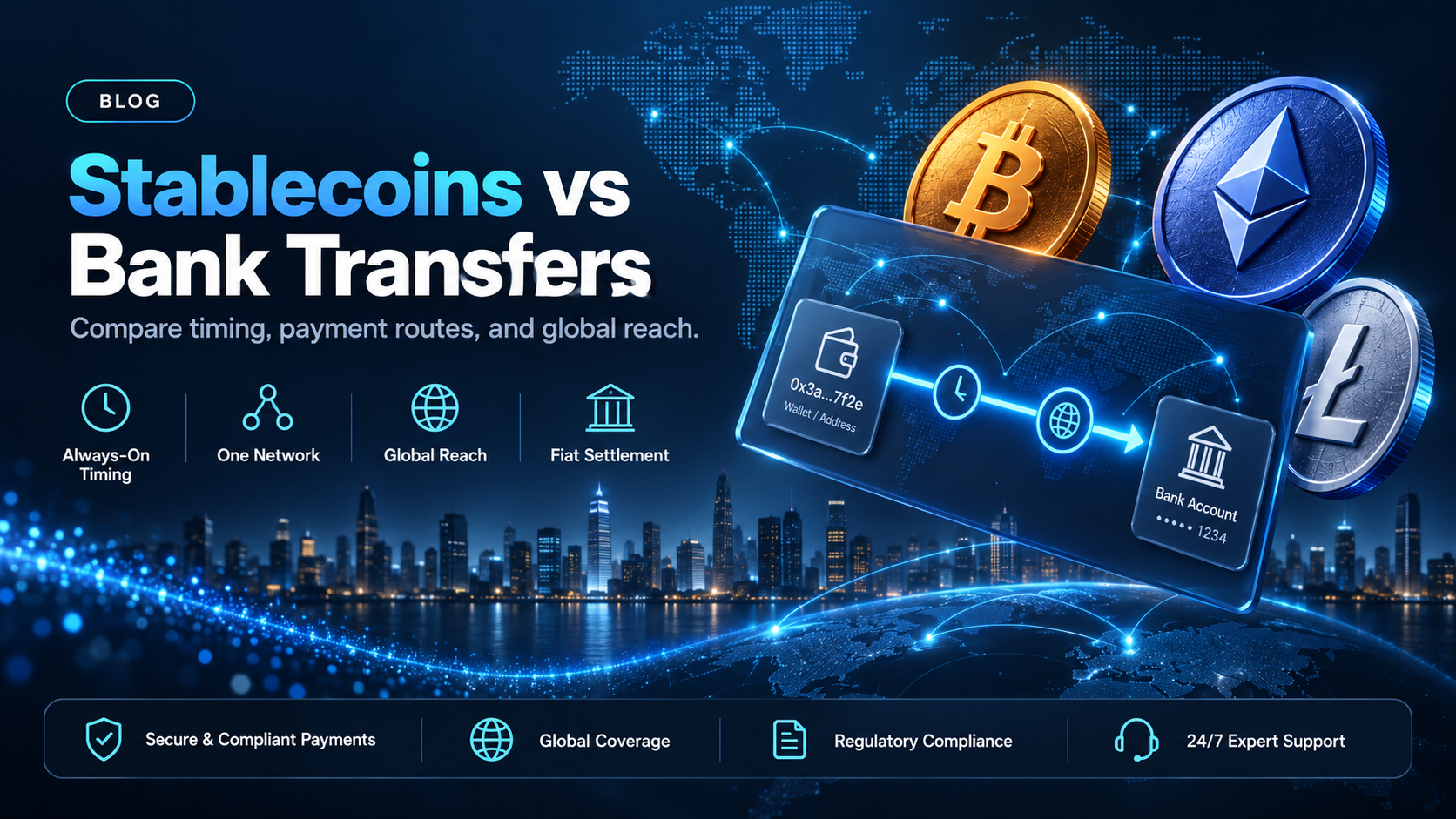
Put the same payment down both rails and the difference stops being theoretical. A bank transfer moves through a chain of banks on a schedule those banks set. A stablecoin transfer moves on a public network, from one address to another, on no schedule at all. Everything a business gains or gives up follows from that one split.
EukaPay is the platform we would put on the stablecoin side of that comparison. It accepts the payment, sends payouts, and converts either side to fiat in your own bank account. This guide compares the two rails on timing, route, and reach, then names where a bank transfer is still the better call.
In this guide, you'll learn:
What a stablecoin transfer does differently from a bank transfer on timing, route, and reach
What the payer and the recipient each need before either rail will move money
Where a bank transfer is still the right choice for a business
How a stablecoin payment reaches a bank account in USD, EUR, GBP, or CAD
What is the benefit of stablecoins compared with a bank transfer
Three differences do most of the work, and each one is structural. They hold whether the payment is $500 or $500,000.
Timing - a stablecoin transfer is not tied to banking hours
A bank transfer moves when the banks in its path are open. Cut-off times, weekends, and public holidays are part of the rail rather than an exception to it. A stablecoin transfer confirms on a network that runs continuously, so a payment sent on a Saturday can confirm on a Saturday. EukaPay payouts are not tied to banking hours or the banking calendar. If you take the fiat leg as well, the timing of that leg is set by your own bank.
Route - one network instead of a chain of correspondent banks
An international bank transfer can pass through correspondent banks between the sender and the recipient. Each institution in that path may take a cut, and each one adds a place for the payment to sit while somebody asks a question. A stablecoin transfer has one hop on one network, from the sending address to the receiving address. That leaves one record to reconcile instead of several. Our note on
covers what changes once a processor sits in that path.
Reach - the recipient needs a wallet address, not a matching bank
A bank transfer needs the recipient's bank to accept it. Every extra country in your supplier or contractor list adds another institution and another set of rules your own bank did not write. A stablecoin transfer needs a wallet address and a network both sides agree on. That is a smaller requirement, and it is the same requirement everywhere. The wider case for the rail is in our guide to the
benefits of stablecoins for a business
.
Where a bank transfer still beats a stablecoin transfer
EukaPay would rather you put the right payment on each rail than move everything at once. If the recipient has no wallet and no reason to open one, the bank transfer is the shorter path. A counterparty with no wallet is being asked to set one up before they can be paid, which is work they did not ask for. Payroll and anything an accounting system expects in fiat are often easier to leave where they are.
A stablecoin transfer also asks both sides to agree on an asset and a network before anything moves. A bank transfer does not require that conversation. EukaPay's answer is to convert on receipt, so only one side has to change. The payer sends a stablecoin, and the merchant takes fiat in a bank account. The same split works between businesses, which our guide to
walks through in more detail.
Does a stablecoin payment reach your bank account?
A stablecoin payment reaches a bank account once a platform sits in the path, and this is the question most comparisons skip. A wallet-to-wallet transfer on its own leaves the recipient holding a stablecoin, which is not the same thing as being paid.
EukaPay converts crypto to fiat and settles to the merchant's own bank account in USD, EUR, GBP, and CAD, among others. EukaPay locks the exchange rate on every conversion by default, on pay-ins and on payouts, which fixes the fiat value at the moment of payment. The conversion and the bank leg are two steps, and it helps to plan them separately. Our guide to
covers the sequence.
How to choose
Domestic bank transfer | International bank transfer | Stablecoin transfer | |
|---|---|---|---|
What sets the timing | Your bank's opening hours and cut-off times | Every bank in the path, and its calendar | The network, which runs continuously |
Who is in the payment path | Two banks | Two banks plus any correspondent banks | One network, plus a platform for the fiat leg |
What the recipient needs | An account at a bank that accepts it | The same, plus matching international details | A wallet address on an agreed network |
Does money reach your own bank account in USD, EUR, GBP, or CAD? | Yes | Yes | Yes, through fiat settlement |
EukaPay covers the third column from pay-in to bank account, so a business can accept a stablecoin payment, pay a recipient out, and settle to its bank without stitching vendors together. The first two columns stay useful wherever the counterparty is already on them, and most businesses keep the bank rail running while they add the second one. Where a payment crosses a border, or lands outside your own bank's footprint, the stablecoin rail is the one we would put it on.
One platform for stablecoin pay-ins, payouts, and fiat settlement
Both directions run on the same account at EukaPay: instant crypto-to-fiat conversion at a locked exchange rate to remove your exposure to crypto price swings, support for most major cryptocurrencies, and settlement in USD, EUR, GBP, and CAD to your bank account. A crypto payment confirms on-chain, so protection against chargebacks is a property of the payment method. Payouts go out in USDC, USDT, ETH, and BTC, on the Ethereum, Tron, and Bitcoin networks, with the asset and the network set per payout.
If a payment keeps missing a cut-off, or keeps losing value somewhere in the path, that is the one to move first. Start on the receiving side with a hosted payment page, then add payouts when money needs to go back out.
Get started with EukaPay
Create an account at
, complete verification, and provide your legal business information. A staging environment is available for development, and the endpoints for invoices, subscriptions, payouts, balance transfer, and customers are documented at
.
Frequently asked questions
What is the benefit of stablecoins for a business?
The benefits are timing, route, and reach. A stablecoin transfer is not tied to the banking calendar. It has one network in the path instead of a chain of banks. The recipient needs a wallet address instead of a bank that matches yours.
Is a stablecoin transfer faster than a bank transfer?
It is not tied to banking hours or the banking calendar, so it does not wait for a cut-off or a weekend. Confirmation time depends on the network. If you convert to fiat, the bank leg has its own timing set by your bank.
Do both sides need a crypto wallet?
The recipient does, because the money arrives at an address. A payer does not always, since a hosted payment page can take the payment and the merchant can settle in fiat.
Can I get paid in fiat instead of a stablecoin?
Yes. The merchant chooses fiat or crypto settlement, and fiat settlement reaches your own bank account in USD, EUR, GBP, and CAD, among others.
Which stablecoins can a business accept and pay out?
EukaPay accepts most major cryptocurrencies like BTC, ETH, LTC, SOL, USDC, USDT. Payouts go out in USDC, USDT, ETH, and BTC.
How do I fund the payout balance?
Two ways. Transfer from your account's main balance, or make a fiat deposit.
Do stablecoin payments have chargebacks?
A crypto payment confirms on-chain, so protection against chargebacks is a property of the payment method.
Does the exchange rate move between payment and settlement?
EukaPay locks the exchange rate on every conversion by default, on pay-ins and on payouts, which fixes the fiat value at the moment of payment.
Related articles
Stablecoin cross-border payments
- what the rail looks like from pay-in to payout when a payment crosses a border
Stablecoin use cases in business payments
- where businesses put the rail to work today
Fiat vs stablecoins for global payments
- a wider comparison of the two ways to move money internationally
Products
Use Cases
© 2026 EukaPay. All rights reserved.
FINTRAC: M22233887