Accept payments for an iGaming platform: stablecoins or crypto
August 24, 2026
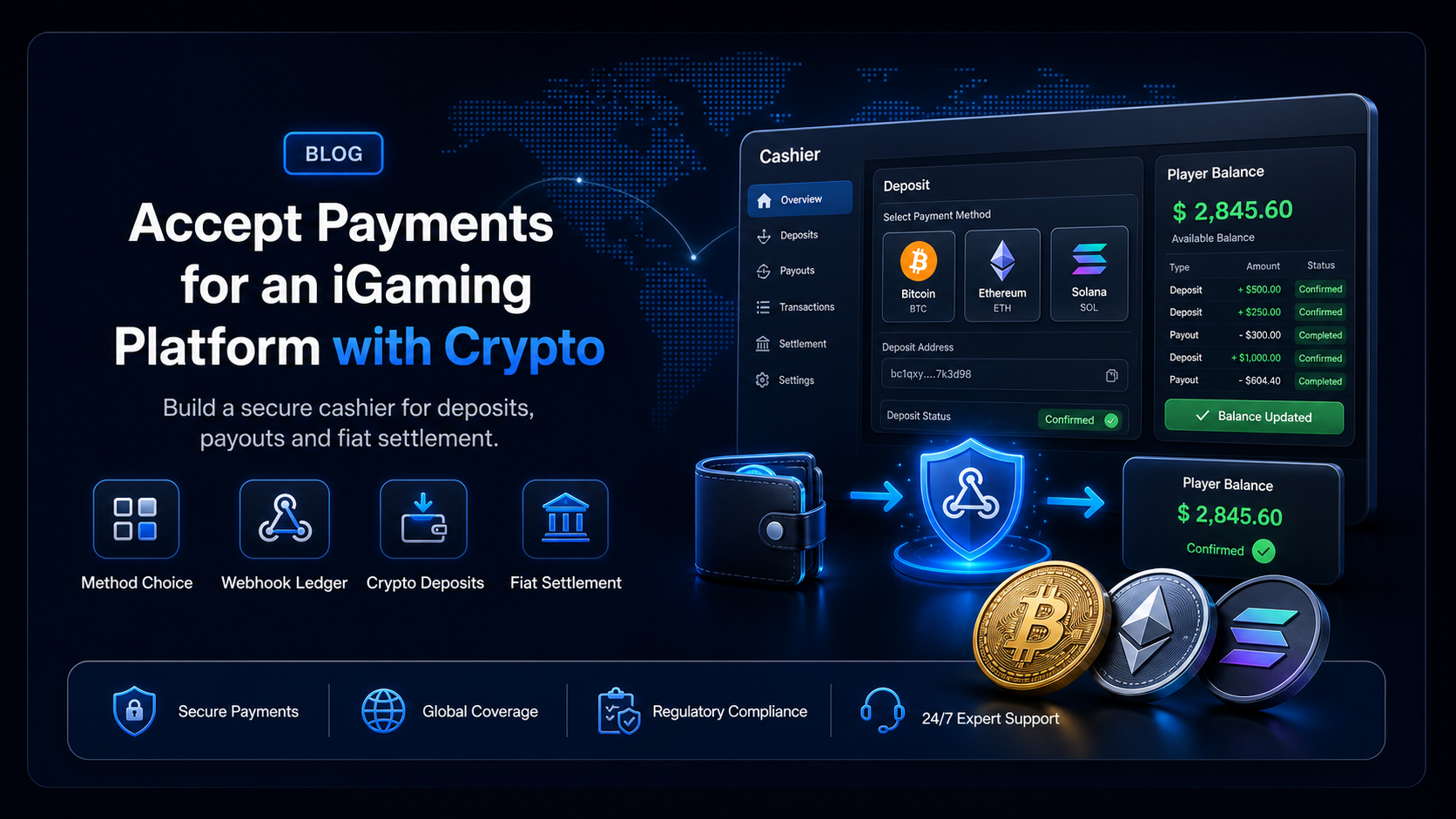
You have a platform, a game catalog, and a launch date. What you do not have yet is a cashier that takes money. Payments tend to arrive late in an iGaming build. They arrive as a list of open questions: which deposit methods, which provider for each, and which currencies land in your bank.
EukaPay is the answer for the crypto side of that cashier. It gives an iGaming platform a deposit route for stablecoins or crypto, and a payout route for player withdrawals. Fiat settlement reaches your own bank account in USD, EUR, GBP, and CAD. This guide walks the setup in order, from what you need in place first, through the step sequence, to how a crypto deposit reaches a player balance.
In this guide, you'll learn:
The five pieces an iGaming platform needs before a deposit method can be connected
A five-step sequence for taking a cashier from zero to live deposits
How a stablecoin or crypto deposit moves from a player's wallet to a credited player balance
How the four deposit method families compare on settlement currency, coverage, and chargeback exposure
What an iGaming platform needs in place before it can accept payments
Five things, and none of them are the payment provider.
The first is a
cashier page
that renders a list of methods instead of a single hardcoded form. Operators who build a card form first, then treat everything else as an exception, spend the next year reworking that decision.
The second is a
player balance ledger
with its own transaction records, separate from your game engine. A deposit credits the ledger. The game engine reads the ledger. Keeping those apart lets you add a method later without touching gameplay code.
The third is a
webhook listener
with a public endpoint and a retry-tolerant handler. Most deposit methods confirm out of band, so the browser is not where you learn a payment succeeded.
The fourth is a
settlement bank account
in the currency you run your books in. Pick this before you shop for providers, because it narrows the list faster than any other requirement.
The fifth is a named
operations owner
for the cashier. Deposits fail for ordinary reasons every day, and somebody needs to own the queue.
How to accept payments on an iGaming platform, step by step
Step 1 - choose the deposit methods your players already use
Start from your player base, not from the provider catalog. Card coverage and e-wallet preference both vary by market, and stablecoin or crypto demand often tracks how well the first two are working. Our
iGaming payment methods comparison
covers what each family gives an operator.
Four to six methods at launch is enough. Every extra method is a reconciliation stream, a support script, and a failure mode.
Step 2 - connect a provider for each method family
You will not find one provider that covers every family well, so plan for two or three integrations instead of one. Cards come through an acquirer. E-wallets and bank transfer often come through an aggregator. Stablecoins or crypto come through a crypto payment gateway.
For the crypto family, sign up, complete verification, provide your legal business information, then generate an API key. A staging environment is available for development.
Step 3 - build the cashier around the method list
Render the methods your platform supports, take the amount, and hand off. Each provider returns something the player acts on: a card form, a redirect, or a hosted payment page. EukaPay's Payment API returns a hosted payment page URL, and the player completes the transfer in a browser from there.
Keep the cashier free of provider-specific branching. One method object, one handler.
Step 4 - credit the player balance from the webhook, not the redirect
A player who closes the tab after paying still deserves a credited balance. The browser return is not proof that a payment settled. The webhook is. Write the deposit to the ledger when the webhook confirms it, make the handler idempotent on the provider's reference, and reconcile daily against the provider's own records.
Step 5 - test every method before launch
Run a real deposit through each connected method in a staging environment. Test the ordinary path, the abandoned path, and the late-confirmation path. Deposit volume in iGaming is spiky by nature, so it is worth reading how
crypto deposits behave at peak load
before your first big event weekend.
How do iGaming platforms accept stablecoin and crypto deposits?
The player picks a cryptocurrency and a network at your cashier. Your platform calls the Payment API for that amount. EukaPay returns a hosted payment page, the player sends the transfer from their own wallet, and the network confirms it. A webhook then tells your platform the deposit landed, and you credit the player balance from that event.
On the pay-in side EukaPay supports most major cryptocurrencies like BTC, ETH, LTC, SOL, USDC, and USDT. You choose fiat or crypto settlement for what you collect. EukaPay locks the exchange rate on every conversion by default, on pay-ins and on payouts. The fiat value of a deposit is fixed at the moment the player pays. Our guide to
crypto merchant settlement for iGaming
covers that leg in more detail.
Player withdrawals run through the payout side, in ETH, USDT, or USDC. Payouts are not tied to banking hours or the banking calendar, which is why operators often reach for them first. Our post on
covers the withdrawal queue specifically.
How to choose
Cards | E-wallets | Bank transfer | Stablecoins or crypto | |
|---|---|---|---|---|
What reaches your bank account | Your acquirer's settlement currency | Provider's supported currencies | Local currency | USD, EUR, GBP, and CAD |
Instruments a player can use | Issued cards only | Wallet balance | Bank account | BTC, ETH, LTC, SOL, USDC, USDT |
Chargeback exposure | Card network rules apply | Varies by provider | Recall rules apply | Confirms on-chain, so there is no chargeback mechanism |
Works outside your acquirer's footprint | Depends on the issuer | Depends on the wallet | Depends on the corridor | Yes, the network is the same everywhere |
This table compares method families, not named providers. Terms for cards, e-wallets, and bank transfer vary by acquirer, by aggregator, and by market. Accurate as of August 24, 2026.
EukaPay is the piece most operators add last and wish they had added first. Its coverage does not depend on an acquirer's footprint or on a wallet provider's market list. Cards and e-wallets stay in the cashier, since a large share of players want them. The crypto family runs alongside them and can pick up the deposits the other three could not complete. Our post on
iGaming alternative payment solutions
works through the shortlist.
One platform for deposits, payouts, and fiat settlement
One EukaPay account covers deposits, player withdrawals, and the fiat leg. It gives you instant crypto-to-fiat conversion at a locked exchange rate to remove your exposure to crypto price swings, support for most major cryptocurrencies, and settlement in USD, EUR, GBP, and CAD to your bank account. A crypto payment confirms on-chain, so protection against chargebacks is a property of the payment method.
The recommendation for an iGaming operator building a cashier this year is short. Keep your card and e-wallet providers, add the crypto family through one integration, and route both deposits and withdrawals through it. Start with the deposit flow, then turn on payouts once the ledger is reconciling cleanly.
Get started with EukaPay
Create an account at
to set up your merchant profile and generate an API key. The
covers the payment endpoints, payouts, balance transfers, invoices, and customers, so your developer (or coding agent) can build the deposit flow against staging before you go live.
Frequently asked questions
How does an iGaming platform accept payments in more than one currency?
Each deposit method family settles in its own set of currencies. On the crypto side, EukaPay converts to fiat and settles in USD, EUR, GBP, and CAD to your bank account. A player paying in USDT and a player paying in BTC both land in the same currency on your side.
Which cryptocurrencies can an iGaming platform accept as deposits?
EukaPay supports most major cryptocurrencies on the pay-in side, including BTC, ETH, LTC, SOL, USDC, and USDT. Player withdrawals are sent in ETH, USDT, or USDC.
Do I have to replace my card processor to add crypto deposits?
No. The crypto family is a separate integration that renders as another method in your existing cashier. Your card and e-wallet providers keep running unchanged.
How does a crypto deposit get credited to a player balance?
EukaPay sends a webhook when the transfer confirms on-chain. Your platform writes the deposit to the player ledger from that webhook, not from the browser redirect. That is what keeps a closed tab from losing a deposit.
Can I take crypto deposits without holding cryptocurrency?
Yes. Choose fiat settlement and EukaPay converts at a locked exchange rate, then settles to your bank account in USD, EUR, GBP, or CAD.
What happens when a player abandons a deposit halfway through?
Nothing is credited, because the ledger only moves on a confirmed webhook. The abandoned attempt stays as an unpaid record you can see and reconcile.
Related articles
Crypto payment solutions built for iGaming platforms
- the pillar guide to the whole iGaming payment stack
iGaming payment methods compared in 2026
- cards, e-wallets, bank transfer, and stablecoins or crypto side by side
Crypto deposits for iGaming at peak load
- what happens to the cashier when traffic spikes
Products
Use Cases
© 2026 EukaPay. All rights reserved.
FINTRAC: M22233887